
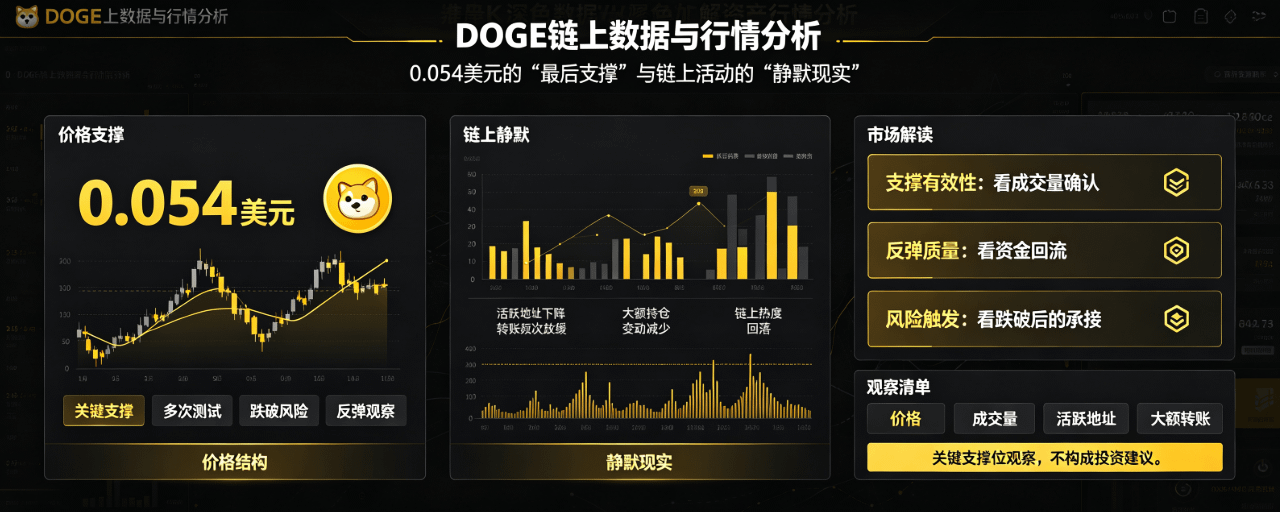

DOGE on-chain data, market insights, and price analysis: $0.054 “last support” and the “silent reality” of on-chain activity
DOGE is currently trading at around $0.0567, up between 3.3% and 8.58% over 24 hours, with a market cap of about $8.88 billion and 24-hour trading volume of around $410 million. On November 21, it briefly touched $0.0511, its lowest level since June 2022. Beneath the appearance of a price rebound from its lows, on-chain data reveals a very different story.
On-chain data: 87.5% of “activity” is ledger entries, not real payments
Bitquery’s complete index of all DOGE blocks, from the genesis block in December 2013 through September 2026, offers the most honest description of the current on-chain state. In 2026, 87.5% of on-chain DOGE transfers went back to the sender’s own address; a custodial wallet sending funds to itself on a timer accounted for one-fifth of the entire chain’s transaction volume. Daily active addresses numbered about 46,700, the lowest since 2017 and down 41% from the same period last year. 72% of all historical transactions were concentrated in the 2023–2024 Doginals boom.
This means that most of the figures that make DOGE’s on-chain activity look “busy” are self-settlements and change returns from custodial wallets, rather than genuine payments between wallets. Bitquery’s assessment is that, after filtering out these “plumbing” transactions, the number of addresses paying one another with DOGE is lower than in any year since 2017.
Technical analysis: A third retest of $0.054; the strength of the oversold bounce remains to be confirmed
The $0.054 level is frequently mentioned because it has been tested twice since 2022: after holding in November 2022, DOGE rebounded 184%; after a test in June 2023, it rebounded 760%. This is the third test. The daily RSI is 28, deep in oversold territory; however, the weekly price has fallen for eight consecutive weeks and remains below both the 50-day moving average (around $0.071) and the 200-day moving average (around $0.085), both of which are overhead resistance.
The first resistance zone above is $0.0605 to $0.0616, with stronger structural resistance near $0.072. If $0.054 is decisively broken, the next reference level is the round-number mark of $0.05, with a deeper level near $0.04936. The ADX indicates that the downtrend remains strong; being oversold does not in itself constitute a reversal signal.
Project research: Payment infrastructure is being built, but on-chain activity has yet to catch up
There has been tangible progress at the ecosystem level: House of Doge and MoonPay have partnered, with plans to support native DOGE payments at more than 6,000 merchants in Q3 2026 and launch a dedicated checkout solution called “ÐOGE Pay,” with a processing fee of 1%. By mid-2026, more than 2,200 merchants worldwide had accepted DOGE as a payment method. From the perspective of infrastructure deployment, this represents real progress.
But the problem is that the pace of infrastructure deployment has not yet translated into growth in real on-chain payment activity. The continued decline in active addresses shows that even as the number of merchants grows, the habit of using DOGE for everyday purchases has yet to take hold at scale. The payment network’s “tracks” are extending, but the number of “trains” running has not increased.
Institutional landscape: The absence of ETFs is structural
U.S. spot DOGE ETFs have total net assets of only about $8.3 million, with cumulative net inflows of approximately $14.6 million since launch. Over the four weeks through November 20, the only fund flow was an outflow of $409,000. No major bank has issued a DOGE price forecast. This means that, at this stage, DOGE lacks a channel for attracting incremental institutional buying through regulated products, leaving any price recovery dependent on existing capital and retail sentiment.
A conditional framework from an expert perspective
The core contradiction for DOGE right now is that the technical picture is showing a third attempt at an oversold bounce at $0.054, but shrinking on-chain activity and the lack of institutional channels leave the rebound without fundamental support. The previous two rebounds of more than 100-fold after this level held occurred in environments with very different on-chain activity and market structures, so historical comparisons should be treated with caution.
Within a “long-only, no shorting” framework, the conditions to watch are whether the $0.054 area continues to show signs of a bottom forming on declining volume during upcoming tests, and whether the rebound can break through the first resistance zone of $0.0605 to $0.0616 on rising volume. If it cannot, the rebound is more likely an oversold recovery than a trend reversal. $0.05 is a short-term structural invalidation reference; a high-volume break below it would open up further downside. Until there is a substantive change in ETF channels or a sustained recovery in active on-chain addresses, position management should take priority over directional calls.

#狗狗币是数字货币的未来🐕 #链上数据 #技术分析参考 #支付生态 #风险管理
(Disclaimer: The content above is an objective compilation of publicly available market data and on-chain information and does not constitute investment advice. Cryptocurrency markets involve extremely high risks; please make decisions with caution based on your own risk tolerance.)