
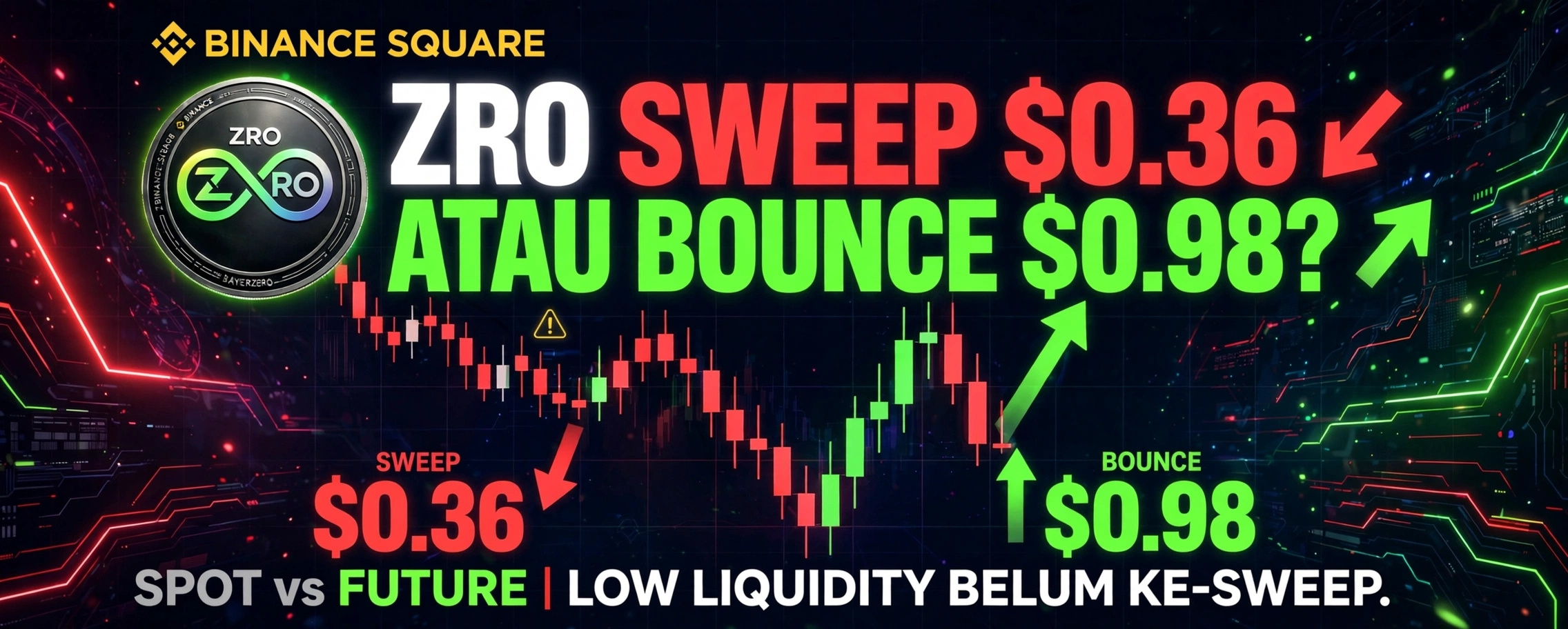

If you only look at ZRO’s price right now, you’d say: "Oh, it’s at $1.08, up 14% today—looks safe."
But if you take a closer look, ZRO is hiding a big mystery: why are the wicks on the spot and futures charts so different?
And from that mystery comes one question that could determine ZRO’s future: Does ZRO need to sweep down to $0.36 before it can make a real move up? Or is a bounce from $0.98 enough?
I wrote this article based on an analysis of spot vs. futures charts, liquidity theory, and comparisons with other analysts. It’s not meant to get you to buy or sell, but to give you something to consider before making a decision.
1. The Reality on the Ground: Spot and Futures Are Closely Aligned, but Their Wicks Differ
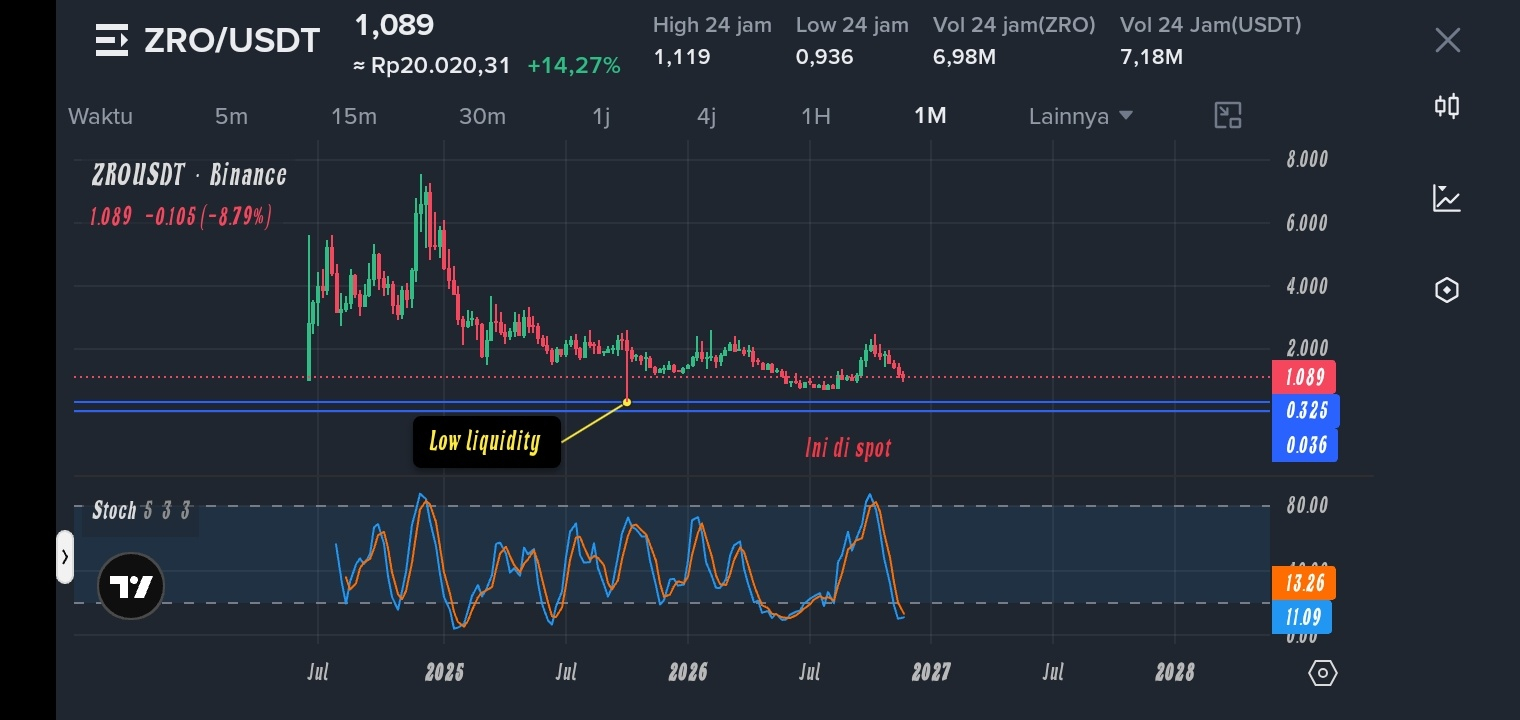
Here's the data from the ZRO 1M (Monthly) chart screenshot:
What They Agree On:
- Spot price: $1.089
- Futures price: $1.0880
24-hour gain: Spot +14.27%, Futures +13.80%
24-hour high: $1.119 vs $1.1173
24-hour low: $0.936 vs $0.9353
That means spot and futures prices are very closely aligned right now. There's no unusual gap.
What's Different:
- 24-hour spot volume: $7.18 million (6.98 million ZRO)
- 24-hour futures volume: $37.67 million (36.55 million ZRO)
Futures volume is 5.2x larger than spot. That's the first key point.
And the second thing, the part that really raises questions: the low-liquidity wicks are different.
- On spot, the lower wick reached $0.36
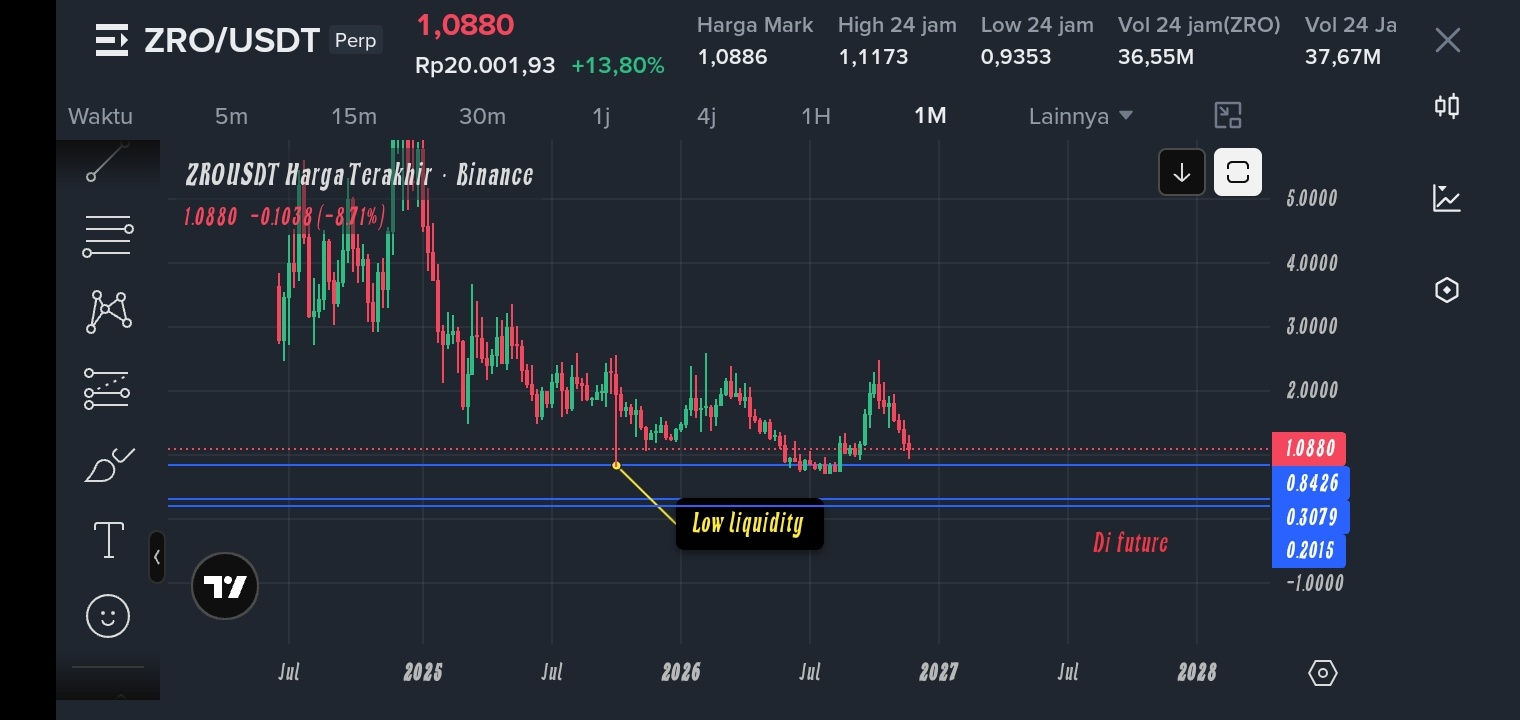
- On futures, the lower wick only reached $0.83
How can the same coin have different wicks?
2. Why Can Futures and Spot Wicks Differ?
The answer is simple, but often overlooked: buying and selling on spot and futures are completely different.
On spot, you buy and sell actual coins. If you sell ZRO at $0.36, someone actually buys your coin at $0.36. The transaction is real.
On futures / perpetuals, you don't buy and sell coins. You just bet on the price using leverage, with USDT as margin.
When the market crashes, what happens in futures isn't "people selling ZRO" but "leveraged longs being forcibly liquidated."
Liquidations are executed as automatic market sells. The price doesn't matter; the system just sells immediately.
If a pile of positions gets liquidated at the same price, the market sells pile up, the thin order book gets wiped out, and the price briefly plunges into an empty zone—a price vacuum—before bouncing back.
That's what can make a futures wick extremely long in a matter of seconds, before the price returns to normal in the same candle.
On spot, when the price plunges, there are buyers who hold it up:
1. Real spot buyers placing limit buys far below to accumulate cheaply
2. Arbitrage bots that buy immediately when futures are cheaper than spot
3. Spot market makers whose job is to maintain the order book
In futures, when there's a crash, market makers actually pull their orders because they don't want to get caught in crazy volatility. The order book becomes empty, and the price falls into a zone with no orders at all.
That's why the wicks are different. It's not because the chart is broken, but because the mechanics are different.
3. Liquidity Theory: Does Spot Need to Sweep $0.36 Before It Can Rise?
Now, this is the core of our analysis.
If we look at it through the lens of liquidity / SMC (Smart Money Concept), price is like a magnet. It will always return to areas where there is still untapped liquidity.
In ZRO's case, the mapping looks like this:
$0.83 level:
- Futures: Already swept
- Spot: Already swept too (because spot has already broken down to $0.36, so it has automatically passed $0.83)
- Status: Done, cleared out
$0.36 level:
- Spot: Not swept yet (the low-liquidity line is still at $0.36, but the price wick hasn't really swept that area clean with confirmation)
- Futures: Not swept yet either
- Status: Still unfinished business, still a magnet
Why does it need to sweep first? Because a rise needs fuel.
The fuel is the stop losses and liquidations of people trapped below. As long as that pile hasn't been taken, market makers have no reason to push the price up. Why would they raise the price when they can briefly push it lower first, take all that money, and then raise it from a cheaper entry?
If the price rises without a sweep, that rise is fragile. There are still a lot of sellers below who haven't been triggered. As soon as the price rises a little, they'll start selling again.
That's why, according to liquidity theory, a valid rise is almost always preceded by a sweep.
So how much of a sweep is ideal?
Not all the way down to $0.036 or zero. The ideal move is just a slight sweep below $0.36, followed by an immediate reclaim.
A VALID sweep:
- The wick touches $0.33 - $0.35 (around 3% - 8% below $0.36)
- The candle closes back above $0.36 - $0.40
- There's a volume spike when the wick forms
This means it has swept the stop losses below $0.36, but buyers immediately stepped in and didn't let the price close below $0.36.
A FAILED sweep:
- The wick touches $0.36, but the candle closes below $0.36 with a large body
- Or the wick extends way too far, down to $0.20 - $0.10
If it closes below $0.36, that's no longer a sweep; that's a breakdown. The next target then shifts to the last spot low-liquidity level: $0.036.
So, according to this theory, the conclusion is: ZRO needs to sweep $0.36 first for its rise to be healthy. Until it does, the short-term bias remains downward, as futures and spot prices move toward alignment.
4. What Other Analysts Say: Mostly Bearish, but No One Is Talking About $0.36
That's what makes the $0.36 sweep analysis interesting. Because after looking into other analysts' data, I found that almost no one is talking about the $0.36 level.
They fall into 3 camps:
The Bearish Camp: Most Technical Analysts
CoinOTAG / Finora (Nov 26) say ZRO has a Strong Bearish Bias on the 4H, Daily, and Weekly timeframes. Of 7 indicator groups, 3 are bearish, 2 bullish, and 2 neutral.
Daily RSI: 33.2 (weak zone), Weekly RSI: 43.6
Nearest support: $0.9833, then $0.9171, then $0.8485
Nearest resistance: $1.1455, then $1.2423
The Daily trend only turns bullish if it closes above $1.9476—that's still 75% away.
CoinCheckup says ZRO's current regime is Bear Volatile, with a capital preservation / avoid chasing reversals strategy. Their support zone: $0.6837 - $0.8226. Resistance zones: $1.13 - $1.27, then $1.27 - $1.64. RSI 14: 27.75, oversold; downside momentum is starting to fade, but there's no reversal confirmation yet.
The Gov Capital AI model is the most pessimistic: BEARISH outlook, Very High Risk at 87/100, 1-year target of $0.507 (-54% from the current price), 116.1% annualized volatility, historical max drawdown of -89.8%, and ATH of $7.15 (-84.4% from ATH).
The bearish camp's conclusion: they don't see $0.36 at all. Their deepest support is $0.68 - $0.82. In their view, if $0.98 breaks, the next level is $0.68, not $0.36.
The Neutral / Range Camp: Fundamental Analysts
Bitrue Research says ZRO was one of the strongest performers in 2026, rising +118% in 90 days and becoming the only interoperability asset still in the green on the weekly timeframe. But its buybacks are still small compared with its market cap. So what's driving the price is technicals + events, not just buybacks.
Their November base case: a $1.55 - $2.40 range, with $2.00 as the pivot. Bear case: a test of $1.40 - $1.55, and if that breaks, $1.20 - $1.30. The problem is, the current price is $1.08, meaning even their bear case has already broken down.
AInvest / Token Autopsy are the most candid about the fundamentals: LayerZero has won the distribution war, having moved $260B+ across 165+ chains, with 70% of stablecoin bridging going through them.
But the fee switch has failed 4 votes. 4 referendums failed to reach quorum. The 5th vote is scheduled for Dec 20-27, 2026.
That means the network is busy, but the token isn't getting the revenue. Messaging fees over 24 hours are only $9,638, and $424K over 30 days, while protocol fees are 0%. The only revenue flowing to the token comes from Stargate buybacks, around $2.58 million over the past year.
They gave it scores of: Utility & Moat 33/35, but Value Capture & Tokenomics 21/35.
The Bullish Camp: Event Catalysts
The main catalysts they're waiting for: Zero Mainnet + the ATLAS launch on Nov 30, and Zero pre-staking starting on Nov 23.
ATLAS fee mechanics: 75% of net fees go to ZRO buy & burn, with the rest going to market makers. This is why many traders call Zero a "decisive test" for ZRO.
One researcher said they're bullish if altcoins get a relief bounce, with a short-term target of $1.80 - $2.00 if ZRO can cleanly break above $1.50. Another trader said the current area is an "attractive accumulation zone" ahead of Zero going live.
On Threads, an analyst drew an Inverse Head & Shoulders pattern with a target of $2.4973 by April 2027, with a neckline around $1.34 and resistance at $2.49.
The problem with the bullish camp is that the $1.50 - $2.00 target is now a long way off. The current price is $1.08. That means they need a +40% to +85% rise just to reach their target.
5. One Thing All Analysts Agree On: Monthly Unlocks Are a Problem
This is the one thing all analysts agree on, from bullish to bearish:
- Nov 20 unlock: *23.28 million ZRO (∼$32.6 million, 3.69% of released supply) has already happened.
- Monthly unlocks: ∼23.6 million ZRO on the 20th of every month through June 2027, totaling around 189 million ZRO. Plus 183 million in foundation reserves locked until Zero Mainnet.
That means new supply enters the market every month, making it hard for the price to rise, even with buybacks.
This ties in closely with the liquidity analysis: if supply keeps increasing every month, market makers have more reason to sweep lower first, because they know new sellers will arrive on the 20th of every month.
6. So Which Makes More Sense? A $0.36 Sweep or a $0.98 Bounce?
To make it simple, let's compare them directly:
Other Analysts:
- Deepest support: $0.68 - $0.82
- They see a Daily RSI of 27-33 = oversold, with bounce potential
- They focus on Zero Mainnet on Nov 30 as an upside catalyst
- They say a breakdown below $0.98 = bearish
Liquidity Analysis ($0.36 Sweep):
- Deepest support: $0.36 (spot low liquidity)
- Sees Monthly Stochastic at 11-13 = oversold, but there's still unfinished business with the sweep
- Focuses on the $0.36 sweep as a condition for a healthy rise
- Says a breakdown below $0.36 = truly bearish, with $0.036 as the target
That means:
- If the other analysts are right, ZRO will bounce at $0.68 - $0.98 and never touch $0.36.
- If the liquidity analysis is right, $0.68 - $0.98 is just a temporary stop, and the price still needs to sweep $0.36 to collect the last bit of fuel before rising.
The liquidity analysis is more bearish in the short term, but more bullish in the medium term. It's saying: sweep down to $0.36 first, then rise in a healthy way. Other analysts are saying: don't sweep; just bounce straight from $0.98.
7. Checklist for Those of You Watching ZRO
To make it easier, here's a checklist you can use:
1. Don't FOMO into a long at $1.08 right now. There's still unfinished business at $0.36 below, which hasn't been swept on spot.
2. The level to watch is $0.33 - $0.36. Not $0.83. $0.83 is in the past.
3. A valid sweep looks like this: a wick to $0.33 - $0.35, a close back above $0.36, and rising volume. If that happens, it's a valid sweep + reclaim, and according to liquidity theory, the safest long entry.
4. A failed sweep looks like this: a close below $0.36. If that happens, don't force a long, because it means the next magnet shifts to $0.036.
5. Watch the Nov 30 catalyst. If the Zero Mainnet + ATLAS launch is quiet or fails, a downside sweep becomes more likely. If the launch is busy and the fees really do go toward buy & burn, a front-run scenario (no sweep, straight up) becomes more likely.
6. Watch the unlocks on the 20th of every month. Around 23.6 million ZRO in new supply arrives each month on the 20th. That's a date when new sellers may enter the market.
Closing: ZRO Isn't a Bad Coin, but Its Tokenomics Are Being Put to the Test
From all this data, one thing is clear: LayerZero is a strong protocol. $260B+ in volume, 165+ chains, 70% of stablecoin bridging, integrations with PayPal, Robinhood, Ondo, and Citadel. That's no small feat.
But ZRO as a token is being put to the test. The fee switch has failed 4 times, there are monthly unlocks, buybacks are still small, and the price is still 84% below its ATH.
So the question "a $0.36 sweep or a $0.98 bounce?" is really a question of whether the market has finished taking all the liquidity below, or whether there's still unfinished business.
If you believe in liquidity theory, the answer is: it's not over; there's still unfinished business at $0.36.
If you believe most technical analysts, the answer is: that's enough; $0.68 - $0.98 is enough to form a bottom.
Which one is right? The market will decide. Our only job is to prepare a plan for both scenarios, not force the market to follow our theory.
What do you think? Are you on team sweep to $0.36 before going up, or team bounce from $0.98 is enough?
Disclaimer: This article is not financial advice. All the data above is based on research and technical / fundamental analysis, which may be wrong. Always DYOR and manage your own risk.