
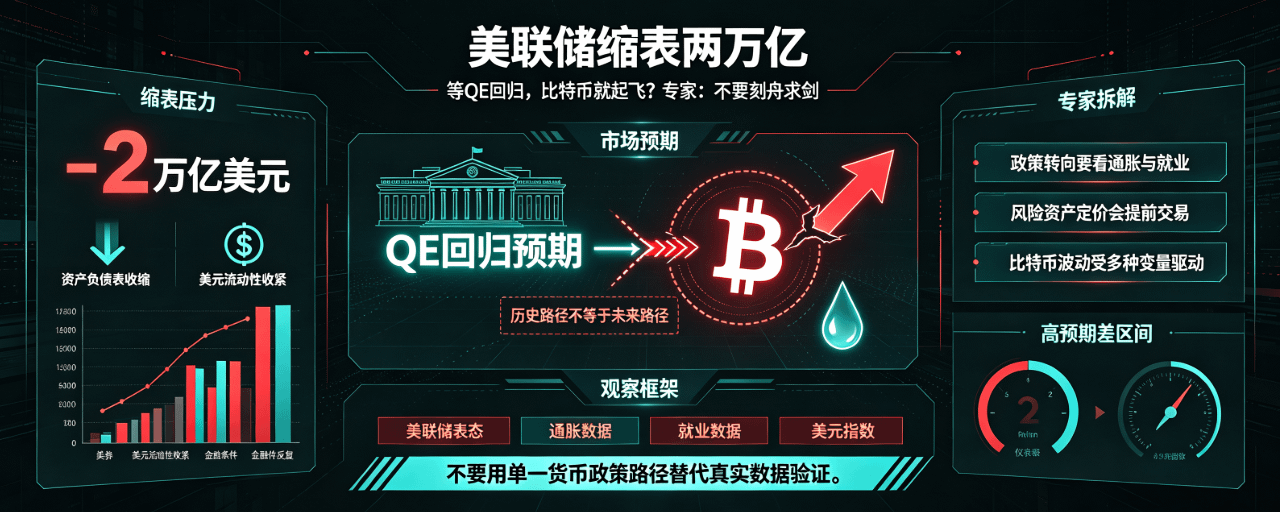

The Fed Shrinks Its Balance Sheet by $2 Trillion—Will Bitcoin Take Off When QE Returns? Expert: Don’t Rely on Outdated Assumptions
Recently, a chart comparing the Federal Reserve’s balance sheet with Bitcoin’s price movements has been circulating in the community. The green line represents the Fed’s balance sheet, which has shrunk by about $2 trillion since 2022; the orange line represents Bitcoin’s price. The chart’s central claim is that once quantitative easing (QE) returns, Bitcoin will skyrocket in a parabolic surge.
From an expert’s objective perspective, this conclusion captures the core logic of macro liquidity, but overlooks the mismatch between time cycles and real-world conditions. We need to distinguish historical patterns from present-day realities.
First, the historical correlation is real, but liquidity transmission takes time.
Looking back at 2020–2021, the Fed’s balance sheet expanded rapidly, and Bitcoin did indeed enter a major bull market. The core logic was that massive money printing eroded fiat purchasing power, sending capital with nowhere else to go into high-risk assets. So when QE actually resumes, Bitcoin will indeed have the macroeconomic conditions for a sharp surge. But the key point is that “expected QE” and “actual QE” are two different things.
Second, current macroeconomic realities do not support a near-term return to QE.
At present, the Fed is showing no signs of easing; instead, it remains in a period of aggressive tightening. The latest year-over-year core PCE reading rose to 3.3%, its highest level in nearly three years, while third-quarter GDP growth exceeded expectations. The probability of a rate hike in December has climbed to a historic high of 93%. With inflation still stubborn and the economy proving resilient, the Fed’s main priority is fighting inflation, not injecting liquidity. Betting that QE will return imminently is an extremely early move, and one that can easily be derailed by the cost of waiting and an open-ended lack of stop-loss limits.
Third, Bitcoin’s pricing dynamics are evolving; they no longer depend entirely on the Fed expanding its balance sheet.
In the past, Bitcoin was a pure call option on macro liquidity. Today, however, with the approval of spot ETFs and the involvement of more institutional capital, Bitcoin’s valuation has become increasingly tied to traditional finance’s asset allocation, institutional inflows, and its own halving cycle. Even during balance-sheet reduction, Bitcoin can still chart its own course, driven by catalysts unique to the industry. So even if QE resumes in the future, Bitcoin’s rise may be steadier rather than a simple parabolic surge.
Experts’ framework for reading the market:
Macroeconomic liquidity is indeed the crypto market’s “ultimate source of fuel,” but trading should not rely on blindly extrapolating from charts. When waiting for QE to return, the focus should not be on guessing the exact day liquidity will be injected, but on watching for early signs of a policy shift—for example, when the Fed officially announces an end to balance-sheet reduction, or when inflation data show a sustained, meaningful decline.
Before QE actually arrives, the market will most likely have to bottom out amid high interest rates and contracting liquidity. For now, keeping a clear head, managing your positions and cash flow, and avoiding getting shaken out before the dawn by blindly anticipating a future bull market matter more than anything.
Discussion time: When do you think the Fed is most likely to make its next substantive policy shift (ending balance-sheet reduction or cutting rates)? Share your thoughts in the comments! 👇
$BTC $ETH #美联储缩表 #qe #宏观流动性 #比特币走势 #风险管理
(Disclaimer: The above content is an objective summary of publicly available market data and macroeconomic logic. It does not constitute investment advice. The crypto market is extremely risky; please make decisions cautiously based on your own risk tolerance.)