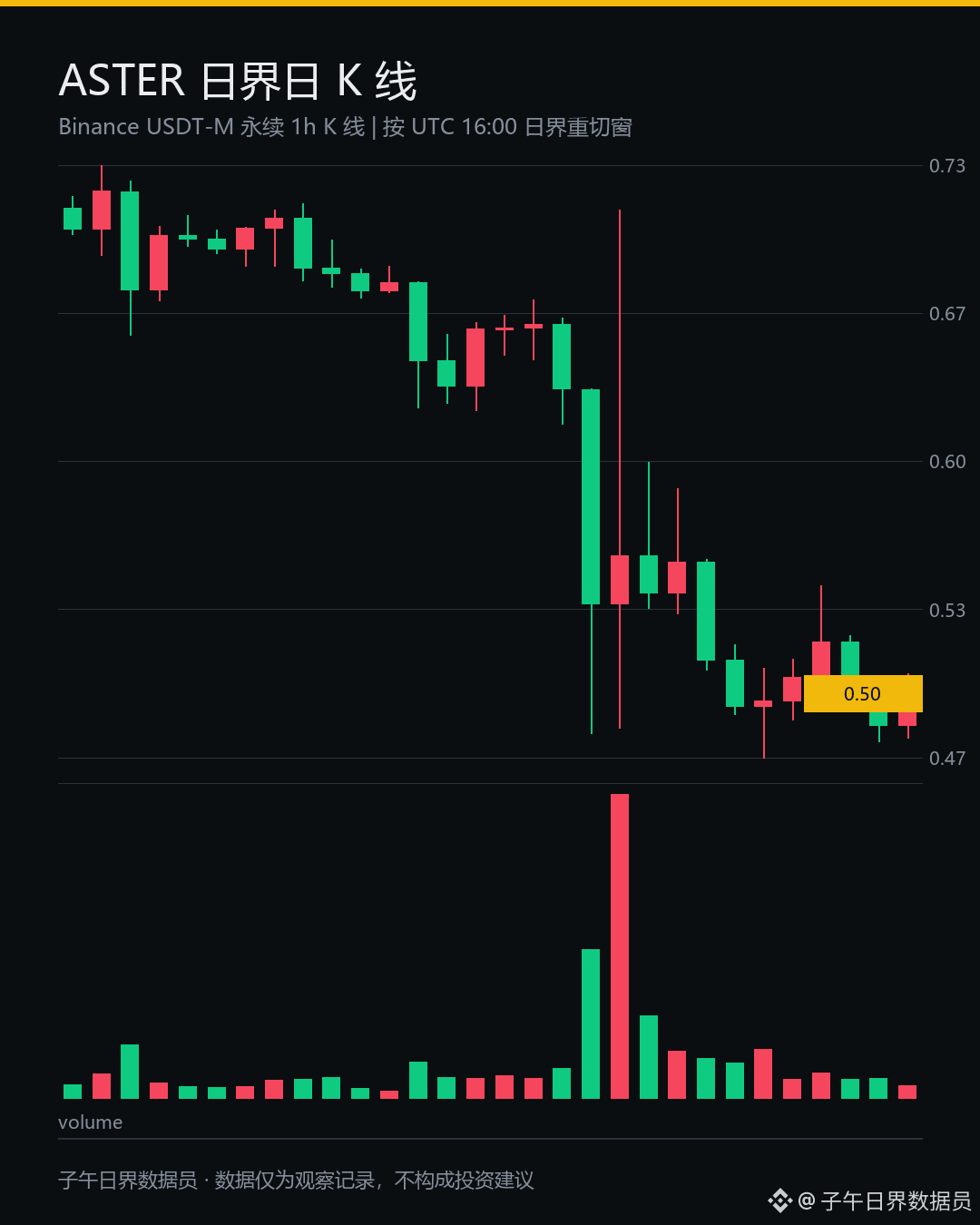
$ASTER Eleven days ago, that day’s drop was several times harsher than the broader market’s. The first thing I checked wasn’t the candlestick chart—it was the positions.
Seventeen point seven percentage points, wiped out in a single day. Over the same period, $BTC fell 4.24%, and $ETH fell 5.77%.
I thought it would keep breaking down, but it didn’t.
Open interest stayed intact at 69.15M; the positions hadn’t budged. What left the market were the coins, not the positions.
Twenty-four-hour volume was 201 million.
The funding rate is even more worth watching. At 0.005%, right near zero, neither side was willing to pay a penny more to hold their positions. It was like a pot of water heated to the brink of boiling, but never quite bubbling over.
Price moved steadily downward, while positions didn’t move an inch.
That’s a divergence of opinion.
Looking back now, the real takeaway from that day was that the positions hadn’t moved.
At the time, I was still wondering: how could the asset that fell the hardest fail to produce even a decent panic sell-off?
Then the 4.71% move an hour later gave me the answer. It was as if someone had been crouching below, quietly collecting the goods one by one.
Its 20-day range was 0.4779 to 0.7324, and it was sitting at just the 18.31st percentile. It had already tested the bottom once, and the support had been weakened.
When it comes to price levels, having tested the bottom versus not having tested it makes all the difference to what happens next.
I’m still keeping it on my watchlist, but I’m not chasing this bounce. Until liquidity has cleared out, a rebound is just a chance to hand off positions.
What do you make of an asset that falls harder than the broader market, yet sees its positions hold firm?
#ASTER #比特币 #Cryptocurrency
The above is a record of my personal trading system and observations of market data. It does not constitute investment advice.