The refund slip was still warm when the passenger slapped it down on the gate and asked, “You said this train was canceled, didn’t you?”
There was a duty attendant at Gate 6 of South City High-Speed Rail Station. Her name was Gu Chi, and she was thirty. In winter, she never took off her gloves; she only exposed her thumbs to scan tickets. She said the cold air blowing into her sleeves made her hands shake, and one tremor was all it took to hit the wrong button. A stopped antique pocket watch was always tucked into her breast pocket, its hands fixed at some position no one could make out. Every so often she would touch it, as if telling herself to stop. Her thermos held aged tangerine peel steeped overnight. By the time she drank it, all that remained was bitterness, but she still topped it up with hot water every day. Before letting passengers through, she had a quirk everyone knew about: she tapped the underside of the gate three times with the toe of her shoe, and only then looked up at the big screen. Her colleague, Sister Jiang, teased her for being a “gate-tapping guru.” Gu Chi let her joke, replying only, “I can’t be sure until I’ve tapped.”
Lao Tan, a regular on the early train, knew her. He always had just one piece of luggage—a gray rolling suitcase—with his ticket tucked into the outermost slot of his ticket wallet. He passed through the gate faster than anyone, sometimes tossing out a “Hope it’s not crowded this morning” as he went. Gu Chi rarely replied. She just held out her thumb. Beep—and he was through.
A little after eight on Thursday morning, the lights in the waiting hall had yet to fully brighten. The big screen above Gate 6 flickered once, then displayed four characters: TRAIN CANCELED. Before the announcement had even played a second time, people were already gathering to ask when they could leave. Following procedure, Gu Chi turned the sign toward the refund counter. Her throat was dry, but she still said what she had to: “Don’t wait for this train. Go to the refund counter.” Lao Tan was at the front of the crowd. He looked at her, said nothing, and wheeled his suitcase away. The line dispersed quickly, as if those four characters had blown it apart.
Gu Chi felt a little uneasy herself. Overnight, that move around $BTC had dropped, then suddenly shot back up. Looking at the screen, she had thought the whole ride was over. Her fingers were quicker than her brain; she hit the close-position button, slipped her phone back into her inner pocket, and touched her pocket watch too, as though she could stop the whole thing. When the big screen announced the cancellation, she was almost relieved: See? Over means over. But her palm was damp inside her glove.
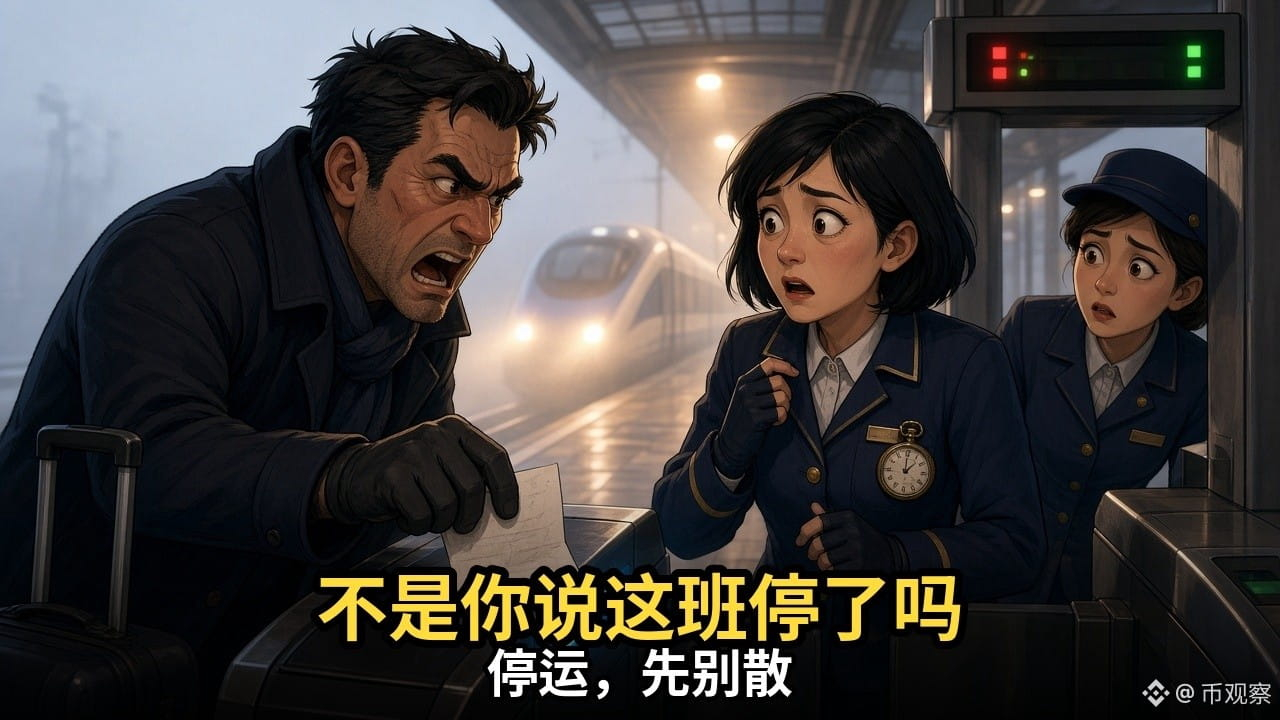
Less than fifteen minutes later, the screen flickered again. The words TRAIN CANCELED disappeared, replaced by CHECK-IN SOON. A metallic scraping sound came from the direction of the platform. Then the headlights emerged from the fog, and the train rolled to a steady stop at Platform 6. The announcement rang out with complete confidence: Check-in for this train is now open. The gate lights all came on at once. This time, Gu Chi hadn’t finished her three taps with her shoe before she froze in place.
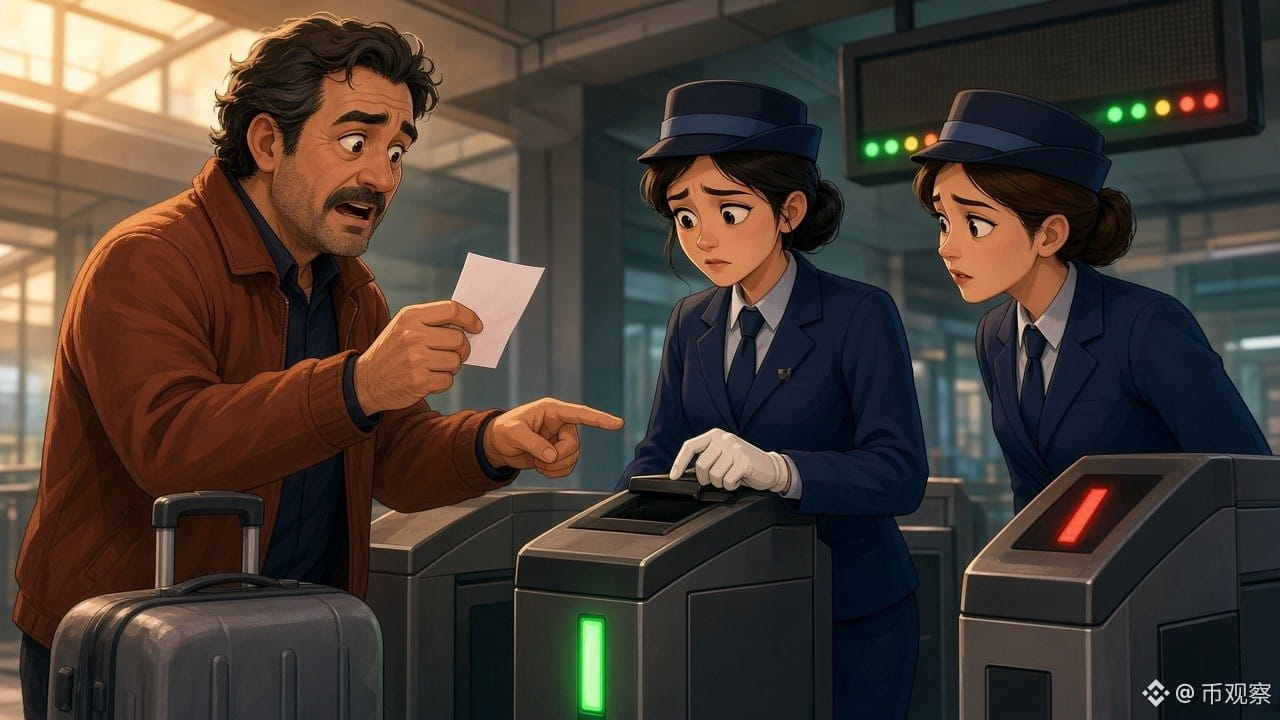
Lao Tan came running back, still clutching his refund slip. The edges had gone soft with sweat. He slapped the still-warm slip down on the gate. His voice wasn’t loud, but everyone on the platform heard him clearly: “You said this train was canceled, didn’t you?”
Gu Chi opened her mouth, then swallowed the words, “The system just changed.” Sister Jiang leaned over from the neighboring gate. She didn’t try to smooth things over for her; she only said quietly, “The train’s still here. You were the one who sent it off to the refund counter first.” She glanced at the stopped watch in Gu Chi’s breast pocket and added, “Don’t mistake a temporary stop for something that’s already gone.”
Gu Chi reopened the gate. Passengers who hadn’t gone far were hurrying back, suitcase wheels rattling across the floor in a chorus. She held out her thumb and scanned the tickets one by one, slower than usual. Lao Tan didn’t press her for an explanation. He folded the refund slip and tucked it into his ticket wallet. As he passed through, he said only, “Next time, don’t sound so certain.” Gu Chi answered softly, and it sounded as though she was saying it to herself.
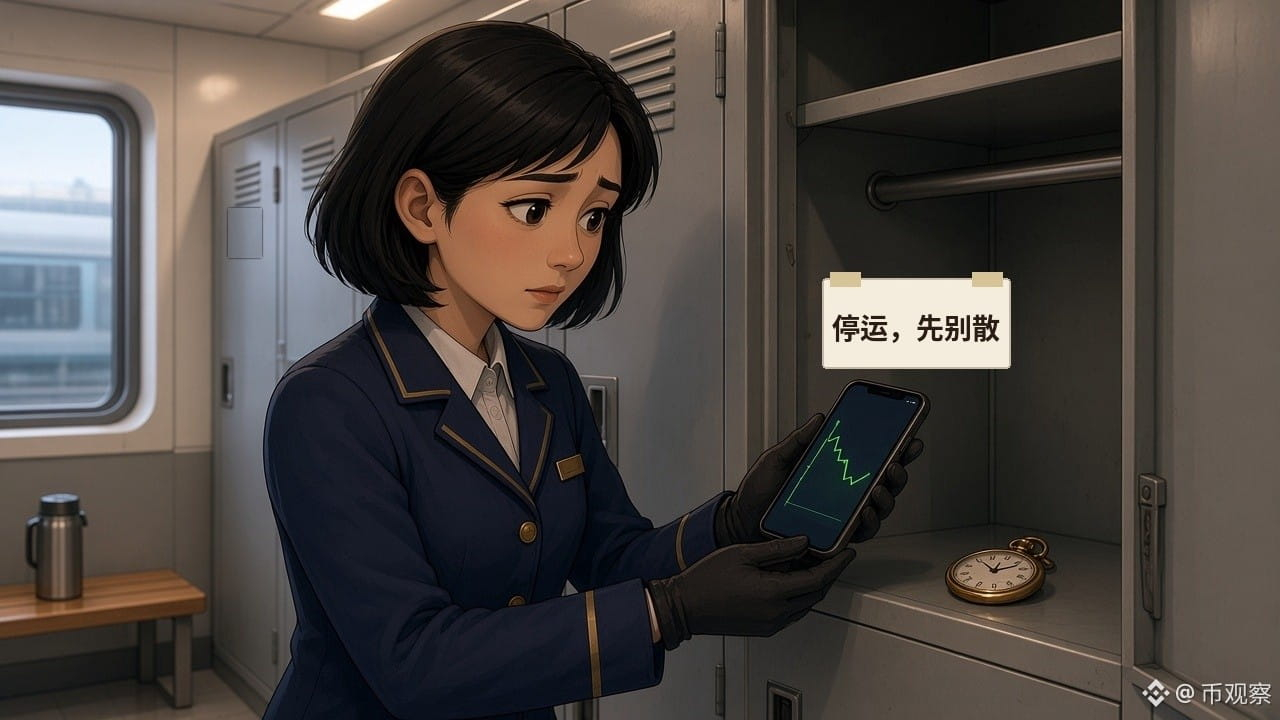
When most of the crowd had passed, she slipped behind the gates and took out her phone. The position she had closed overnight, of course, hadn’t come back with the train. The line on the screen, which had stopped climbing earlier, was still there. She didn’t reach for the button to add to her position again. She kept only a small spot position, switched off the twenty-times leverage, and put her phone—and the stopped pocket watch—together on the innermost shelf of her locker. Before closing the door, she wrote six characters on its inside with a marker: “Canceled? Don’t scatter yet.” When she was done, she looked at them twice herself, as if afraid she’d forget again the moment she turned away.
Sister Jiang passed by and asked, “Gu Chi, didn’t the train come back after all?”
Gu Chi tugged her gloves tight and smiled, though her voice was serious. “Even when it comes, I’m not going to chase after it and squeeze aboard. Just now, I talked the passengers into leaving—and talked myself out of my position too. You have to manage your own position. Don’t mistake a temporary stop for the end, and don’t assume that a light suddenly coming back on means you’re sure to get on the train.”
(The characters in this story are fictional.)