SOXL at $33—would you dare to buy the dip?
From $302 down to $33, a 90% drop; down 40% in 5 days, down 70% in a month—everyone says, “It’s fallen too much; it has to rebound.” But after a violent 40% rebound on November 23, it fell back again within two days. Think it’s the bottom? The math of 3x leveraged ETFs tells you this: after a 90% drop, it takes only another 30% drop in the underlying to lose another 90%.
First, the surface picture: a violent rebound after the plunge, followed by another drop.
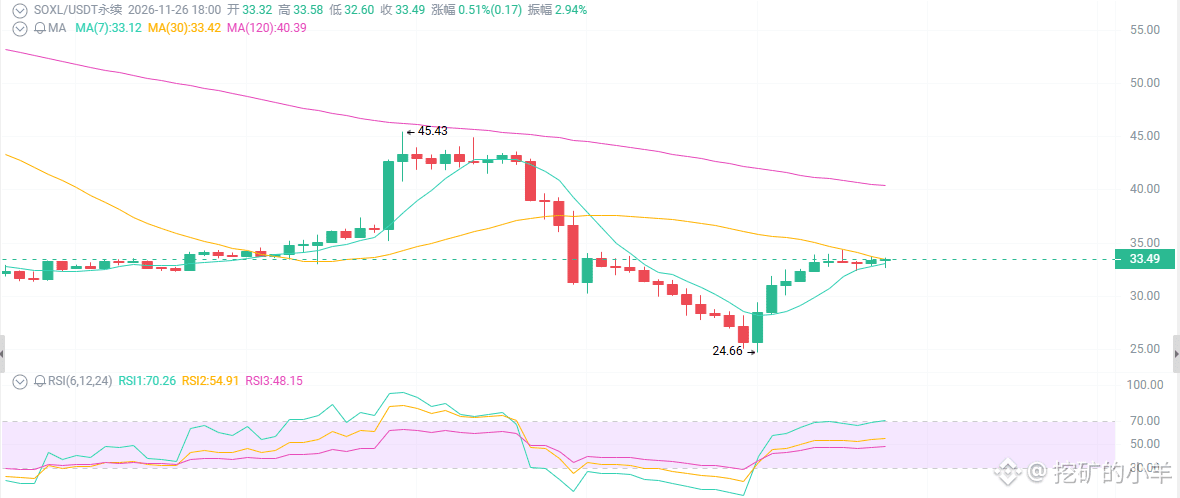
Around November 20, SOXL plunged to an extreme low of $24.60. On November 23, it surged nearly 40% in a single day, and everyone shouted, “The bottom is in.” Then it fell sharply again on November 24–25, closing at $32.02, with an intraday low of $24.61. The swings were so huge you’d think you were watching a shitcoin.
The chart tells you: from its midyear high of $302, it entered a steep downtrend and broke below all its medium- and long-term moving averages. The trend is clearly bearish; the rebound is just a dead-cat bounce.
First thing: you’re not buying “cheap semiconductor stocks”—you’re buying a 3x leveraged meat grinder.
SOXL tracks the U.S. semiconductor index (NVDA, AMD, AVGO, MU, INTC, etc.), with 3x daily leverage and daily resets.
Holding SOXL long term is mathematically a slow-motion suicide. Historically, it has repeatedly suffered near-total drawdowns after huge rallies; the drop from $302 to $33 is just the latest. You think you’re buying the dip in semiconductors, but you’re really betting against leveraged decay.
Second thing: the AI narrative isn’t dead, but the market has started doing the math.
The long-term semiconductor story is still intact: strong demand for data centers, HBM, and advanced manufacturing processes. Some institutions forecast that global semiconductor market growth in 2026 could reach twice its current rate, while SEMI predicts equipment sales will hit new highs again in 2026–2028.
But the market has shifted from “pricing in AI without question” to “questioning whether capex can pay off”:
AI is the future, but that doesn’t mean the leveraged ETF you buy today will survive until then. Many people saw Tesla’s potential in 2020, but most people who went long on Tesla with 3x leverage couldn’t withstand the drawdowns along the way.
Third thing: the technical picture boils down to one sentence—the rebound is a chance to get out alive.
Big picture: steep downtrend, moving averages in bearish alignment, bearish trend
Recently: wild swings in the $24–$35 range; short-term support at $24–$25, with overhead resistance from a previous gap and rebound highs around $35–$40
Pattern: a short-term attempt to form a bottom is possible, but there’s no clear bottoming structure—it only counts if it holds above higher lows on strong volume
Indicators: RSI has recovered from oversold levels but remains low; trading volume is enormous, and ATR is extremely high