
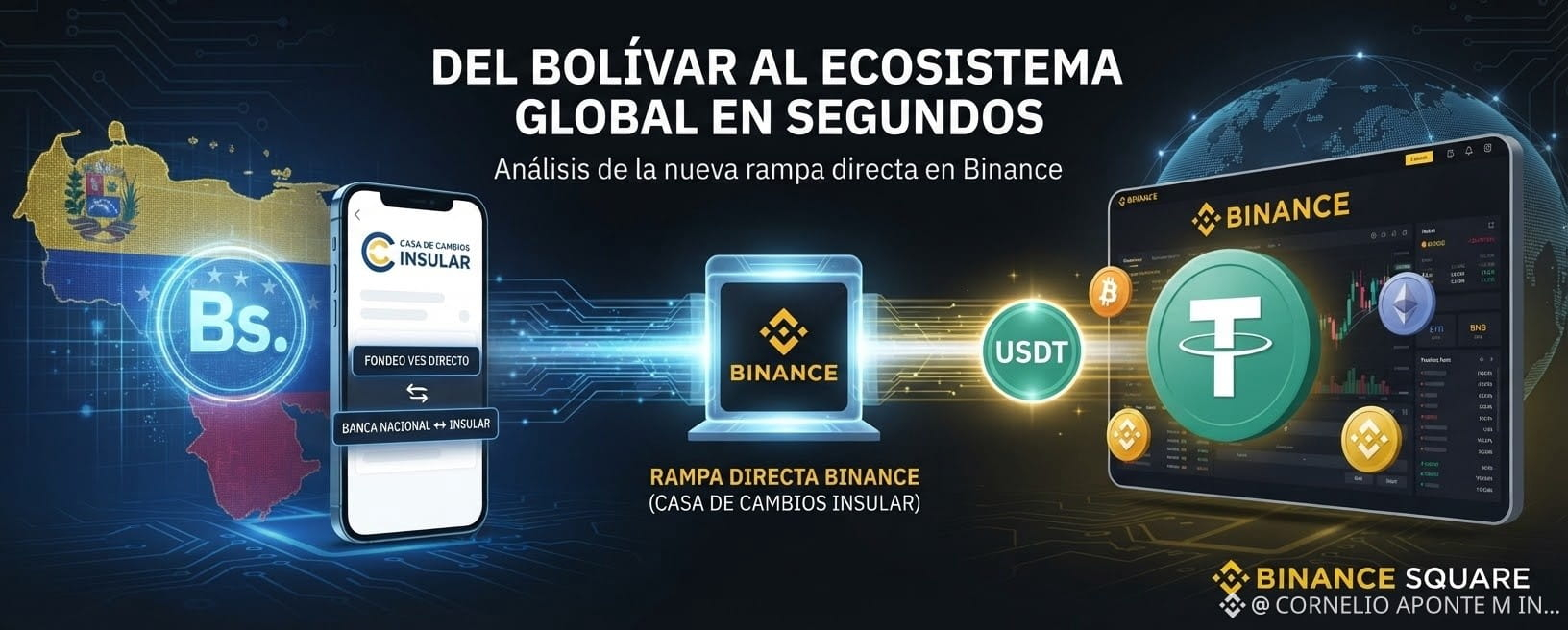

Yesterday, I carried out a practical transaction that captures the direction of digital liquidity in Venezuela: directly funding Binance with bolívares (VES) to acquire $USDT and gain immediate access to the rest of the assets listed on the platform.
Beyond our currency’s nominal value against hard currencies, when a local asset becomes instantly convertible and transferable, it gains enormous tactical utility. As the world once again looks to Venezuela’s energy potential following recent easing measures and sector-specific licenses, having agile financial rails becomes a key operational advantage.
However, when you examine the transaction closely from a financial and technical perspective, four realities emerge that every user should weigh:
1. Speed vs. Price: The 0.72% Equation
In finance, convenience and immediacy almost always come at a cost. In my transaction, buying $USDT through the direct route cost Bs. 1,113, compared with the Bs. 1,105 quoted by the P2P market at that same moment. That gap of Bs. 8 per unit (~0.72%) is the price of avoiding the search for counterparties, chats, and waiting.
When does the direct route make sense? For urgent transactions, tactical amounts, or when zero friction is the priority.
When does P2P make sense? For larger volumes, where every bolívar of spread affects the final margin.
2. Why is there an intermediary instead of direct BCV–Binance clearing?
From a purely efficiency-focused perspective, the ideal solution would be a direct bridge between the national banking system/BCV and Binance through a clearinghouse. However, in the current financial architecture, a central bank does not act as a retail gateway to an international exchange, and Binance operates within its global corporate framework. This is why a local processor regulated by SUDEBAN and the BCV (such as Casa de Cambios Insular) comes into the picture: it is the institutional bridge needed to connect domestic banking rails with global liquidity, even if it adds a layer of intermediation.
3. Traceability and accounting records
Many people wonder whether this mechanism is driven by greater tax audit oversight. The reality is that any transaction leaving a Venezuelan bank account—whether through P2P or a direct on-ramp—already leaves a local banking trail. The difference lies in standardized, clear documentation: transacting from your own accounts through an identified channel reduces the risk of third-party blocks and makes it easier to provide accounting and tax records in the event of an audit.
4. Caution in the face of energy optimism
While the gradual reopening of sectors such as oil, gas, and electricity may boost the economy in the medium term, building a currency’s structural strength takes time. Today, the bolívar’s greatest value within this ecosystem is not in holding it static, but in using it as a fast, liquid means of moving into store-of-value or investment assets such as $USDT, USDC, or BTC.
In conclusion: The direct on-ramp does not replace P2P; it complements it. Having both tools lets us choose at any given moment whether to optimize for price or for speed and traceability.
And you, have you tried this direct route with VES, or do you still prefer P2P to protect your margin? Let me know in the comments.
#BinanceVenezuela #VES #USDT #CriptoVenezuela #FinanzasDigitales #BinanceSquare $USDT USDCBTC