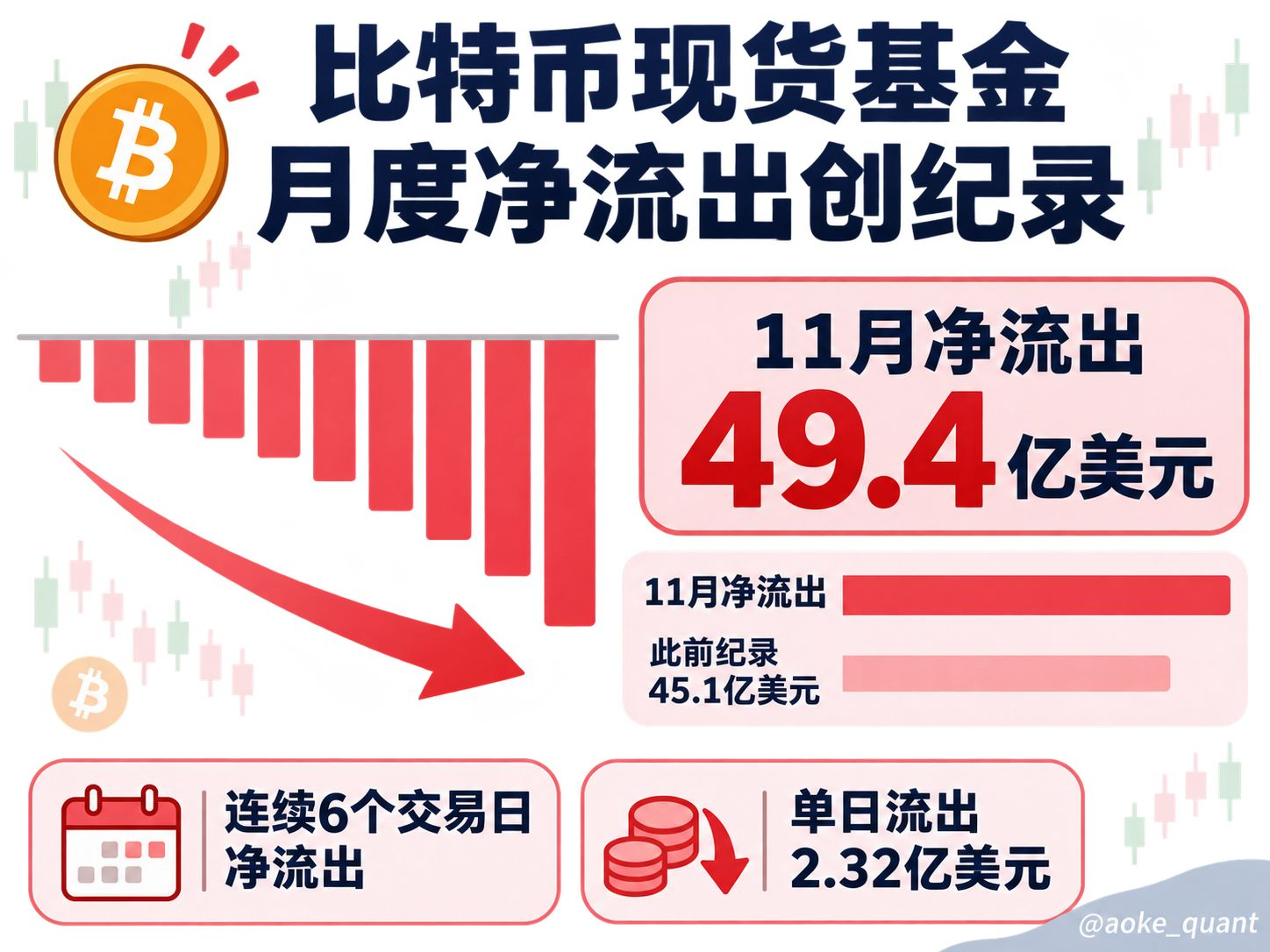
U.S. spot Bitcoin ETFs record a single-month outflow in November, totaling $4.94 billion
Since launching in January 2024, U.S. spot Bitcoin ETFs have served as an important window into institutional fund flows. These products allow traditional investors to gain exposure to Bitcoin without going through an exchange, and the difference between subscriptions and redemptions—commonly known as net inflows or outflows—is often viewed as a barometer of market sentiment and appetite for allocation. Over the past two years, monthly fund-flow data has gradually become a common reference point both inside and outside the industry. According to SoSoValue, U.S.-listed spot Bitcoin ETFs saw net outflows of $232 million on Tuesday, marking six consecutive trading days of net outflows. The monthly figure has drawn even more attention: November’s cumulative net outflows reached $4.94 billion, exceeding the $4.51 billion recorded in June and setting a new single-month record. Since these products launched in January 2024, this is the first time monthly net outflows have approached the $5 billion mark. The combination of redemptions over six consecutive trading days and a monthly record points to a sustained period of fund adjustments rather than an isolated one-day fluctuation. It is worth emphasizing that this is an inference based on the data pattern; the data itself does not reveal the specific reasons behind the outflows.
Mechanically, ETF net outflows mean that redemptions exceed new subscriptions. When redeeming, authorized participants return ETF shares to the fund and receive Bitcoin in exchange, which they typically need to sell on the spot market to complete the arbitrage cycle. As a result, sustained net outflows can transmit selling pressure to the Bitcoin spot market. However, this is a conventional interpretation of market mechanics; SoSoValue’s data records only the difference in fund flows and does not directly indicate who is selling or why.
For the crypto market, there are broadly three transmission channels. The first is liquidity: sustained net outflows mean that holdings accumulated through ETFs are declining. If the pace of redemptions continues, the spot market’s ability to absorb them may be tested. The second is sentiment: record outflow figures can reinforce a wait-and-see mood, particularly near year-end, when institutional portfolio rebalancing and profit-taking may be more pronounced. The third is market structure: some argue that capital has not left crypto assets but is instead seeking other ways to hold them outside ETFs. For now, this remains speculation; the current data neither supports nor disproves the claim, making it an important point to watch going forward.
Editor’s note: A single-month record is certainly striking, but it is a lagging, one-dimensional indicator. It does not, by itself, establish a trend or prove that institutions are systematically exiting. Also, the $4.94 billion figure is calculated through Tuesday, with several trading days still left in November. The final total could continue to rise or narrow. The data’s cutoff time is another reason to treat the record figure with measured caution. For readers, it is more useful to track whether outflows slow in December and whether the record redemptions coincide with changes in holdings through other channels. Separating facts from interpretation brings us closer to understanding what is really happening than focusing on a single number.
#BitcoinETFNovemberOutflowsRecord494B #BTC #ETH #BNB