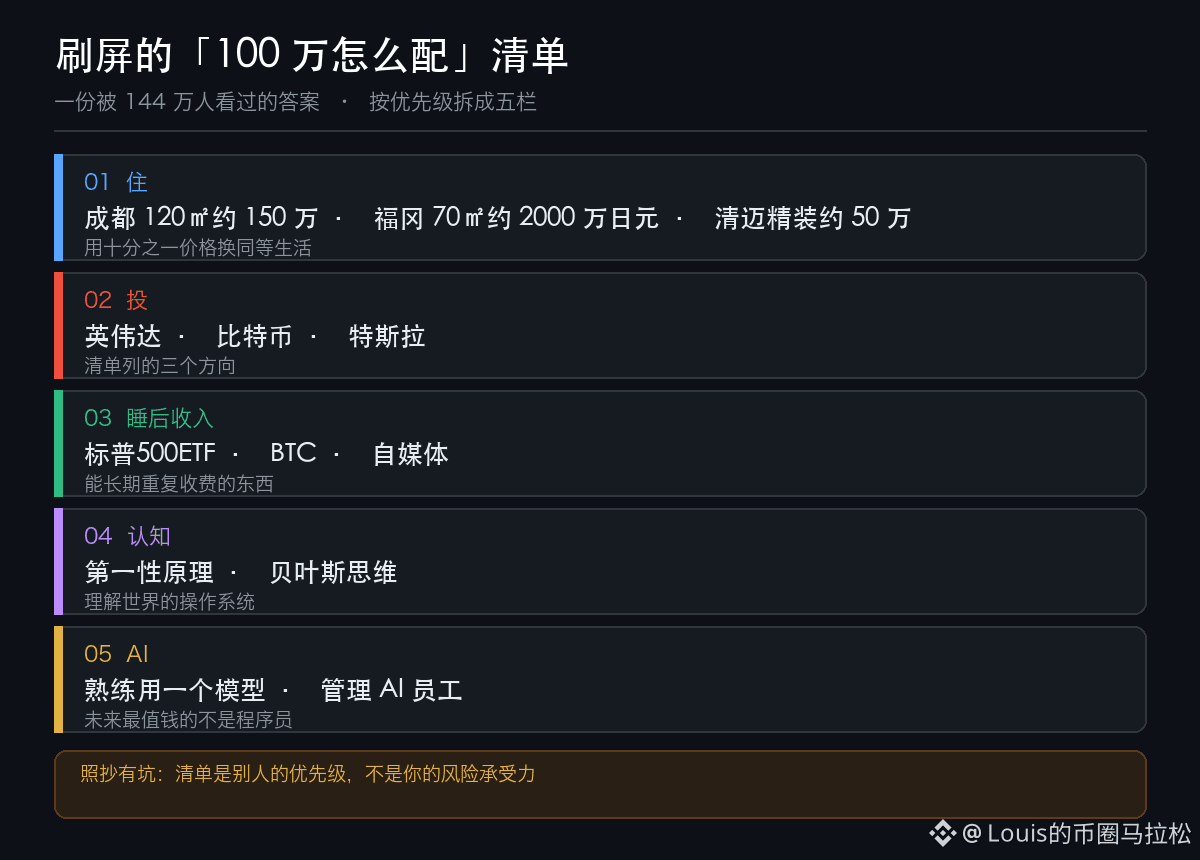
A “how to allocate 1 million” checklist has been all over social media these past couple of days, with one post getting 1.44 million views. It breaks the answer into a few categories: living—Chengdu, Fukuoka, Chiang Mai, trading down to one-tenth the cost for the same quality of life; investing—Nvidia, Bitcoin, Tesla; passive income—the S&P 500 ETF and $BTC , plus creating content; knowledge and AI—first principles, Bayesian thinking, and “the most valuable people in the future will be those who know how to manage AI.”
What’s interesting isn’t which city or stocks it picked, but the order: first bring down housing costs to free up cash flow, then buy “things that can keep earning over the long term.” The S&P 500 ETF and $BTC are put in the same category for the same reason—you can stay exposed to growth without actively timing the market.
But blindly copying it has its pitfalls. The checklist’s claim that “Bitcoin is the only truly scarce asset in the world” is a belief, not a fact: the 21-million-coin cap is a rule; the price is based on consensus, and consensus can change. Someone else’s checklist reflects their risk tolerance, not yours.
Given this order of priorities, if you could only do one thing first, would you cut housing costs, cut back on investing, or cut content production?
$BTC $BNB $ANT