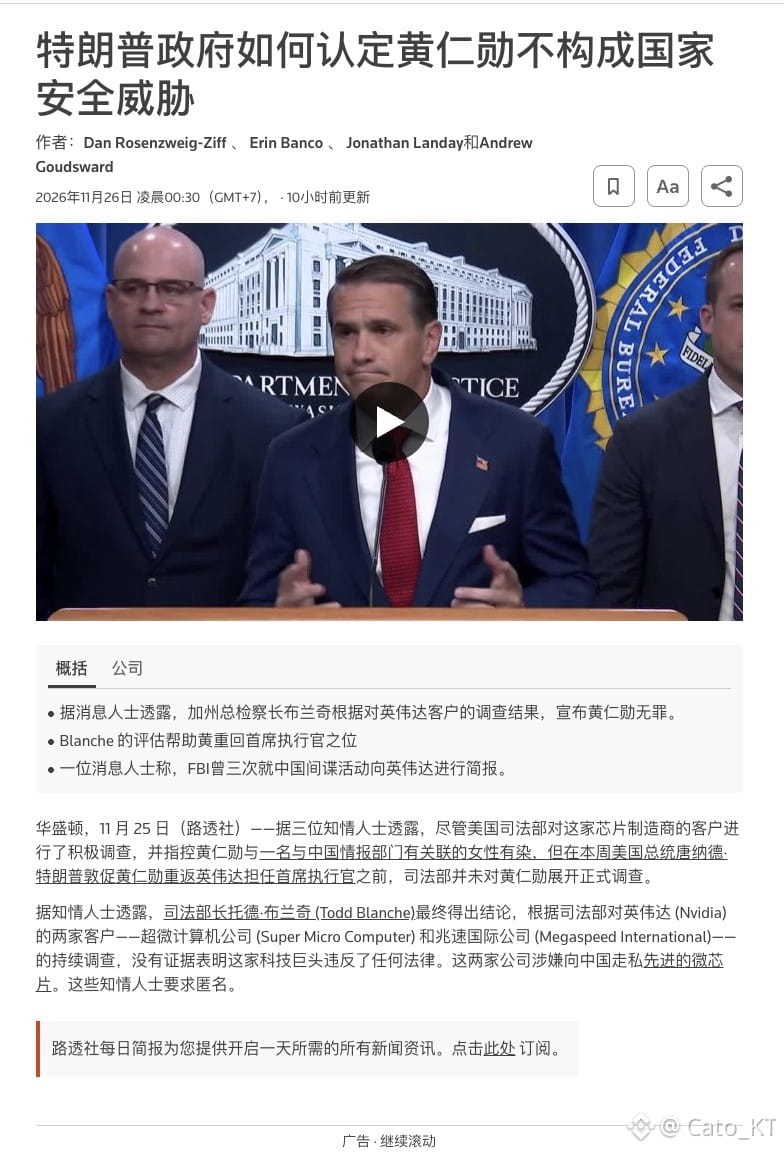
Reuters, citing people familiar with the matter, reported that before Huang’s return, the U.S. Department of Justice had not launched a formal criminal or counterintelligence investigation targeting Jensen Huang personally.
The main reason was that, based on the information currently available to the attorney general, there was no evidence that Huang had violated U.S. law, acted on behalf of China, or knowingly transferred sensitive technology.
Considering the Singaporean prime minister’s statement that the investigation into Megaspeed had been obstructed mainly because the U.S. had not shared all the relevant information, it seems that although the Justice Department’s investigation is still ongoing, there is indeed no substantive evidence proving that Huang or Megaspeed poses a criminal risk.
Trump and Vice President Vance then conveyed this conclusion and assessment to Nvidia’s board. This was very likely what Nvidia’s website referred to, in its disclosure about Huang’s return, as the “views of government officials”—clearly pointing to Trump and Vance.
As the risk of criminal prosecution facing Huang has gradually diminished, Trump has repeatedly said he hopes Huang will not invoke the Fifth Amendment to the U.S. Constitution and refuse to incriminate himself at the December hearing.
Explanation of the Fifth Amendment to the U.S. Constitution: The government can investigate you, but it cannot force you to prove your own guilt, nor can it arbitrarily deprive you of your liberty or property.
In an interview on November 24, Trump made it clear once again that pardoning Huang remains an option, but he does not think it is necessary.
Clearly, Trump must have learned that the Justice Department’s investigation lacks credible evidence. At the same time, he hopes Huang will not confront Congress during its inquiry, but face the questions and resolve the issue. If all else fails, Trump still has the option of a pardon.
In fact, Trump’s reluctance to have Huang invoke the Fifth Amendment during the congressional inquiry is mainly about putting on a show for Republicans. After all, some Republicans have also expressed dissatisfaction over the Huang case. If Huang takes a hard line during the congressional inquiry, it would indeed be bad for party unity.
It feels like the Huang matter is gradually dying down. From the recent pressure from Democrats, it’s clear that they are no longer targeting Huang personally. The bigger the uproar and the higher the political stakes, the safer Huang is! #SpaceX太空数据中心获批,AI芯片需求迎来新增长点?