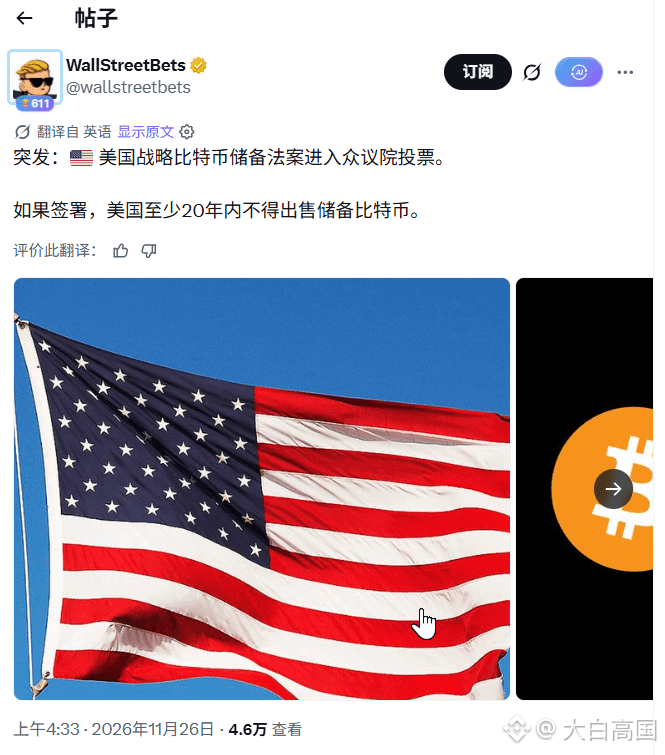
Is the “Strategic Bitcoin Reserve Act” good news for the current market?
There’s been quite a bit of discussion in the English-speaking community about the Strategic Bitcoin Reserve Act, but it has barely generated any buzz in the Chinese-speaking community.
The biggest upside of the U.S. Strategic Bitcoin Reserve (H. Rept. 119-894) is that the 300,000 BTC held by the U.S. won’t be sold for 20 years.
As things stand, the chances of it passing are slim, and the chances of it becoming law are even lower. It also won’t do anything to lift the current sluggish market.
November 24 is merely when it “becomes eligible for a vote.” There’s no set date for when voting will begin—it’s up to the leadership to decide.
And after the midterm elections, the Democrats will control both chambers, making passage highly unlikely.
The U.S. is currently in a lame-duck session, when bills tend to be shelved. Bills related to crypto that also lean toward the Democrats are especially unlikely to go anywhere.
If this version isn’t passed before January 3, 2027—that is, before the Democrats take power—it will automatically expire and have to be reintroduced in the new Congress.
Even if it gets a chance to be voted on, it would still need to pass the Senate and be signed by the president after passing the House. Right now, it can’t even get through the first step properly.
If you think a strategic Bitcoin reserve will boost the current market, don’t hold your breath.
For now, it’s just the media hyping itself up; it won’t help BTC’s price.