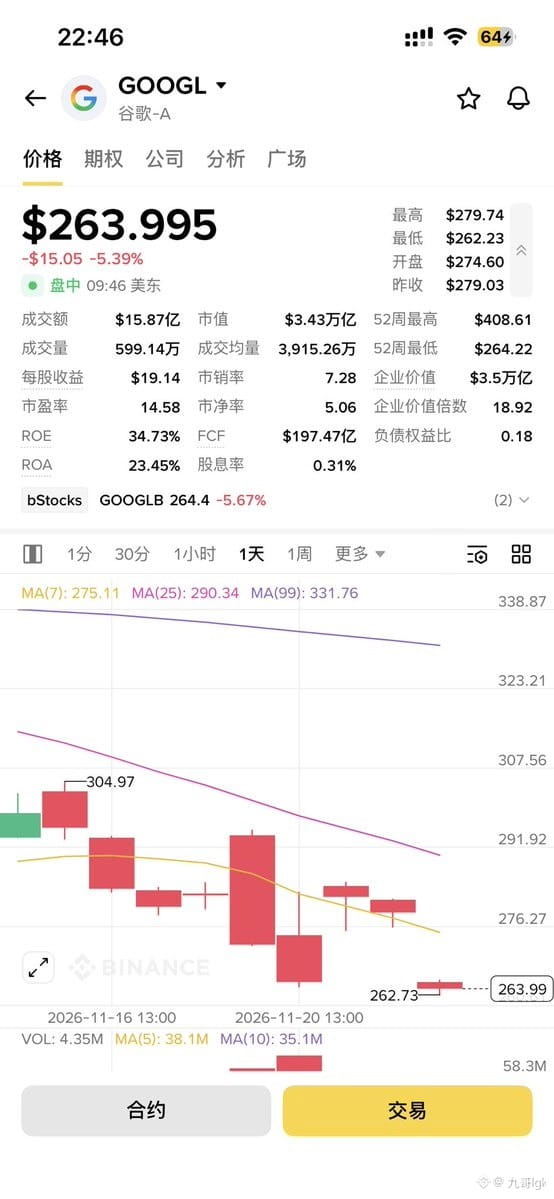
Is it time to buy the dip in Google?
Google may be one of the undervalued opportunities in this AI wave.
First, the stock: GOOGL is currently around $273, down about 33% from its 52-week high of $408.61.
But have Google’s fundamentals really deteriorated?
1. AI models: Gemini has rejoined the top tier
Google’s latest release, Gemini 4 Neon, ranks third on the Artificial Analysis Intelligence Index.
Google has not only Gemini, but also a massive user base. The Gemini app has reached 1 billion users, and its first-party model APIs process nearly 32 billion tokens per minute.
2. Chips: Google is more than just an NVIDIA customer
Google develops its own TPUs. Its latest-generation Ironwood can connect up to 9,216 chips in a single compute cluster.
Google has already started selling TPU systems to external customers.
It can use its own chips to train and run Gemini, while also selling computing power to other AI companies through Google Cloud.
3. Search and YouTube: The old money-making machines are still growing
Many people worry that AI will disrupt Google Search, but the latest earnings report tells a different story.
In the third quarter, Google Search revenue reached $63.35 billion, up about 12% year over year.
YouTube ad revenue reached $11.2 billion.
AI hasn’t immediately made Google’s existing business model obsolete. Instead, it’s helping the company transform the search experience.
4. Google Cloud: A new growth engine
In the third quarter, Google Cloud revenue reached $30.7 billion, up 103% year over year.
Operating income reached $11.1 billion.
Cloud’s remaining performance obligation backlog has also reached about $561 billion.
TPUs, AI infrastructure, and enterprise AI services are becoming new sources of revenue for Google.
5. A look at the company’s earnings power and valuation
For 2025, Alphabet reported approximately $402.8 billion in full-year revenue and about $132.2 billion in net income.
In the third quarter of 2026, quarterly revenue had already reached $127.6 billion, up 25% year over year.
Meanwhile, GOOGL is currently around $273 per share, with a market capitalization of about $3.36 trillion.
According to market data providers, its current P/E ratio is about 14, and its forward P/E is about 20.
However, Google’s capital expenditures are expected to reach as much as $195 billion–$205 billion this year and could rise further in 2027. The returns on its AI investments still need to be proven.
My view:
The most valuable thing about Google isn’t just how powerful the Gemini models are.
It has AI models, TPU chips, data centers, cloud computing, search advertising, and a user base numbering in the billions.
From chips to models, applications, and commercialization, it covers almost the entire AI value chain.
Clearly, Google isn’t leaving the table in the AI game.
GOOGL$274.55
https://x.com/Lgk007/status/2125862120592220447