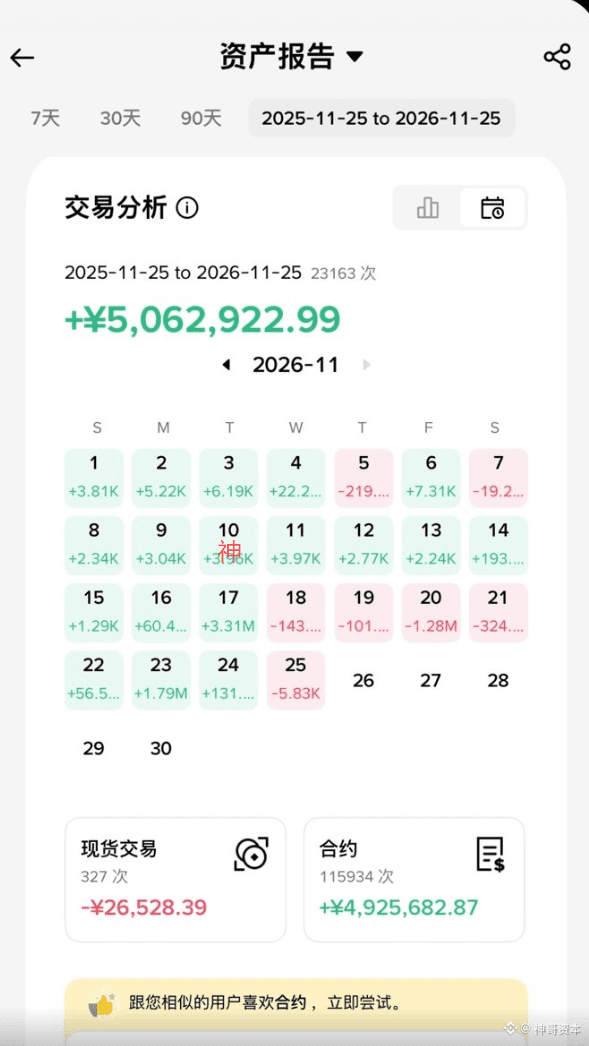
Why does frequent trading always end in failure? #BTC
Guys! One year, I reviewed my trades: 217 trades, a 61% win rate.
It turned out that 80% of my profits came from just 3 trades—the three I happened to hold the longest. I wanted to sell two of them along the way, but I was traveling and couldn’t check the market, so I ended up holding on. The other 214 trades combined were in the red.
I didn’t make money through skill. I made it by “not watching the market.”
The only real advantage retail traders have isn’t information, speed, or research. It’s this: we don’t have to compete for rankings, use leverage, or meet performance targets. We can wait.
With frequent trading, every time you sell, you give up that advantage.
The returns from a positive-expectancy strategy are right-skewed: a tiny number of trades account for most of the profits. But frequent trading pushes you to take profits too early without pushing you to cut losses properly. So the right tail gets cut short, while the left tail stays just as long.
A 60% win rate with a 0.3:1 reward-to-risk ratio. You win three units 60 times and lose ten units 40 times. Mathematically, that’s a sure way to fail.
Position sizing isn’t about “how much can I make?” It’s about “if I’m wrong, can I still survive?” Keep your position small enough that you can even hope the price will fall—that’s how you’ll be able to hold on.
The truly effective solution isn’t stronger willpower; it’s fewer decision points: turn off notifications, remove trading apps from your phone’s home screen, and reduce your position to a level where you don’t need to check it every day.
#新人宝典:从零了解TradFi
The market has never rewarded hard work. It rewards holding on without interruption. You don’t need to make more accurate predictions; you just need to interrupt yourself less often. @神哥资本