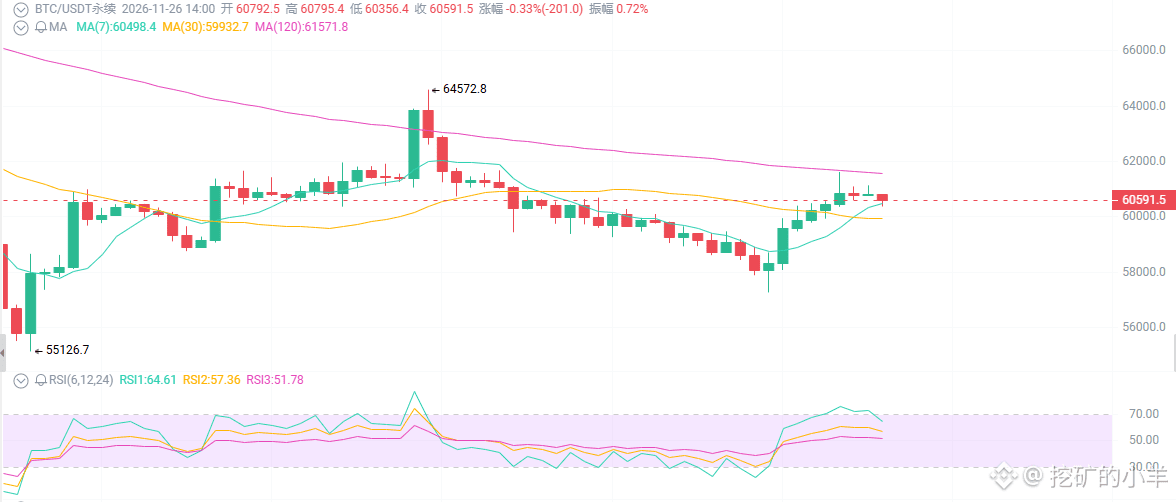
BTC at $60,600—would you still dare to buy?
From 126,000 down to 60,000: cut in half. ETFs saw $5 billion flee in a month, a record. October core PCE jumped to 3.3%, and the odds of a December rate hike hit 98%. But just now, after bottoming at 57,200, BTC snapped back to 60,600—is this a dead-cat bounce, or a real bottom?
First, the surface picture: it’s rebounding, but don’t celebrate just yet.
Up 2–3% in 24 hours—it looks like things are stabilizing. But look at the weekly chart: down 3–5%. Look at the monthly chart: down 24–25%. From its all-time high of 126,000 in October 2025 to now, it’s fallen more than 50%.
The daily moving averages are stacked bearishly, with the price below the 20-day, 50-day, and 200-day averages. The RSI has climbed out of oversold territory (20–30), and the MACD is showing signs of bullish divergence—but divergence isn’t a bottom. It’s a hint that “we might be near one,” not confirmation.
First thing: institutions are voting with their feet, while you’re trying to catch a falling knife.
In November, U.S. spot BTC ETFs saw cumulative net outflows in the $5 billion range—a record. BlackRock’s IBIT led the decline, with outflows for several consecutive days. Institutions are running, and they’re running in an orderly queue.
You might say, “Great, they’ve left—I’ll buy the dip.”
Buddy, what do you have that can compete with BlackRock on information, risk management, or financial firepower?
Second thing: the Fed isn’t planning to save you.
October core PCE came in at 3.3%, a three-year high and above expectations. Headline PCE was 3.8%.
Markets have almost fully priced in a 25-basis-point rate hike on December 9, with the probability at 94–98%. Another hike in January is possible.
What do high interest rates mean?
If you can earn 5% risk-free by keeping your money in the bank, who’s going to hold Bitcoin when it can drop 10% in a day?
BTC is highly correlated with the Nasdaq, which has also been under pressure lately—tariff worries, AI volatility, and declining risk appetite.
This isn’t a bear market for BTC alone; it’s the whole risk-asset market shedding excess. And BTC is always the most volatile one—the one that falls the hardest.
Third thing: the only hope is hidden in the fear.
The Fear and Greed Index: extreme fear.
Historically, extreme fear often shows up near a temporary bottom. But note—“near” doesn’t mean “it is the bottom.” Extreme fear can last for weeks, and prices can still fall another 20%.
The U.S. Strategic Bitcoin Reserve bill passed a House committee and could proceed to a full House vote, locking in government holdings of BTC for 20 years. A new European spot ETF has launched.
But honestly, these positive developments can’t even make a ripple against rate hikes and ETF outflows.