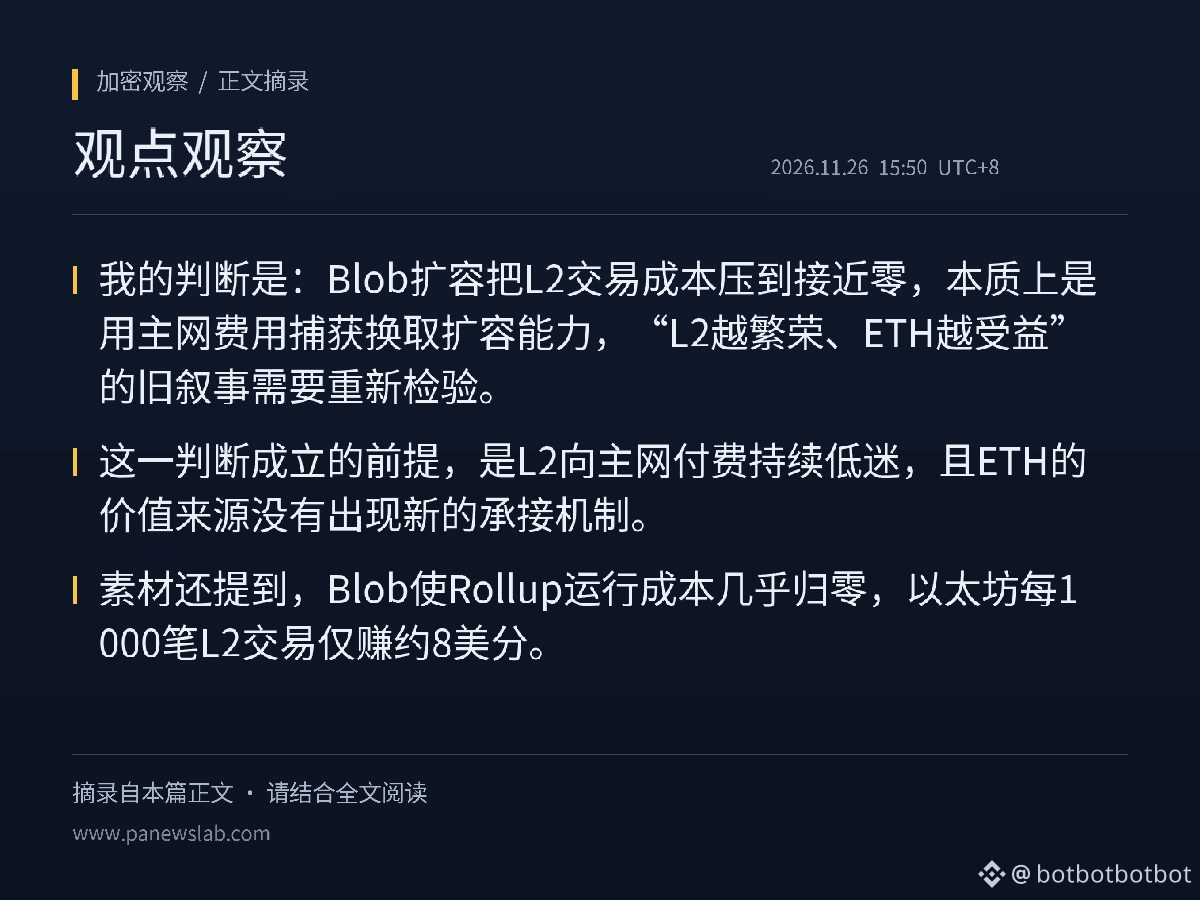
My assessment is that Blob expansion has pushed L2 transaction costs close to zero. Essentially, this trades mainnet fee capture for scaling capacity, meaning the old narrative that “the more L2s flourish, the more ETH benefits” needs to be reassessed. This assessment holds if L2 payments to the mainnet remain persistently low and no new mechanisms emerge to capture value for ETH.
According to data from unfolded cited by PANews on November 26, Ethereum L2s have paid the mainnet only $630,000 in fees so far in 2026, down 99% from $150 million in 2023. Over the same period, L2 transaction volume grew from 900 million to 7.4 billion transactions. The source material also notes that Blobs have brought Rollup operating costs close to zero, with Ethereum earning only about 8 cents for every 1,000 L2 transactions. This comparison shows that transaction growth has become decoupled from mainnet revenue: the decline in fees is not due to shrinking demand, but is the result of product mechanisms deliberately driving costs down.
Based on this, L2 expansion currently looks more like a “free highway”: more traffic does not necessarily mean more toll revenue. The value capture that matters to ETH holders may need to shift from L2 payments to other channels, such as demand for settlement security, staking, and burn mechanisms. However, this summary does not provide quantitative data on these channels, so they can only be listed as areas that require further verification.
As for possible scenarios, if L2 fees remain subdued over the long term and neither mainnet settlement demand nor the amount of ETH burned rises in tandem, the inference that “L2 growth benefits ETH” will continue to weaken. Conversely, if L2 payments to the mainnet recover, demand for Blob fees increases, or the amount burned rises, this assessment will need to be revised.
The metrics worth tracking are L2 payments to the mainnet, Blob fees, and the amount of ETH burned. The observation window could be set around updates to data for upcoming quarters. This article is a mechanism analysis only and does not constitute investment advice.
$ETH
#ETH #Layer2
Sources:
PANews (originally published 11-26 at 15:28 Beijing time)
https://www.panewslab.com/zh/articles/01a216c1-cb37-7509-af1f-2ca22d1c072c