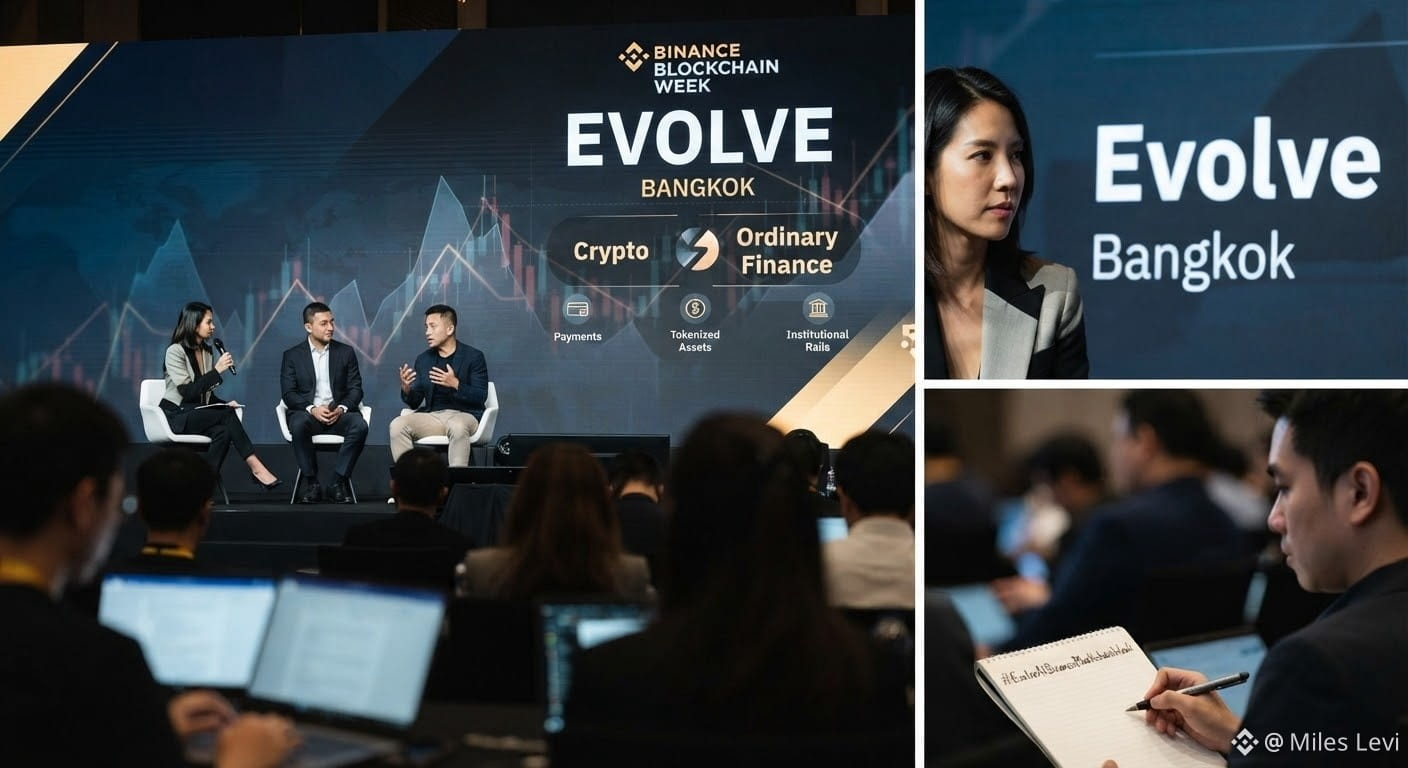
#币安区块链周进化由你 I keep noticing how often crypto now talks about becoming part of ordinary finance. The language has shifted toward payments, tokenized assets, institutional rails and AI managing money. Perhaps that is evolution. It also makes me cautious.
Binance Blockchain Week in Bangkok, under the theme “Evolve”, brings that shift into one room. I’m interested in the discussion around real use, but not just polished demonstrations. A payment that works in a demo is one thing; one that settles reliably, at a sensible cost, and can be resolved when something goes wrong is another. The same goes for tokenized assets. Putting a familiar asset on-chain does not automatically create deep liquidity, clear ownership or an easy exit when everyone wants out.
I’ve seen this industry confuse access with usability before. A wallet can make entry look simple while custody, fees, bridges, compliance checks and withdrawal limits remain complicated underneath. And 24/7 markets sound liberating until thin liquidity makes a quiet hour expensive. AI may smooth the interface, but it cannot make weak infrastructure dependable.
That is what I’ll be watching for in Bangkok: less talk about how much finance can move on-chain, and more honesty about who carries the risk when it does. Maybe the next stage is real progress. Maybe it is old friction behind a better interface. I’m not sure yet, and that is why the discussion matters.