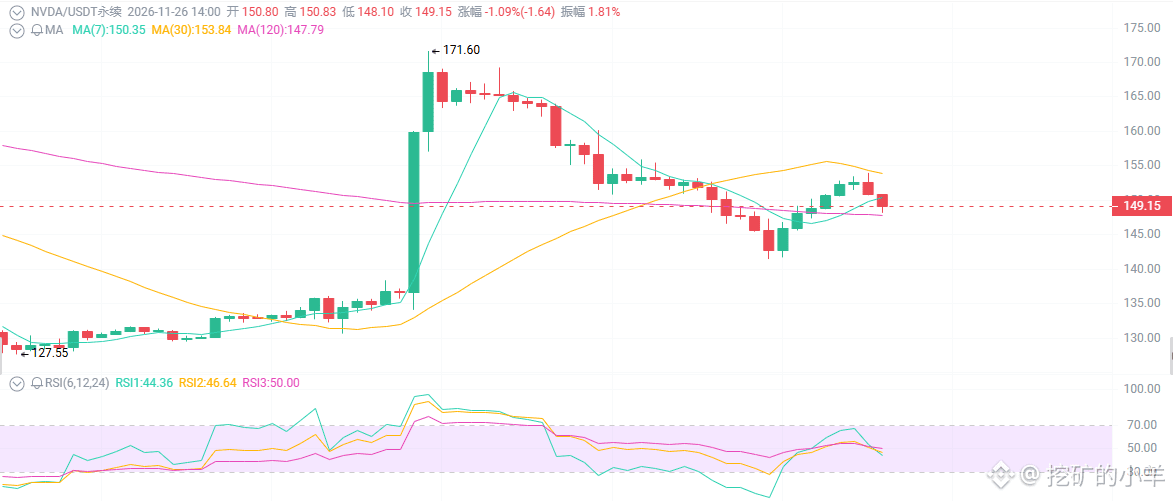
Nvidia at $149—would you still dare to buy the dip?
Jensen Huang was “rescued” back by the Trump administration. The stock surged 31% in a day, going from $125 to $165, and everyone was shouting, “The king is back.” Then it gave back most of those gains over the next two days. Now it’s at $149. Earnings are through the roof, the PE is just 16, yet the stock is still 38% below its peak. Is this a golden buying opportunity, or is the market trying to tell you something in advance?
First, the surface story: the surge was fake; the pullback is real.
On Monday, Jensen Huang returned to his post, and the stock shot up from $125.5 to $165—a 31% gain. Everyone on social media was saying, “Nailed the dip.” On Tuesday and Wednesday, sentiment cooled and most of the gains evaporated. It’s now at $149, still 38% below the $243 peak on October 6.
The rebound is about sentiment; the decline is structural. Since peaking at $243 in October, it has broken through every support level at $205, $188, $174, and $171. The daily moving averages are bearishly aligned, and the price is far below both the 50-day and 200-day averages.
First: Jensen Huang is back, but “back” doesn’t mean “problem solved.”
He stepped down on November 12 amid a relationship scandal and national security concerns, then returned on November 23 under pressure from the Trump administration. Sounds like a happy ending?
Wake up. S&P has already flagged that “management and governance risks could affect the rating.” He’s due before a congressional hearing on December 3. Export controls are tightening, and the securities class action is still unresolved.
What the market is worried about isn’t Jensen Huang himself. It’s that “political interference can bring him back—and can make him leave again.”
Second: earnings are phenomenal, but the stock isn’t buying it—and that’s the most painful part.
Q3 revenue was $115.8 billion, up 103% year over year; gross margin was 74.8%; data centers made up a huge share of revenue; and management raised its outlook. The trailing-twelve-month PE is 16–17, and the forward PE is barely above 10.
Tell me, is that expensive? In 2021, when Nvidia’s PE was 80, everyone called it “the greatest stock ever.” Now it’s at 16, and everyone says “it’s doomed.”
Why? Because the market isn’t pricing in “earnings today”—it’s pricing in “uncertainty about the future.”
Third: macro conditions are stabbing it in the back.
The latest core PCE came in at 3.3%, hotter than expected. Q3 GDP was revised up to 4.3%. The market is pricing in more than a 90% chance of a rate hike in December.
Hot inflation + strong growth = higher rates for longer = valuations slashed for high-beta growth stocks. Nvidia is the leading proxy for AI, and when rates rise, it gets hit harder than just about anything else.
That’s why the whole growth-stock sector can’t get off the mat in the face of interest rates. No matter how bullish you are on AI, you can’t shrug off the Fed’s scythe.