Brothers, I’ve been watching the markets for ten years, and it’s rare for a tech headline to jolt me awake—but today, this Huawei HBM news has my hands shaking!
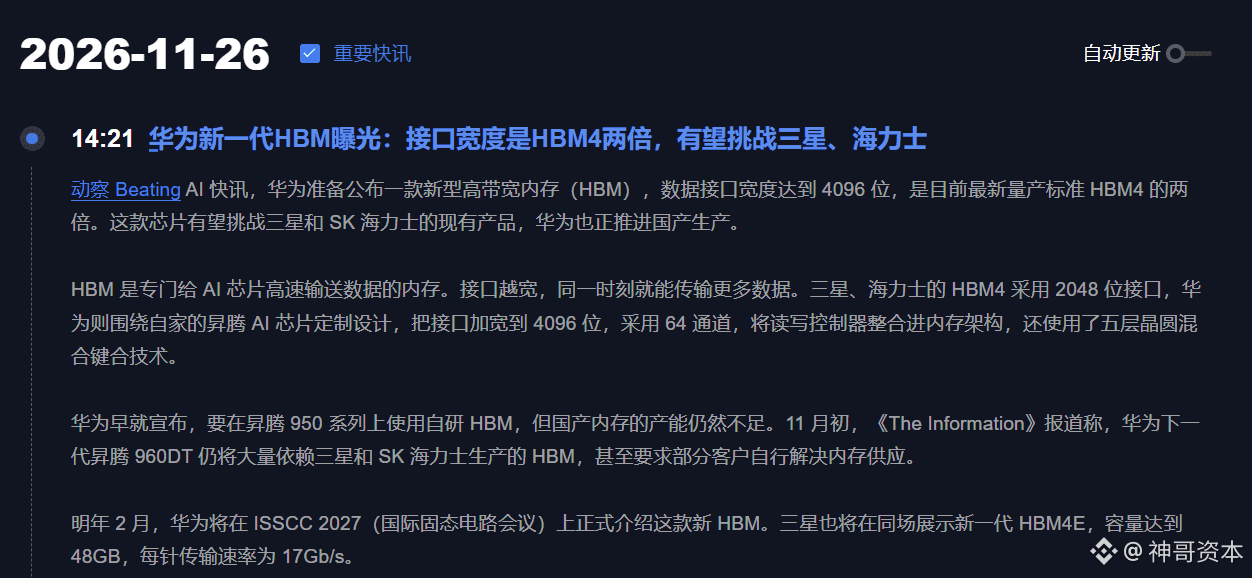
I just saw a breaking update from Dongcha, and I nearly spilled my coffee.
Huawei’s next-generation HBM interface is reportedly 4,096 bits wide—exactly twice the width of the latest mass-produced HBM4. It features 64 channels, integrated read/write controllers, and five-layer wafer hybrid bonding, all custom-designed for Huawei’s Ascend chips. It’s set to make its official debut at ISSCC next February.
Put simply: twice the data throughput in the same amount of time.
That could redefine AI training and inference efficiency. This isn’t a minor upgrade—it’s aimed at taking on Samsung and SK Hynix head-on.
But after all these years of trading, what worries me most is when something “sounds impressive but takes forever to deliver.”
Looking back at the big domestic AI hardware headlines of the past few years, the market has always priced in a sentiment premium first. The people who really make money aren’t the ones who rush in after seeing the news. They’re the ones who anticipate whether production can keep up and whether customers will actually use it.
The reality is sobering: although the Ascend 950 is supposed to use homegrown HBM, domestic production capacity is still insufficient. The next-generation Ascend 960DT will likely continue to rely heavily on Samsung and Hynix—and some customers have even been asked to source their own memory.
So for now, this is first and foremost a sentiment bomb; the long-term domestic substitution story comes second.
My approach is clear:
During the golden 24–48 hours after the news breaks, I’ll prioritize sentiment and fund flows and look for short-term swings. What really determines the medium-term trend will be production ramp-up and yield data down the line.
I won’t go all in, but I’ll definitely be watching for volatility-driven opportunities tied to the AI computing-power narrative.
Ten years of trading have taught me one thing:
What consistently makes people money isn’t technology that “looks impressive.” It’s having an information edge—getting positioned before everyone else stops sitting on the sidelines.
This Huawei HBM story is one of the biggest information gaps in the market right now.
Do you think this could ignite the next AI rally, or will production bottlenecks make it fizzle out?
Share your take and your position in the comments. I’ll read every one carefully.
Follow me, and when production capacity, customer adoption, and real-world test data come out, I’ll break them down for you right away.
I’ve got my eye on this story. How about you?