From 43,800 to 29,800 in just one day
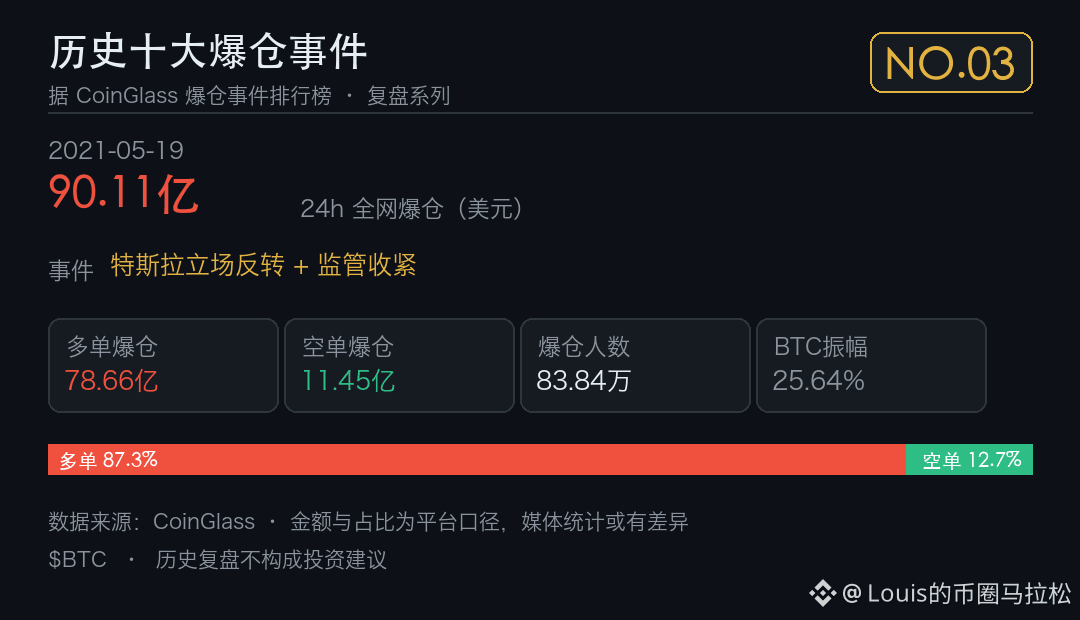
On May 19, $9.011 billion in crypto positions were liquidated across the market, including $7.866 billion in long positions. 838,400 traders were liquidated, and $BTC saw a 25.64% swing—the biggest volatility spike among the ten major events.
The spark came days earlier: On May 12, Musk announced that Tesla would stop accepting BTC payments due to the carbon emissions from mining. On May 18, three industry associations jointly warned about trading risks, while Inner Mongolia moved to shut down mining projects. On the 19th, prices plunged, crashing from 43,800 to 29,800 intraday—nearly halving from April's high of 64,800.
Ethereum fell 22.5%, Dogecoin dropped 26%, and nearly $1 trillion was wiped off the global market cap in a single day. But U.S. stocks barely budged: the Dow fell 0.48%, the Nasdaq was down 0.03%, and Tesla itself slipped 2.49%.
This is a textbook narrative reversal: when the biggest source of support becomes the biggest bearish signal, what falls isn't the fundamentals—it's belief. But just six weeks later, BTC was back above 40,000. Belief collapsed, but recovered faster than the fundamentals.
If someone who has always supported it suddenly changes their tune, would you reduce your position right away, or first see if it's just emotion?
*Contract trading is highly volatile; manage your position size carefully
$BTC $ANT