

I'm not going to lie, keeping up with crypto these days is exhausting.
Every other week there's a new chain, a new narrative, a new token, or some project claiming it's about to fix everything wrong with the internet. A few months ago everyone was talking about AI. Before that, it was memecoins, NFTs, DeFi, and whatever else was trending at the time.
And somehow, every new project is always different.
We've heard that word so many times that it barely means anything anymore.
I've watched projects get millions in attention, build massive communities, attract influencers, and make all kinds of promises. Then a market cycle changes and suddenly nobody wants to talk about them.
That's crypto, I guess.
You learn to stop getting excited about announcements and start paying attention to what actually happens after the announcement.
That's more or less how I look at Celo.
Celo isn't exactly a new name. It's been around for years, and its original idea was pretty straightforward: make crypto and financial services easier to access, especially through mobile devices.
Now it's taken a pretty big step.
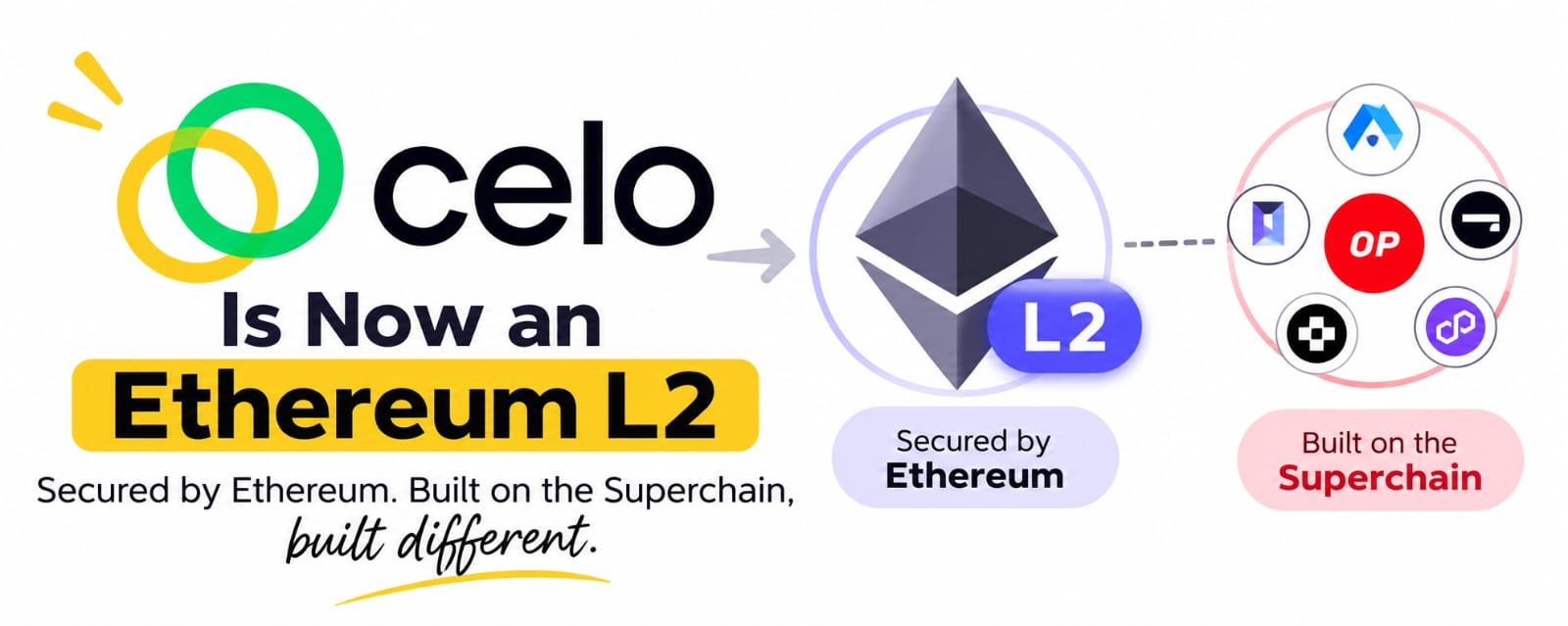
Celo has moved from being its own Layer 1 blockchain to becoming an Ethereum Layer 2. It completed that transition in March 2025 and joined the Superchain ecosystem.
It's an interesting move, no doubt.
But I don't think simply becoming an Ethereum L2 is enough to make me bullish on anything.
There are already so many L2s competing for attention. Everyone wants developers, liquidity, users, and a place in the Ethereum ecosystem. Some have huge funding, some have big communities, and some have been promising the same things for years.
So, what makes Celo worth paying attention to?
For me, it's not really the L2 narrative.
It's the payments side of things.
Think about it for a second. Sending money internationally is still a headache for a lot of people. Fees can be ridiculous, transfers can take time, and accessing basic financial services isn't always easy.
In some countries, people also have to deal with currencies that lose value faster than they'd like.
For these people, stablecoins aren't just another crypto trend.
They're useful.
Being able to receive digital dollars, send money to someone, or move funds without dealing with the usual banking complications can make a real difference.
And honestly, I think this is a much more interesting problem to work on than launching another blockchain and hoping people will find a reason to use it.
Celo has been focused on this idea for a while.
Its mobile-first approach and products like MiniPay are worth watching because they bring the conversation closer to ordinary users.
Not everyone wants to become a crypto expert. Most people don't care whether a transaction happens on an L1 or L2. They just want to send money and get on with their day.
That's something the industry sometimes forgets.
We spend so much time discussing infrastructure that we forget the person who is supposed to use it.
But here's where I still have questions.
Getting people to download a wallet isn't the same as getting them to use it regularly.
We've seen projects celebrate user numbers before. We've seen transaction counts go up because of incentives, campaigns, and airdrop farming. Then the rewards stop, and so does a lot of the activity.
I'd rather see fewer numbers and more genuine usage.
Are people actually using Celo to send money? Are they coming back? Are merchants accepting payments? Is there a reason for someone to choose it over the alternatives?
Those are the things that matter to me.
The Ethereum L2 transition also makes sense from a broader perspective.
Being connected to Ethereum gives Celo access to a much larger ecosystem. Developers, infrastructure, liquidity, and existing tools are all important advantages.
The Superchain connection adds another interesting layer to that strategy.
But let's not pretend that being connected to Ethereum automatically solves every problem.
There are still questions around decentralization, sequencer operation, data availability, upgrades, and long-term security.
Celo uses EigenDA for data availability, so its architecture isn't simply a case of putting everything directly on Ethereum and calling it a day.
I'm not saying the design is bad. I'm saying people should understand what they're actually investing in.
Crypto has a habit of turning technical details into marketing slogans.
And I'd rather understand the risks than blindly repeat the latest narrative.
Another thing I keep thinking about is CELO itself.
Because this is where things get a little more complicated.
A blockchain can become useful without its token necessarily becoming more valuable.
We've seen that happen before.
CELO has a role in network fees and governance, and the network supports fee abstraction, meaning users can pay transaction fees with supported assets instead of always needing CELO in their wallets.
From a normal user's perspective, that's great.
Imagine trying to send someone money and being told you first need to buy a completely separate token just to pay a tiny transaction fee.
Most people would probably give up.
But from an investor's perspective, it raises a different question.
If users don't always need CELO to interact with the network, what creates sustainable demand for the token?
How does increased usage translate into value for CELO holders?
That's not something I'd ignore.
I don't think a project's ecosystem growth and token performance should automatically be treated as the same thing. They're connected in some ways, but the relationship needs to be clear.
And that's something I'd like to understand better as Celo continues developing its L2 economy.
The competition is another thing.
Celo isn't the only network interested in stablecoin payments. There are already established chains doing serious transaction volume, and plenty of other projects are trying to become the preferred place for moving digital dollars.
Being cheap isn't enough anymore.
Being fast isn't enough either.
Almost every chain says those things.
The real challenge is getting people to actually choose your network and keep using it.
That's probably harder than building the technology itself.
Can Celo make the experience simple enough for people who have never used crypto? Can it build trust? Can it attract businesses that have a genuine reason to use its infrastructure?
And perhaps most importantly, can it do all that without depending forever on incentives and crypto-native users?
I don't have a confident answer to those questions yet.
But I do think the problem Celo is trying to solve deserves attention.
There's a difference between building something because a particular narrative is popular and building something around a problem that people already have.
Payments, remittances, and access to stable financial assets aren't going away just because the crypto market enters another boring phase.
That's what keeps Celo interesting to me.
Not the fact that it's now an Ethereum L2. Not the Superchain association. Not another round of ecosystem announcements.
It's the possibility that blockchain technology could become useful in a way that people don't even need to think about.
Maybe that's what adoption should look like.
People using something without caring about the technology behind it.
Of course, there's still a long way to go. Competition is real, adoption takes time, and the token economics deserve just as much attention as the technology.
I'm not ready to call Celo a success story just because it has made this transition.
I've seen too many promising projects struggle after the initial excitement disappears.
But I'm also not going to dismiss it.
Sometimes the most interesting projects aren't the ones making the loudest promises. They're the ones quietly working on problems that have existed for years.
Celo has an opportunity to prove that its approach can work.
Now I'd rather watch what people actually do with it than listen to another hundred explanations about why it's different.
Because honestly, we've heard enough promises in crypto.
At some point, the product has to speak for itself.
