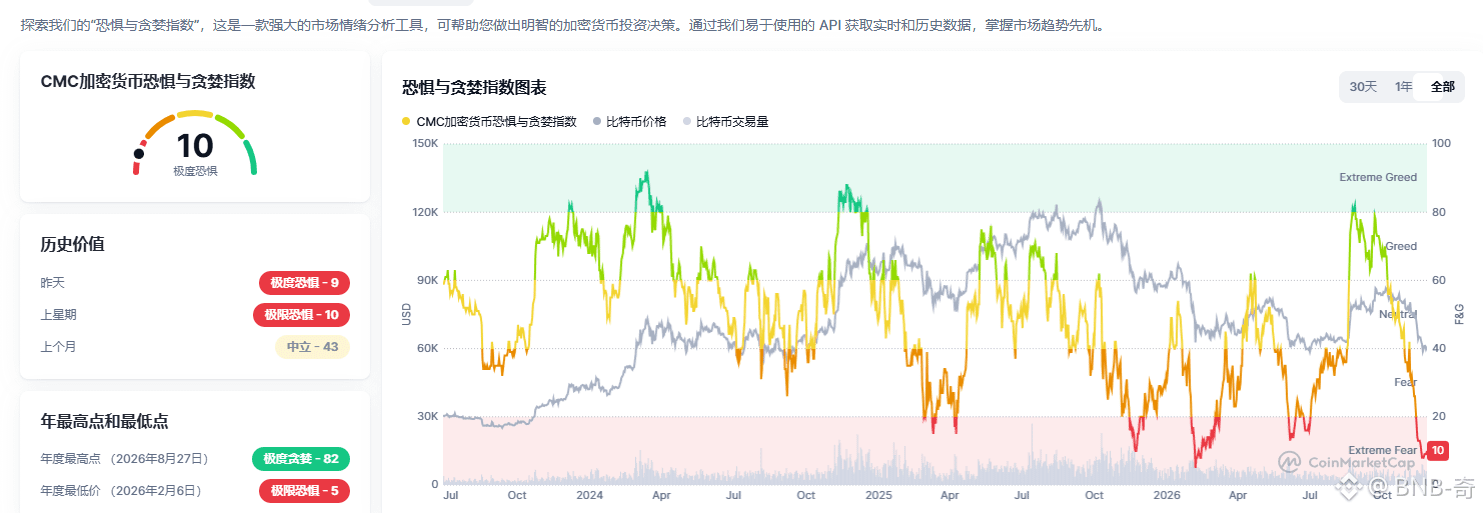
Market sentiment remains in the “Extreme Fear” zone today, with the Fear & Greed Index at 10. The daily moving averages are still weighing heavily on the market, but genuine investment opportunities often emerge when most people are afraid or unwilling to buy.
Returns ultimately come from a mismatch between what you know and what the market price reflects. When everyone is optimistic, good news has already been priced in; when everyone is pessimistic, bad news is often fully priced in as well. By the time sentiment has fully recovered and positive developments are confirmed, the most attractive price range has usually been missed.
This is not an encouragement to blindly buy the dip. History and market experience have repeatedly shown that an opportunity is worth serious consideration only when all of the following conditions are met: the asset itself is high quality; its valuation has returned to a reasonable or low range; it is at a cyclical low rather than facing a breakdown in its underlying thesis; and its risk-reward profile is improving.
A steep drop, or “everyone is criticizing it,” is not a reason to buy. True contrarian investing means calmly assessing the gap between price and value when others are selling out of fear—not opposing the crowd just for the sake of it.
U.S. stocks, Hong Kong stocks, and crypto markets are currently undergoing a significant correction, while policymakers have begun sending signals of stability. Market sentiment has entered the Extreme Fear zone. At this point, the most important thing is not to predict which round-number level BTC will fall to, or guess when the index will reach a new high, but to establish your own framework for making decisions.
Data: Has the asset entered a historically undervalued range? Have the fundamentals deteriorated fundamentally?
Cycle: Distinguish between a normal cyclical correction and a breakdown in the long-term thesis.
Sentiment: Extreme fear may lead to irrational pricing, but fear itself is not a signal.
Price and flows: Monitor trading volume, fund flows, market breadth, and key support levels to see whether selling pressure has truly dried up.
When the conditions are met, it is generally better to build a position in stages rather than trying to pinpoint the absolute bottom. The market can be wrong, but only those who are well prepared and can withstand short-term volatility can turn those mistakes into returns.
$BTC