The Man Who Shorted Subprime Just Cashed In Half His Insurance
On November 25, U.S. Eastern Time, Michael Burry wrote in his column that he had sold half of his Nasdaq 100 put options. After closing those positions, aside from two “insurance policies” on individual stocks, the man who made his name shorting the market was almost entirely bullish.
Headlines everywhere said the Big Short had thrown in the towel.
I read those paragraphs word for word twice. He specifically emphasized the word “temporarily,” saying he was still looking for opportunities to short. The next sentence matters even more. He hasn’t sold his Nvidia calls, which have doubled in value. He plans to wait until the stock reaches $200 and market optimism returns before shorting again. The time isn’t right yet.
Most people would read closing out his positions as a bullish move. But he stated his reason for dropping the insurance in the original column: with the VIX rising and the broader market falling, even puts on relatively solid companies with some connection to AI had become absurdly expensive. They were so expensive that he would rather switch to shorting the stocks directly. It costs less, but the risk and reward are asymmetric—in the bears’ favor.
That’s expensive, all right.
He still has a quarter of his portfolio in cash. Some of it came from selling those options; some was newly added. That money is waiting for the next opportunity, not sitting around hoping for a rally. The column doesn’t say why he chose to act today in particular.
What I’m thinking about is the timing. The Nasdaq 100 briefly fell 20% below its October high intraday, right at the threshold of a technical bear market. On that very day, the man best known for shorting the market dropped his insurance. It wasn’t because he’d turned bullish; premiums had become so expensive that he’d rather switch to naked shorts than keep paying them.
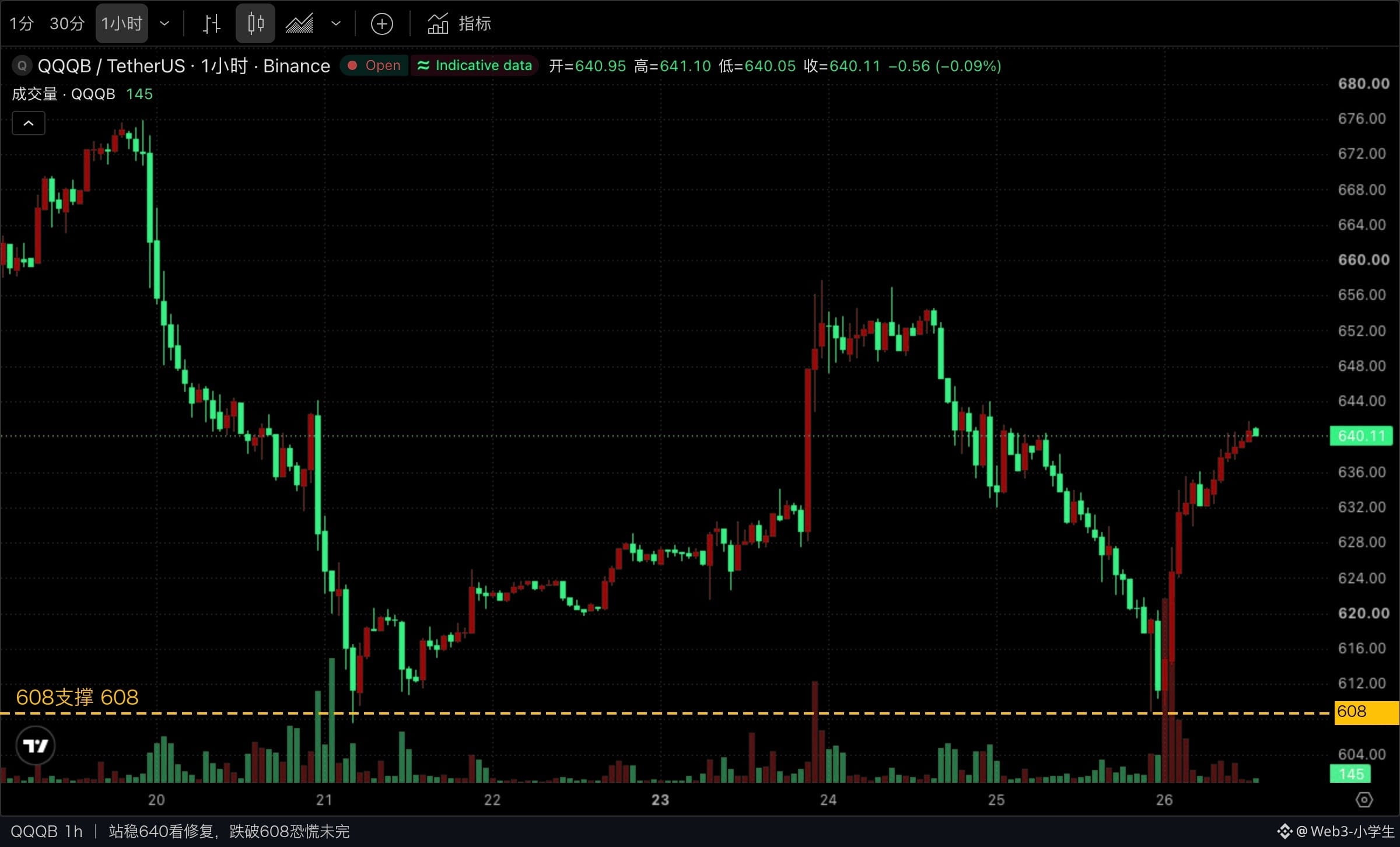
For anyone holding $QQQB , this shouldn’t be taken as a signal that the market has bottomed. $QQQB tracks the Nasdaq 100. It’s currently quoted at 640, up 1.76% over the past 24 hours.
The Nvidia option he’s watching corresponds to $NVDAB , now at 152—still some way from his target of $200.
The key level to watch is 608, the low from the past couple of days. A sustained hold above 640 would point to a recovery; a break below 608 would mean this wave of panic isn’t over. $TQQQB is the 3x leveraged long product. It’s up 5.32%, with volatility magnified threefold. Don’t treat it as a substitute for $QQQB .
On the day he closed out his positions, U.S. stocks were still in the red intraday. The December Fed meeting and the debt issued by those AI companies are what this cash is really waiting for. No one knows exactly where he’s putting that quarter of his portfolio in cash.