
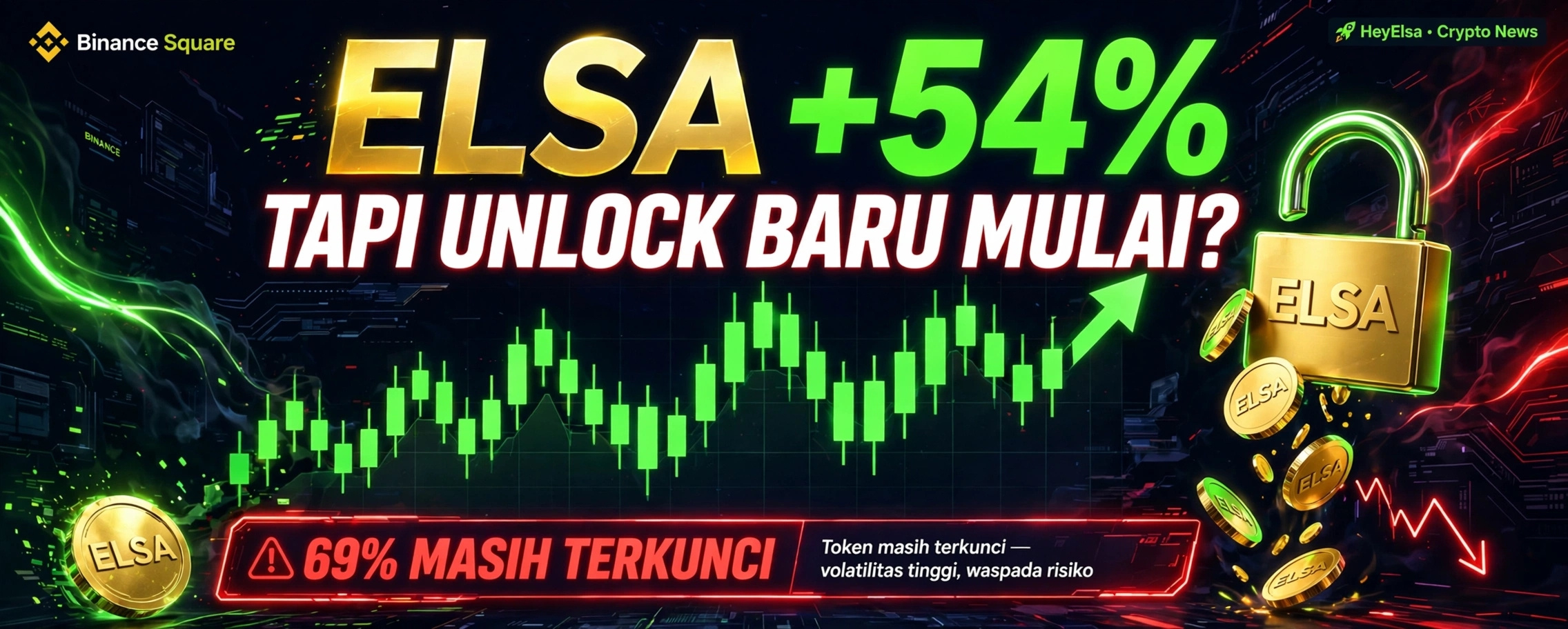

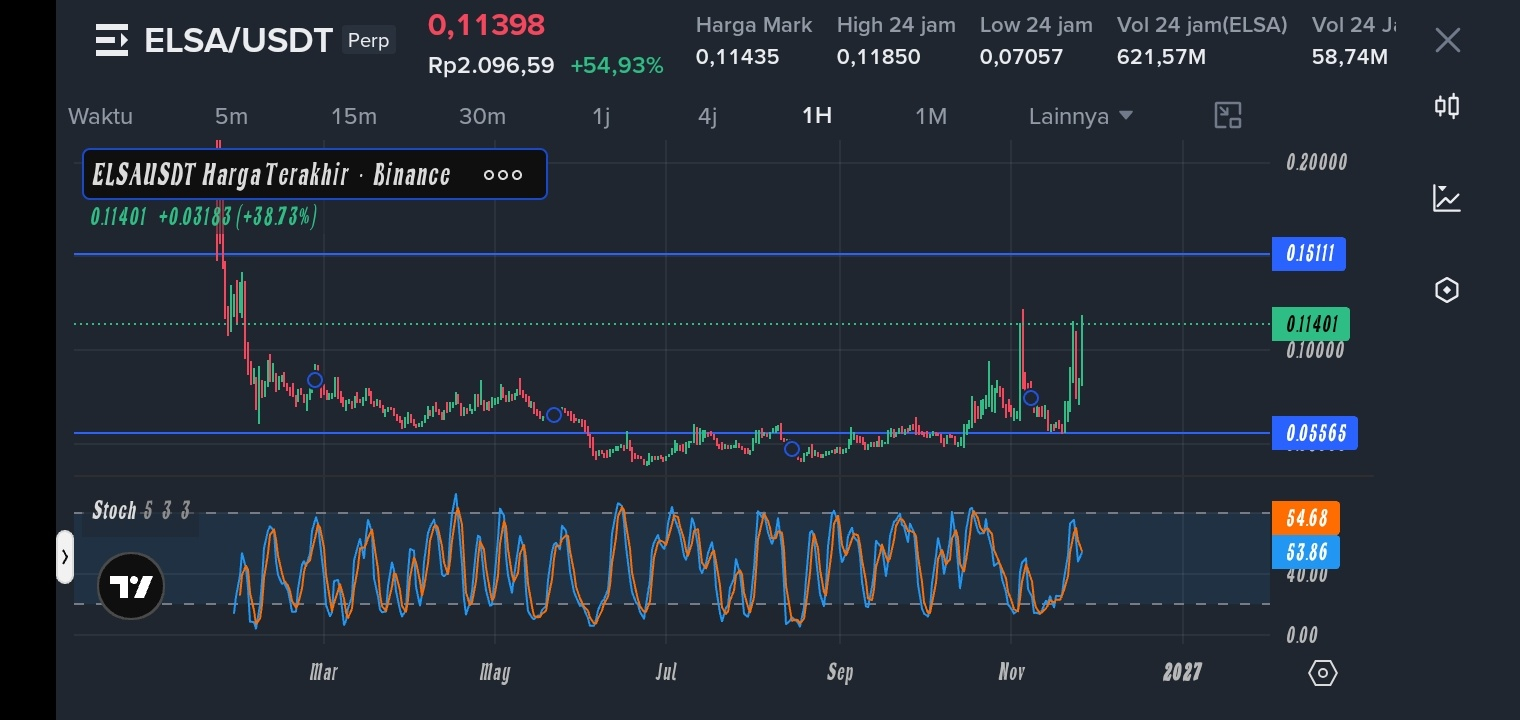
ELSA is one of the hottest tokens this week. In a chart screenshot making the rounds, ELSA / USDT briefly touched $0.11398, up +54.93% in 24 hours, with a high of $0.11850 and a low of $0.07057.
The volume is no joke either: 621.57 million ELSA, or around $58.74 million USDT, in 24 hours.
But if we only look at the green candles, we'll miss the more important story. This pump coincided with three things: a rotation in Korea, a newly opened Foundation unlock, and very thin liquidity.
Here’s the full breakdown using data, not just gut feelings.
1. Chart: Breakout After Months of Dormancy
Looking back from March through November, ELSA spent a very long time dormant in the $0.055–$0.07 range.
Up a little, then dumped again. Up a little, then dumped again. This pattern repeated for months.
Only this November did it finally break above the range. The latest candle shot straight from $0.07 to $0.11.
Structurally, this is a classic pattern: Long accumulation -> Breakout -> FOMO.
Chart levels to watch:
Resistance:
- $0.11401 — Current price. This was minor resistance in early November. If it closes above this level, the breakout is confirmed. If it fails, this could be a false breakout.
- $0.15111 — Major resistance above. This was the previous peak. It’s still around +32% from the current price.
Support:
- $0.08–$0.09 — This is the breakout zone and the most important support right now. If it breaks below this area, the pump is considered a failure.
- $0.05568 — This is the floor of the sideways range that lasted for months. If it returns here, it means this pump was just a pump and dump.
The Stochastic indicator on the chart is at 54.68 / 53.86, still in the middle. This means it isn’t technically overbought yet. But don’t be fooled. Stoch being in the middle after a +54% pump doesn’t mean it’s safe. It means momentum is still strong, but the price has already run far above its average. This is the kind of setup most vulnerable to a sudden retracement.
2. Why Is the Pump Coming from Korea?
This ELSA pump isn’t a broad-based global pump. It’s being led by Korea.
Data shows that on November 20, right at 17:00 KST, at the start of the Korean evening session, Korean order books immediately started bidding. In 15 hours, the price on Upbit rose from 76.9 won to 96.3 won, and both Upbit and Bithumb printed highs of 100 won.
What’s even crazier is the volume. Bithumb, which had usually traded only 500 million won per day for two weeks, suddenly posted 64.8 billion won (∼$45 million) in a single day—130x its baseline—with a volume of 689 million ELSA. That’s more than 2x its circulating supply.
Upbit added 31 billion won. Those two Korean exchanges alone saw around 95 billion won (∼$65 million) traded in a single day, about 3x ELSA’s market cap at the time.
On another day, ELSA also recorded Upbit turnover of around 265.8 billion won (∼$19.8 million) in 24 hours, even though its market cap was only $21.5 million. That means 1x its market cap was traded in a single day on just one exchange.
This is typical of a Korean pump: it rises quickly and often gets dumped just as quickly. It’s not about whether that’s good or bad, but about the highly momentum-driven nature of the flow.
The pump also coincided with a small-cap AI rotation in Korea. In the same session, tokens like Cyber and Kernel DAO also rose 16–20%. So ELSA wasn’t alone—it was leading Korea’s AI rotation at the time.
What’s the Narrative Catalyst?
On the product side, HeyElsa is indeed rebranding its narrative.
On November 13, they released the *Elsa Stack* thread: Infero for inference, x402 for machine-native payments, Aegis for payable APIs, Fixy for context, and CLI for developers.
On November 19, they released a walkthrough video showing an agent paying per API call on-chain. Its facilitator is live at http://facilitator.heyelsa.build, with pricing of $0.002–$0.05 per call, and settlement can be made in USDC or ELSA on Base.
The narrative has shifted from simply “an AI trading app with a token” to “a payment rail paid for by agents.” This narrative ties in with the hype around OpenClaw, a viral agent framework.
So, narratively, there’s a reason people are interested. But in terms of flow, it’s Korea—not the global narrative—that’s driving the price.
3. Unlocks: ELSA’s Biggest Challenge
This is the part people experiencing FOMO most often overlook.
ELSA Tokenomics:
- Total Supply: 1,000,000,000 ELSA (1 billion, fixed, cannot be increased)
- Already circulating: ∼306 million (30.7%)
- Still locked: ∼693 million (69.3%)
This means the price of $0.113 only accounts for 30% of the supply. If the entire supply were in circulation, its valuation would be its FDV, around $114 million, not $34 million. Its FDV is about 3.3x its market cap.
The distribution:
- Community (Airdrop & Incentive): 40% — 20% unlocks at TGE, with the remainder vesting linearly over 48 months
- Foundation / Elsa AI Ltd: 34.49% — 20% unlocks at TGE, followed by a 10-month cliff and then linear vesting over 24 months
- Private Investors: 10.5% — 12-month cliff, followed by linear vesting over 24 months
- Team: 7% — 12-month cliff, followed by linear vesting over 24 months
- Liquidity: 8% — 100% unlocks at TGE
The TGE was on January 20, 2026. Full vesting runs through January 20, 2030.
Unlock Timeline to Keep Track Of:
November 20, 2026 — JUST PASSED
The Foundation’s 10-month cliff ends. Starting on this date, the Foundation’s 34.49% allocation begins unlocking gradually each week / month.
Tokenomics data shows that November’s unlock rose to around 18.16 million tokens (6.1% of the market cap). Previously, in September and October, unlocks were only 2.4% per month.
So the +54% pump happened RIGHT AFTER the Foundation unlock began. Not before.
November 27, 2026 — THIS WEEK
A linear weekly drip of around 2.64 million tokens per week began on November 19. It’s a small amount, worth around $300K per week at the current price. It doesn’t have much impact on its own, but it keeps accumulating.
December 20, 2026 — NEXT UNLOCK
The next unlock: 17.7 million tokens, worth ∼$1.3 million (5.8% of the market cap).
January 20, 2027 — THE BIGGEST BOMB
The 12-month cliff for the Team + Investors ends. That means the Team (7%) + Private Investors (10.5%) = 17.5% of the total supply, which has been completely locked until now, starts unlocking and can be sold.
The January 2027 unlock is projected to rise to 7.6% of the market cap, the biggest so far.
ELSA’s unlocks aren’t a single event. They’re an ongoing supply pressure from now through 2030. The most sensitive point is January 2027, because those who have been waiting for a year have the strongest incentive to sell.
4. On-Chain: Many Holders, but Large Wallets Hold the Majority
This is ELSA’s paradox.
On one hand, it has a huge number of holders. Data shows 241,900 wallet addresses, ranking 5th among AI tokens. This is often used to brag.
But on the other hand, distribution is highly uneven.
On-chain data shows the top 10 wallets hold around 88%–94% of the supply, depending on the calculation method (whether vesting vaults are included or not). Most of the locked supply is in the Sablier Lockup NFT contract, a vesting vault visible on Basescan.
Outside that vault, around 8 unidentified wallets collectively hold 18.6% of the supply.
And most importantly: liquidity is extremely thin.
Liquidity in the main DEX pool on PancakeSwap is only around $546K–$654K, while its market cap is $25–$34 million. The liquidity-to-market-cap ratio is only around 2.18%.
That means selling just $1 million could send the price crashing. There’s nothing to cushion the fall.
Activity data also shows an unusual pattern. On one hand, there were 64,191 trades in 24 hours (31,373 buys, 32,818 sells)—almost balanced. On PancakeSwap, there were 56,363 buys versus 56,934 sells. This looks more like a two-way churn machine than accumulation.
There was even a signal from DexGrade, which briefly lowered ELSA’s score from 100 to 94 due to indications of likely fake volume on November 24. And CoinPaprika gave it a Trust Score of just 19/100, with a volume authenticity score of 21/100.
This doesn’t mean ELSA is a scam. Its contract is verified, there’s no mint function, no buy/sell tax, and no dangerous owner privileges. The project is real, backed by the Base Ecosystem Fund, and has raised $3 million from investors including M31 Capital and Coinbase Ventures.
But it does mean that the volume we’re seeing isn’t all organic demand. Some of it is rotation, arbitrage, and churn.
So, Is This Pump Sustainable?
Let’s sum up the 3 scenarios:
Bullish Scenario (Continued Rise):
ELSA could close above $0.114, then retest $0.085–$0.09 and hold. If that happens, the next target is $0.15. This requires Korean volume to keep bidding and the Foundation not to sell heavily.
Base Case Scenario (Sideways / Healthy Retracement):
ELSA gradually falls to $0.085–$0.09, consolidates there, then rises again. This is the healthiest scenario. A vertical pump rarely lasts without a retest.
Bearish Scenario (Failed Pump):
ELSA breaks below $0.08. If this happens, it means the breakout has failed, and it will most likely return to its old range of $0.055–$0.07. This could be made worse if the Foundation unlock starts being sold into a market with thin liquidity.
Conclusion for Those Considering an Entry
- If you already bought lower ($0.055–$0.07), now isn’t the time to FOMO in and add more. It’s time to consider taking profits gradually around $0.11–$0.12.
- If you don’t own any and are thinking of FOMO-buying at $0.113, the risk-reward is poor. A rise to $0.15 is +32%, but a drop to the $0.08 support is -29%. Almost 1:1. It’s not worth chasing a vertical green candle.
- The healthiest scenario is to wait for a retest at $0.085–$0.09 and see if it can hold.
And most importantly, don’t trade ELSA by looking only at the chart. Check the calendar.
December 20, 2026 and January 20, 2027 are two dates that will determine whether ELSA can hold up. That’s because new supply will enter the market on those dates, where liquidity is already thin.
ELSA has a real product, a strong x402 narrative, and a large community. But it also has a very challenging supply structure: 69% of the supply is still locked, the top 10 holders own the majority, and liquidity is thin.
A pump can come from Korea in a day. But unlocks will keep coming every month for the next 3 years.
Disclaimer: This article is for educational and informational purposes only, and is not an invitation to buy or sell crypto assets. Price and unlock data may change. Always DYOR and understand the risks before making a decision. Never invest money you can’t afford to lose.