$SKY : Quality Gates
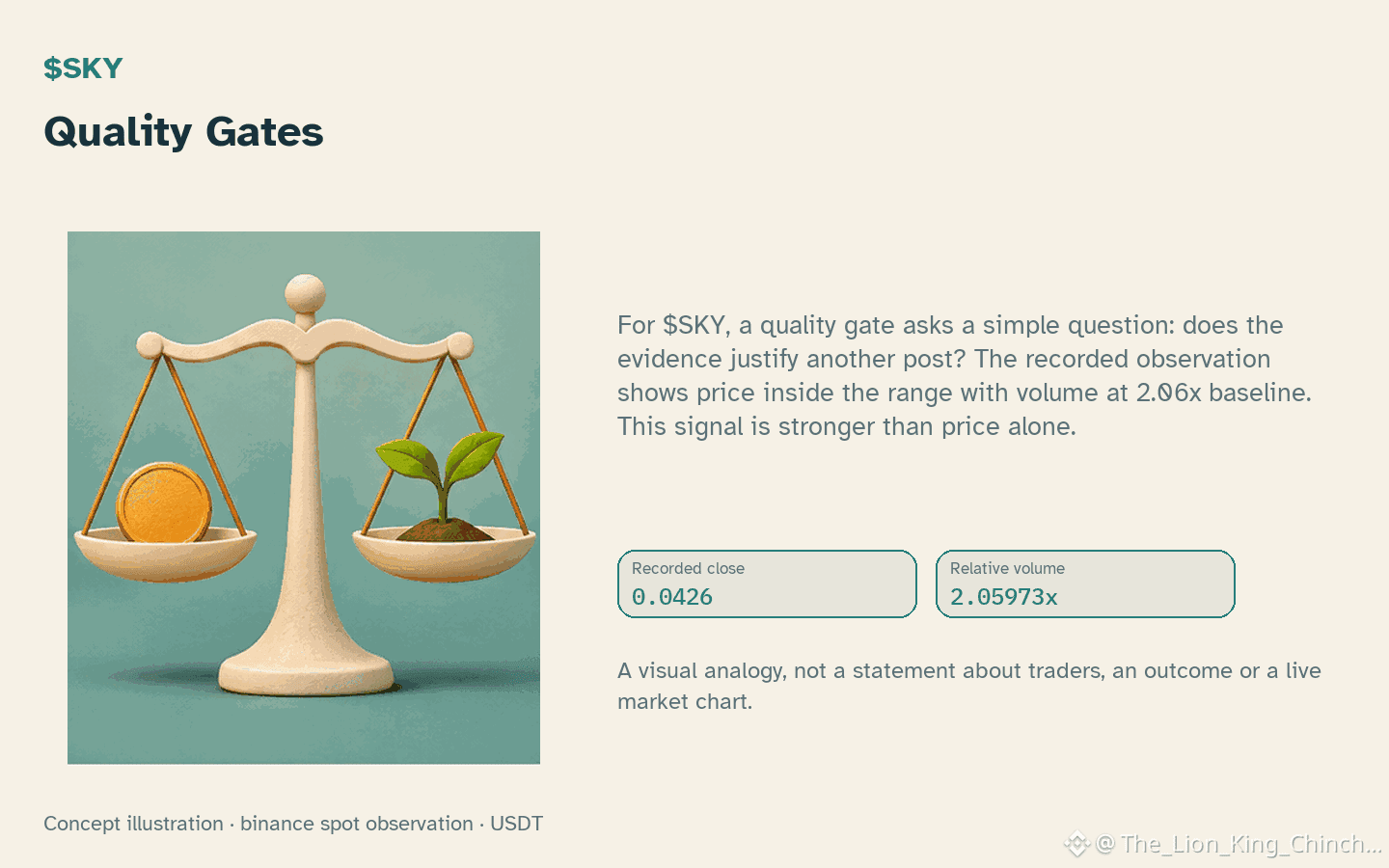
For $SKY , a quality gate asks a simple question: does the evidence justify another post? The recorded observation shows price inside the range with volume at 2.06x baseline. This signal is stronger than price alone.
A hypothetical mechanism tests this. If a trader posts only when relative volume crosses a threshold, the feed becomes a filter for attention. Spam volume dilutes trust; each low-effort update adds noise. A counterexample helps: a candle closes flat with standard volume. Quality gates withhold the post because the data lacks surprise. This preserves the credibility of future alerts.
Think to Earn incentives often reward frequency. Authors may post every hourly candle to maximize points. This creates a tension between earning rewards and serving readers. The reader cannot easily distinguish urgent evidence from algorithmic padding.
The limits are clear. RSI 53.6 describes momentum state, not intent. It does not guarantee a reversal or continuation. Incentive structures can produce behavior that looks like expertise but is merely output automation. We must separate public persuasion from private checking.
A specific reassessment condition: if the next closed candle shows volume dropping below baseline while price remains flat, the quality gate fails. The previous post lacked predictive value for the next bar. This self-check ensures that posting frequency aligns with actual signal quality.
Probabilistic market research, not a recommendation or guaranteed return.
The comparison to keep in mind: $BTC has hourly direction up and volume not above its baseline; $SSV has hourly direction up and volume above its baseline. This alone does not establish correlation.
#SKY #BTC