

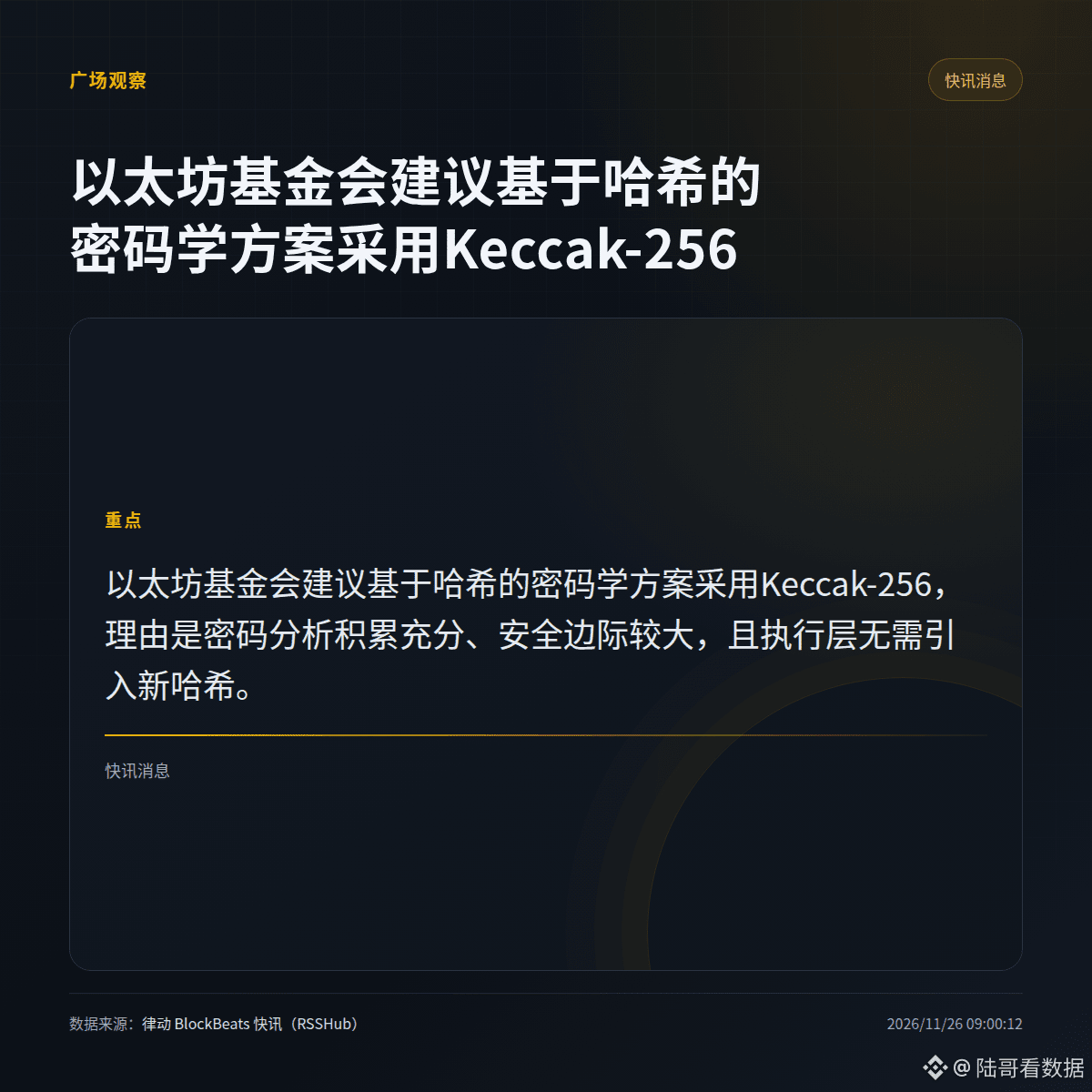
The Ethereum Foundation made a clear recommendation in its blog: use Keccak-256 for hash-based cryptographic schemes. The reasoning is practical: this function has nearly two decades of cryptanalysis behind it and a strong security margin, and it’s already used for addresses and execution-layer state. There’s no need to add a third general-purpose hash to the protocol alongside SHA2-256. People used to worry that conventional hashes were too expensive for zero-knowledge proofs, and thought post-quantum signatures might need proof-friendly hashes like Poseidon. But the Foundation says binary-field SNARKs and GKR-based proof systems are already fast enough, so proof performance is no longer the bottleneck; security is now the deciding factor. For now, keep an eye on the price range and trading volume, and don’t rush to conclusions until things are confirmed.
Join global crypto users on Binance Square
⚡️ Get latest and useful information about crypto.
💬 Trusted by the world’s largest crypto exchange.
👍 Discover real insights from verified creators.
Email / Phone number