
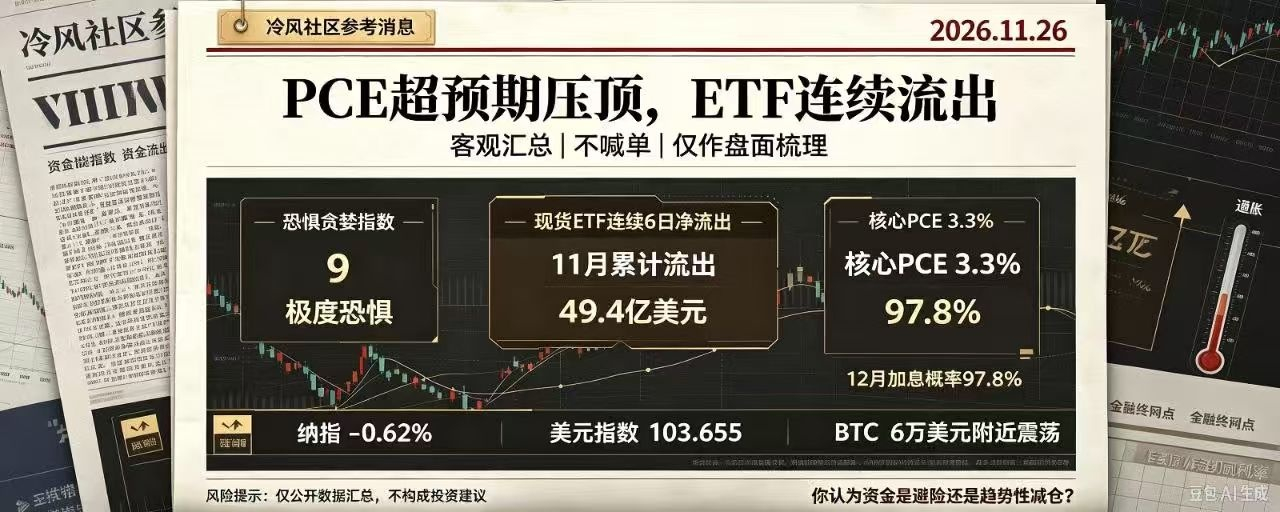

An objective summary of publicly available data for the day, with no trading calls or price predictions—solely a review of market conditions and risk alerts.
I. Market Sentiment: Fear & Greed Index at 9; extreme fear persists
As of the morning of November 26, the Crypto Fear & Greed Index stood at 9, in the “Extreme Fear” zone (also 9 yesterday and 12 last week; sentiment remains subdued).
Readings from multiple sources range from 9 to 25, but the overall conclusion is consistent: market risk appetite is extremely low, with capital largely staying on the sidelines or seeking safe havens. Rebounds are often accompanied by position reductions, and there is a clear lack of appetite for chasing highs.
II. BTC Spot ETFs: Net outflows for 6 consecutive trading days; November outflows hit a record
According to SoSoValue, on Tuesday, November 25 (U.S. Eastern Time), U.S.-listed spot Bitcoin ETFs saw net outflows of approximately $232 million, marking the sixth consecutive trading day of net outflows.
- Cumulative net outflows in November reached approximately $4.94 billion, exceeding the previous monthly record of $4.51 billion set in June. This is the closest monthly outflow to $5 billion since spot ETFs launched;
- Among the daily outflows, IBIT (BlackRock) was one of the main contributors; some smaller ETFs still recorded modest net inflows;
- Spot ETH ETFs also saw net outflows over the same period, with institutional funds broadly remaining cautious.
Note: Daily ETF figures are based on disclosures for that day. Quarterly 13F holdings and daily flows use different methodologies and cannot be used interchangeably.
III. Global Markets at the Close: U.S. Stocks Recovered After Opening Lower, but the Nasdaq Still Closed Down; the Dollar Edged Lower
U.S. stock market close on November 25:
Index Closing Performance
Dow Jones Industrial Average +0.33% (turned positive intraday)
S&P 500 -0.25%
Nasdaq Composite -0.62%
All three major indexes rose after opening lower, in a weak recovery following oversold conditions, while the rebound in tech stocks was limited.
The U.S. Dollar Index closed at 103.655 on November 25, down 0.09%. It edged lower from elevated levels but was still up about 1.88% for the month, remaining broadly strong.
IV. Key Macro Developments Today: Core PCE Came in Above Expectations, and the Probability of a December Rate Hike Is Nearly Fully Priced In
1. Inflation data: The U.S. core PCE price index rose 3.3% year over year in October, its highest level since November 2023. The market had expected a modest increase to 3.2%, so inflation proved stickier than anticipated.
2. Rate expectations: According to CME FedWatch, after the data was released:
- The probability of a 25-basis-point rate hike in December was 97.8%, while the probability of rates remaining unchanged was 2.2%;
- By January next year, the probability of a 25-basis-point rate hike was 40.7%, while the probability of a cumulative 50-basis-point hike was 58.4%.
A distinction is important here: these are probability estimates inferred by the market from the data; they do not mean the Federal Reserve has already decided to raise rates. The continuation of high interest rates weighs on the valuations of risk assets such as crypto, which do not generate interest.
V. Other Key Market Data
- BTC: Trading around $60,000, down approximately 3.75% so far this week. It tested support at the $60,000 level several times intraday, while rebound volume remained weak;
- Futures market: Liquidations over the previous 24 hours were mainly long positions. Funding rates were low, open interest was at a relatively low percentile compared with recent years, and overall long-side leverage was modest;
Sector performance: Major coins were broadly weak, altcoin volatility increased, and capital clustered in Bitcoin, with few assets showing independent strength;
Stablecoins: The cash pool had continued to contract, with redemptions still exceeding new issuance and limited fresh liquidity entering the market.
VI. Risk Management Notes for Today (Not investment advice)
1. Until macroeconomic pressures ease, markets are likely to continue bottoming out in a volatile range; a single up day does not signal a trend reversal;
2. ETFs are still seeing persistent outflows, and institutional buying has yet to stabilize. A one-day rebound should not be treated as a signal that the market has bottomed;
3. With expectations of high interest rates, prioritize managing position sizes and leverage, and avoid making large bets on a bottom during periods of extreme sentiment;
4. Altcoins carry higher risks than Bitcoin, and small-cap thematic coins are highly volatile, so extra caution is warranted.
VII. Key Signals to Watch Tomorrow
1. Whether ETFs can end their consecutive net outflows and return to steady net inflows;
2. The direction of U.S. Treasury yields and the U.S. Dollar Index, and their impact on liquidity for risk assets;
3. Upcoming remarks from Federal Reserve officials and changes in interest rate expectations;
4. How well BTC holds the $60,000 level, and whether any rebound is accompanied by higher trading volume.
\u003ct-128/\u003e \u003ct-130/\u003e \u003ct-132/\u003e \u003ct-134/\u003e #CryptoMacro #ColdWindCommunityReferences #BinanceSquare
ETFs have seen six consecutive days of outflows, with nearly $5 billion flowing out in November. Do you think this round of outflows reflects temporary risk aversion or a trend toward reducing exposure? Could inflows resume tomorrow? Share your thoughts in the comments.
\u003cc-141/\u003e
