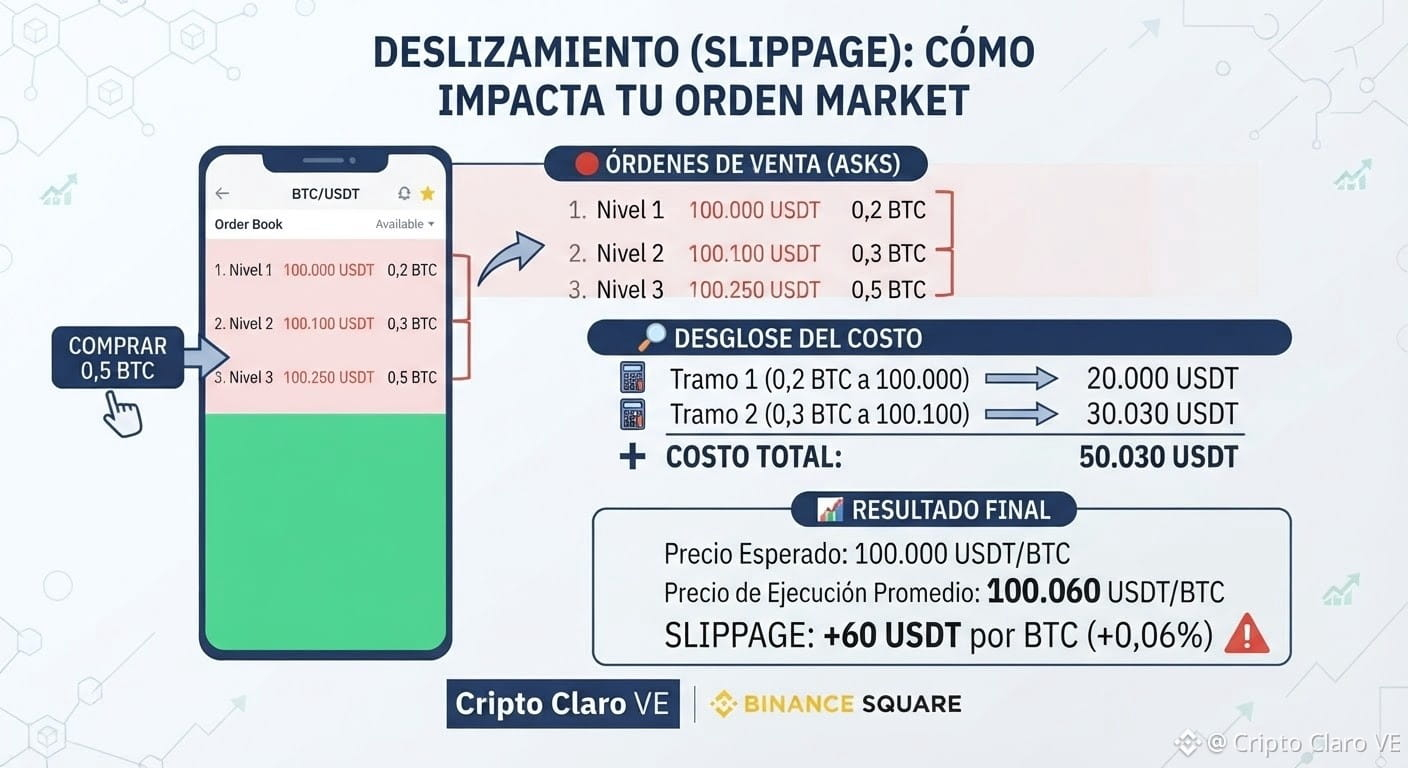
📉 Why is the average price at which an order is executed on Binance Spot sometimes different from the price you saw before buying?
This phenomenon is known as slippage: it occurs when the actual execution price differs from the expected price, usually because of the liquidity available in the order book relative to the order size, or due to rapid market movements.
📌 Practical example with BTC/USDT
Imagine you buy 0.5 BTC using a Market order, and the order book shows these sell orders (Asks):
🔴 Level 1: 100,000 USDT → 0.2 BTC available
🔴 Level 2: 100,100 USDT → 0.3 BTC available
🔴 Level 3: 100,250 USDT → 0.5 BTC available
Since there aren't 0.5 BTC at the first level, your order takes the next 0.3 BTC at 100,100 USDT:
Part 1: 0.2 BTC × 100,000 USDT = 20,000 USDT
Part 2: 0.3 BTC × 100,100 USDT = 30,030 USDT
Total cost: 20,000 + 30,030 = 50,030 USDT
Average price: 50,030 ÷ 0.5 = 100,060 USDT per BTC
💡 How much slippage was there?
From an initial best Ask of 100,000 USDT to an average of 100,060 USDT, the difference is 60 USDT per BTC (≈ 0.06%), which represents an additional 30 USDT compared with buying 0.5 BTC at 100,000 USDT (excluding fees).
⚠️ When is it usually more noticeable?
With Market orders that are large relative to the available depth.
In pairs with lower liquidity or wider spreads.
During major news events or periods of high volatility.
When orders in the order book change or are removed quickly.
🛠️ How can you manage it in practice?
1️⃣ Check the order book and depth before placing large orders.
2️⃣ Consider using Limit orders if you want to control the maximum purchase price or minimum sale price, keeping in mind that they may remain pending or be partially filled.
3️⃣ Consider splitting large trades into smaller portions, bearing in mind that this does not guarantee lower costs or eliminate the risk of price movements.
#CriptoClaroVE #BinanceSquare #Slippage #liquidez #BinanceSpot