

A lot of folks have been feeling lost lately: U.S. stocks can sometimes bounce back, but Bitcoin just can’t seem to get off the ground. Any little rally gets knocked right back down. Today, I’m putting together the latest major headlines to explain the underlying logic in plain English, what to keep an eye on, and what we should do.
First, let’s sum up a few key headlines:
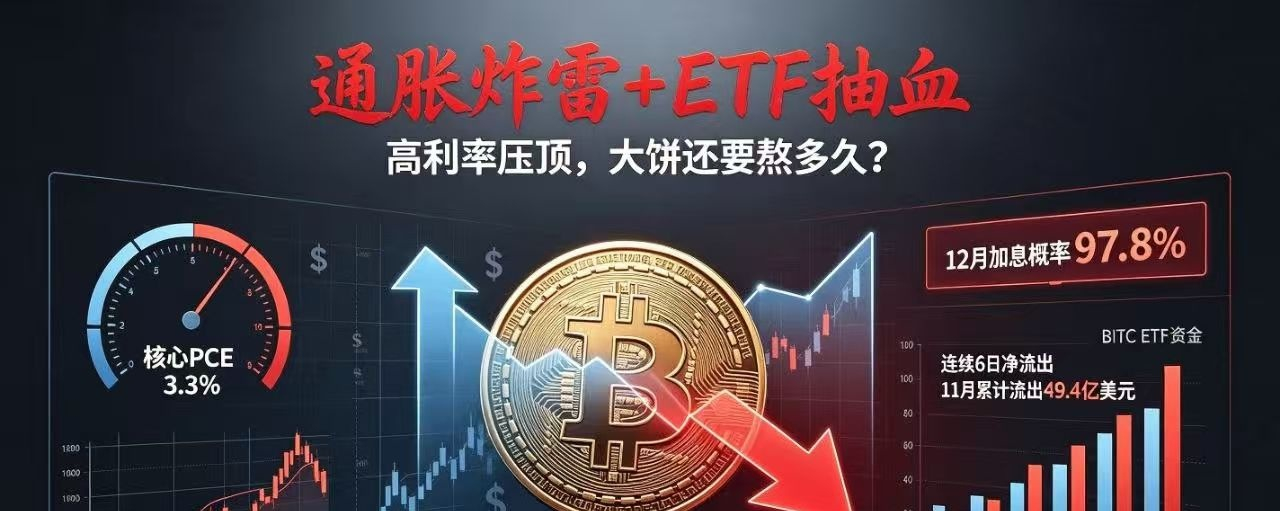
1. Core PCE data is out at 3.3%, higher than expected and the highest since November 2023. Inflation is proving stickier than expected;
2. CME FedWatch: The probability of a 25-basis-point rate hike in December has jumped to 97.8%—pretty much a done deal. There’s also a chance of another hike in January next year;
3. Spot Bitcoin ETFs have seen net outflows for 6 consecutive days, with $232 million flowing out in a single day. Cumulative outflows for November have reached $4.94 billion, breaking the June record. Monthly outflows since launch have nearly reached $5 billion;
4. U.S. stocks fluctuated and recovered after opening lower. The Dow turned positive, while the Nasdaq still closed down 0.62%. This is a weak rebound after being deeply oversold, not a trend reversal.
✅The underlying logic in a nutshell
Bitcoin itself generates no interest and is a classic high-risk asset. It fears two things most: persistently rising interest rates and institutions continuing to pull their money out.
If inflation doesn’t come down, the Fed won’t dare to cut rates and may even have to keep raising them.
You can earn high interest steadily by putting your money in U.S. Treasuries. Who would rather hold Bitcoin, which pays no interest and is highly volatile? That’s the opportunity cost.
Occasional rebounds in U.S. tech stocks are just short covering and an oversold recovery after a steep decline. They’re weak rebounds and can’t change the broader high-interest-rate environment.
Add to that continued large ETF redemptions, with institutional capital steadily flowing out. It’s as if the main buyers are continuously leaving the market.
With macroeconomic liquidity being drained on one side and major market participants fleeing on the other, the market is under pressure from both directions. That’s why rebounds are weak and lack staying power.
Simply put: we’re in a liquidity-tightening cycle, not an environment conducive to a major bull market.
📌What to expect from the market next
Short term: The market is likely to keep oscillating and forming a bottom. Most rebounds will be brief bursts with little staying power, and sharp wicks will become very frequent. Don’t assume a bull market is here just because you see one bullish candle.
Mid term: The pressure will only truly ease when one of two signals appears: either inflation data falls significantly and the market starts pricing in fewer rate hikes, or ETF outflows stop and turn into steady net inflows.
Until either of these signals appears, the overall trend will remain under pressure. Altcoins will fare worse than Bitcoin: they’ll lag during rallies and fall harder during declines.
⚠️Key distinction: a recovery in U.S. stocks ≠ a recovery in the crypto market.
A weak Nasdaq rebound can only lift sentiment temporarily. As long as ETF funds keep flowing out and rate-hike expectations remain high, Bitcoin is unlikely to make a sustained move upward.
👀3 key indicators for everyday investors to watch—no need to stare at charts all day
1. Inflation data and Fed comments: CPI and PCE. As long as inflation stays stubbornly high, rate-hike expectations won’t ease and the broader environment will remain bearish;
2. Daily ETF fund flows: These reflect institutions’ real stance. A sustained end to outflows and a shift to inflows would be a signal worth paying attention to;
3. U.S. Treasury yields and the U.S. dollar index: As long as yields remain high, it’ll be difficult for risk assets to make a major move.
🛡️A simple, practical plan for everyday investors
1. Stay away from high leverage! Volatility is extreme right now, and a single sharp wick can liquidate both long and short positions. Don’t gamble on a rebound or try to catch the bottom;
2. Don’t go all-in trying to guess the bottom. If you want to build a position gradually, split your purchases into several tranches and keep plenty of cash in reserve. Don’t use all your ammunition at once;
3. Lower your expectations for altcoins. Bitcoin is under pressure at this stage, and altcoins carry far more risk than opportunity. Avoid small-cap narrative coins as much as possible;
4. Don’t be fooled by a one-day rebound. Weak rebounds are common during a decline. Without support from fund flows, a rebound is most likely a bull trap;
5. Focus on protecting your principal. In a bear market, losing less and staying in the game matter more than catching a rebound.
⚠️Risk warning: This article provides an objective interpretation of publicly available market news and does not constitute investment advice. Crypto assets are highly volatile, and risks increase during rate-hike cycles. You are responsible for all profits and losses from your trades. Please participate rationally.
#BTC #比特币ETF #PCE通胀 #FedRateHikes #CryptoMacro #BinanceSquare
When do you think ETF outflows will finally stop? In this rebound, would you reduce your position or buy more on dips? Let’s discuss in the comments.