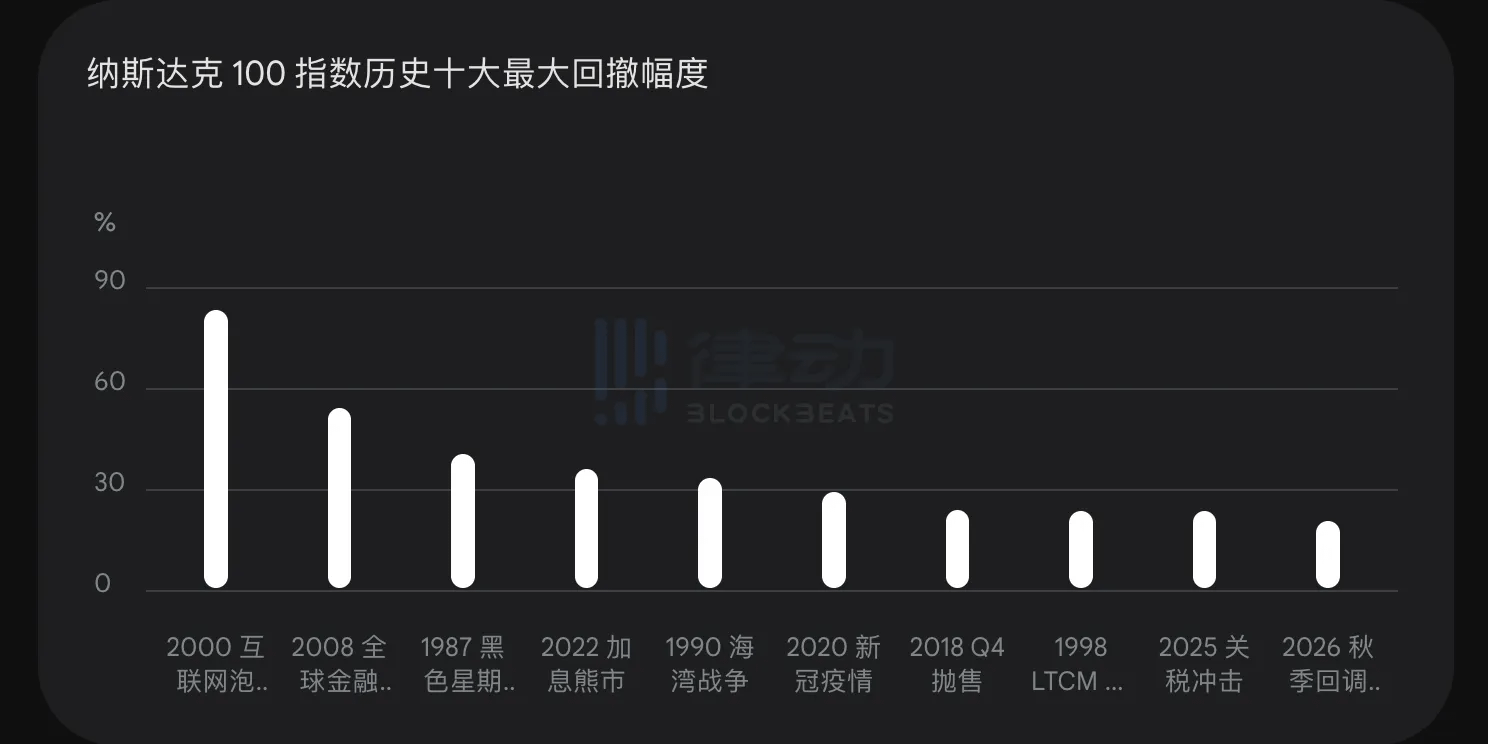
#纳指100本轮回撤幅度跻身历史十大跌幅榜
The Nasdaq-100 Index has continued to decline since reaching a record high on October 6, 2026. As of today, the Nasdaq-100's maximum intraday drawdown is approximately 20.53%, officially putting it in a technical bear market. Compared with historical data since the index was launched in 1985, this pullback is already roughly on par with the 1998 LTCM crisis (-23.0%), the late-2018 rate-hike sell-off (-23.2%), and the spring 2025 tariff shock (-22.9%). However, it still has a buffer of around 8 to 13 percentage points before reaching the levels seen during the early stages of the 2020 COVID-19 pandemic (-28.6%) and the 1990 Gulf War shock (-32.9%).
Historical patterns show that moderate corrections, in which the Nasdaq-100's drawdown remains within the 20%–30% range, typically bottom out within 1 to 4 months and recover their losses within the following 3 to 8 months. Once losses exceed 30% (as in the 1990 Gulf War, the 2022 rate-hike cycle, and the 2000 dot-com bubble), however, the index's recovery period often extends to a year or even several years.
$BTC