The agency that polices crypto money laundering just got hacked — and it still doesn't know what the intruders took.
The U.S. Treasury's FinCEN confirmed on Tuesday that hackers gained unauthorized access to a limited subset of its systems. It took several systems offline as a precaution and is now working with the FBI, CISA, and outside forensic examiners to determine the scope.
FinCEN collects the suspicious activity reports (SARs) that banks, brokers, and crypto exchanges file on suspect customers — about 4.8 million of them in fiscal 2025 alone. Officials say there is no evidence yet that the Bank Secrecy Act or beneficial-ownership databases were breached — but the investigation is ongoing, and that could change. Filing deadlines for affected institutions were extended to December 30, while the main BSA E-Filing site stays up.
The same day, an unclassified open-source intelligence system shared by the CIA, ODNI, and the National Geospatial-Intelligence Agency was also breached. Two federal intrusions in one day — and the watchdog that demands airtight reporting from crypto firms couldn't keep its own house secure.
The irony is hard to miss: this lands weeks after the $6.3B Binance hack, with enforcement already under strain. If SAR filings stall, the compliance net gets weaker — and if SAR data leaked, sensitive reports on exchange customers could be exposed.
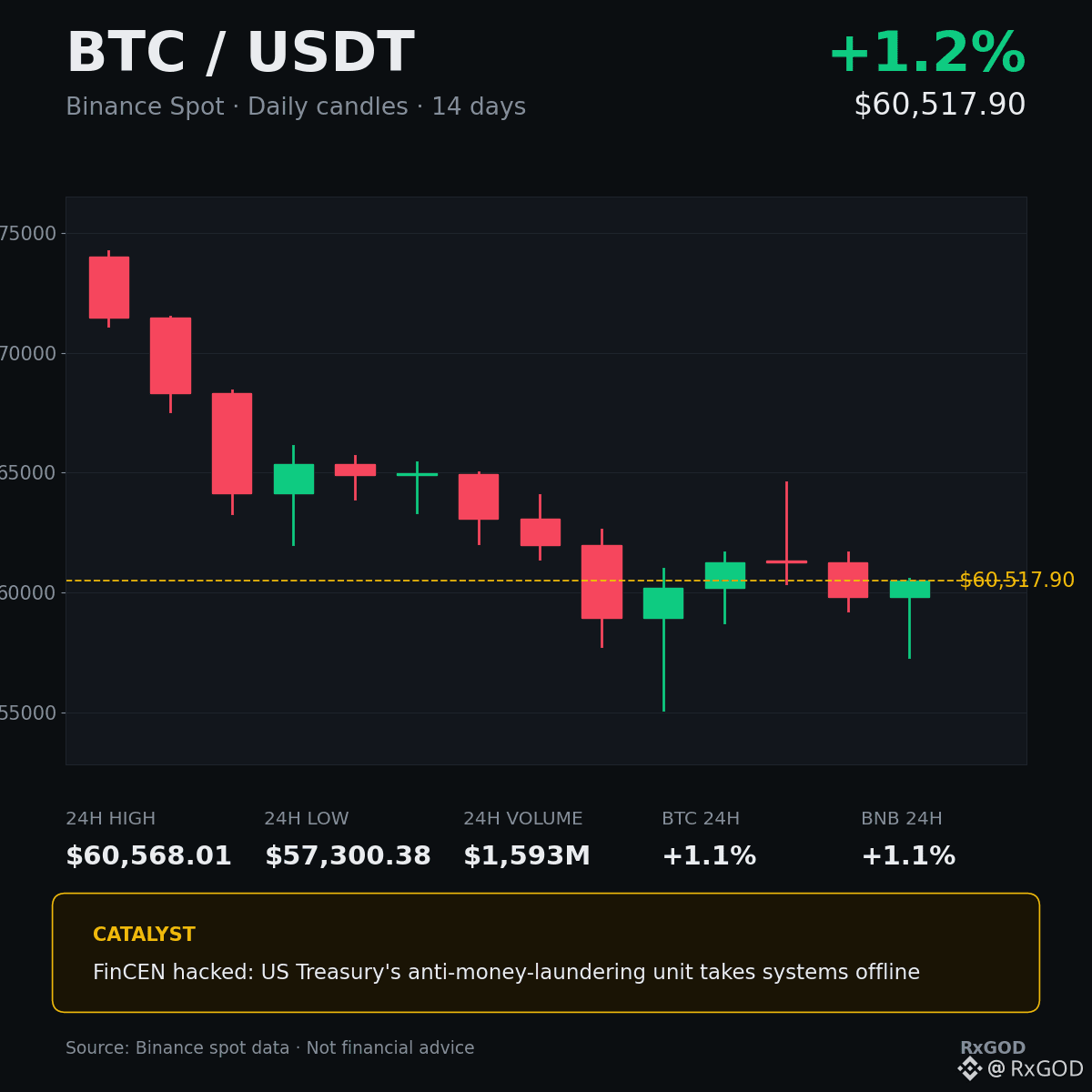
$BTC is holding its relief bounce at $60,552 (+1.21% in 24h), near the top of its daily range after dumping to $57,300 on the hot PCE print. But zoom out: still -15.3% over 14 days, just 28% up its 14-day range — a bounce inside a downtrend, not a reversal yet. Fear & Greed sits at 9, Extreme Fear.
Does a breach at the watchdog make you trust crypto regulation more or less — and should exchanges get reporting relief while FinCEN's own systems are down? What's the bigger risk: the data that may have leaked, or the enforcement gap while filings stall?
Not financial advice — DYOR.
#FinCEN #CryptoNews #ExtremeFear #Bitcoin