
GM, #学堂日报 Nov. 26 Market Brief ☀️
1️⃣ Market Overview
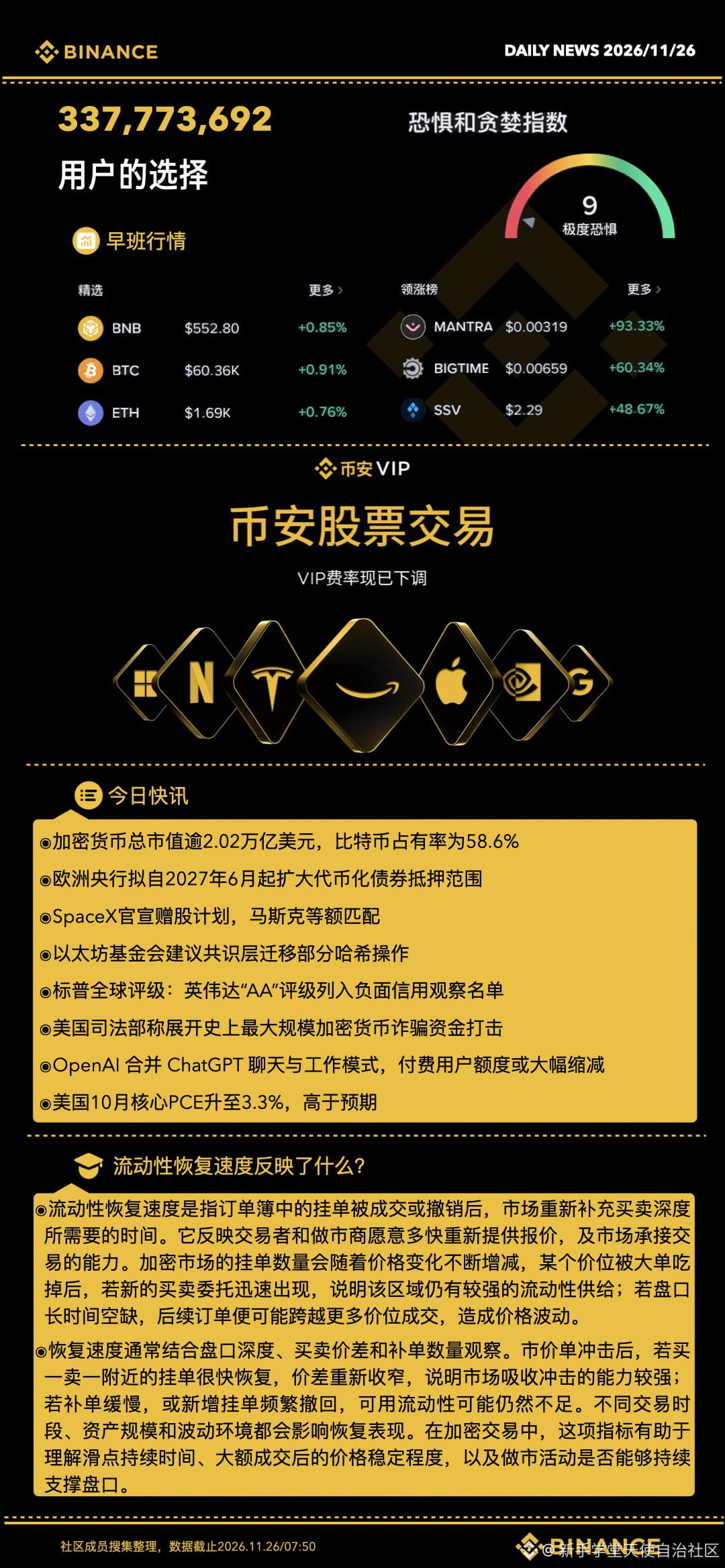
▪️ Total crypto market cap exceeds $2.02 trillion. Bitcoin dominance is 58.6%, and the Fear & Greed Index is 9, remaining in the extreme fear zone
▪️ BTC is up 0.91%, ETH is up 0.76%, and BNB is up 0.85%. MANTRA leads the gainers, up 93.33%
2️⃣ Binance Updates
▪️ Binance Stock Trading VIP fees have now been reduced. Please refer to the campaign rules for details
3️⃣ Industry Highlights
▪️ The European Central Bank plans to expand the range of tokenized bonds accepted as collateral starting in June 2027
▪️ SpaceX announces a stock-gifting plan, with Musk matching contributions dollar for dollar
▪️ The Ethereum Foundation proposes migrating some hash operations to the consensus layer
▪️ S&P Global Ratings: Nvidia’s “AA” rating placed on negative credit watch
▪️ The U.S. Department of Justice says it has launched the largest-ever crackdown on cryptocurrency fraud proceeds
▪️ OpenAI merges ChatGPT’s chat and work modes; usage limits for paid users may be significantly reduced
▪️ U.S. core PCE rose to 3.3% in October, above expectations
4️⃣ Today’s Explainer: What Does the Speed of Liquidity Recovery Tell Us?
💡 Liquidity recovery speed is how long it takes the market to replenish its bid and ask depth after limit orders are taken out by a large order or canceled
▪️ What it tells us: It reflects how willing traders and market makers are to re-quote quickly, and how well the market can absorb trades
▪️ How to assess it: If new buy and sell orders quickly appear after a large order sweeps a price level, liquidity there is holding up well. If the order book stays empty for a long time, subsequent orders may sweep across several price levels at once, increasing price volatility
▪️ What to look at together: If orders quickly replenish near the best bid and ask after a market order moves through, and the spread narrows again, the market is absorbing the impact well. If replenishment is slow or new limit orders are frequently canceled, the order book may look deep while the liquidity actually available is insufficient
Trading hours, asset size, and volatility conditions all affect recovery speed. Paying attention to this can help you better understand slippage, price stability after large trades, and market-making activity.
For discussion and educational purposes only; this is not investment advice. Follow @新手学堂天使自治社区 for more updates 🚀