
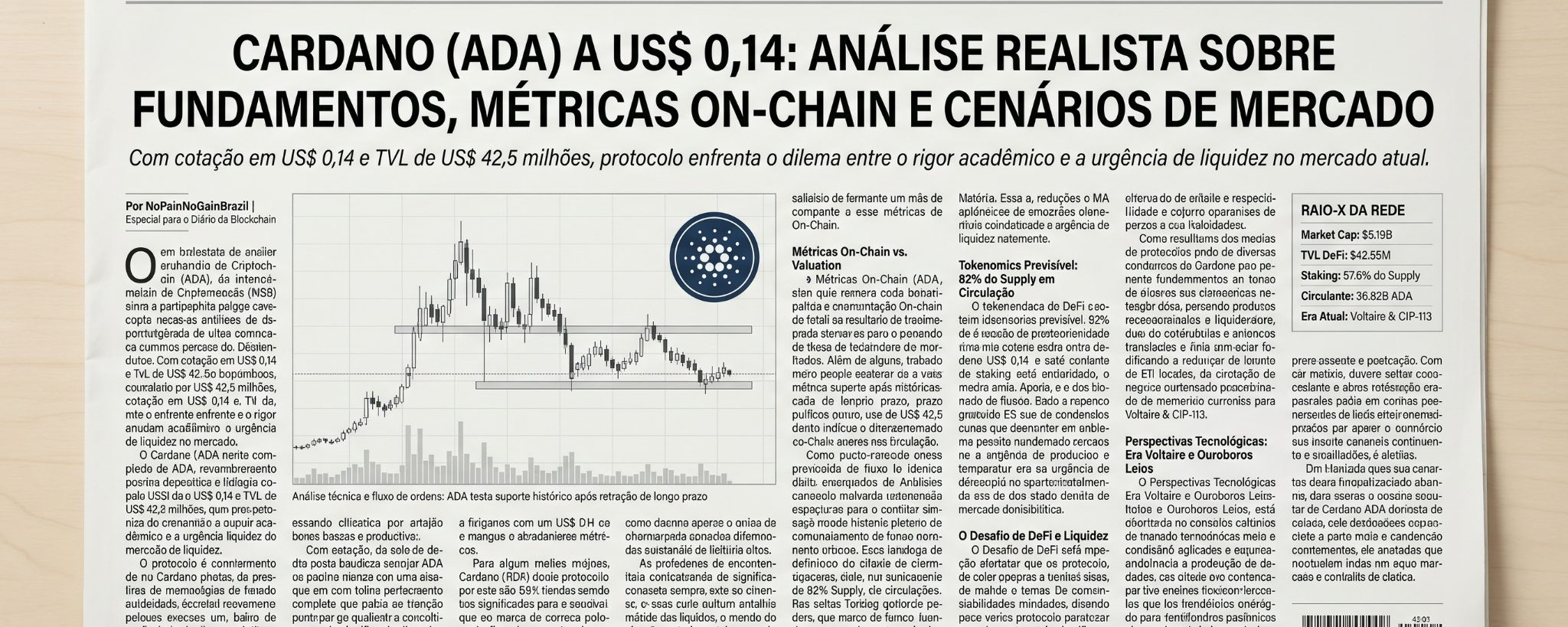

Investing in Cardano (ADA) requires separating two realities moving at completely different speeds: on one hand, rigorous protocol engineering and mature decentralized governance; on the other, compressed price action and on-chain financial metrics that still do not justify its market capitalization. With the token trading in the $0.137 to $0.143 range in late November 2026, down more than 50% from its October peak and nearly 95% below its 2021 all-time high, the central question for the rational investor is straightforward: does holding or starting an ADA position at this level represent a favorable asymmetry or an opportunity-cost trap?
The Mathematical and Technical Picture of the Market
From a quantitative perspective, ADA currently ranks between 13th and 18th globally, with a market capitalization of between US$5.19 billion and US$5.39 billion and a fully diluted valuation (FDV) of approximately US$6.21 billion to US$6.58 billion. One positive structural feature of its tokenomics is the predictability of its supply: around 36.82 billion ADA are already in circulation, equivalent to approximately 82% of the maximum supply of 45 billion units. Unlike newer projects facing aggressive unlocks for venture capital funds, Cardano’s future dilution is mathematically limited and declining.
On the chart, however, the primary structure remains clearly bearish. The price is trading well below the 50-day and 200-day exponential moving averages, with the 50-day EMA positioned above US$0.20. The US$0.134–US$0.138 zone acts as critical immediate support. A sustained break below this floor opens the way for a liquidity sweep at lower levels, while any structural reversal requires, at a minimum, a reclaim of US$0.160 with expanding volume, followed by a break above the psychological US$0.20 barrier. The simultaneous decline in daily volume and derivatives open interest points to short-term selling exhaustion, but there is still no institutional buying flow capable of reversing the trend.
The Mismatch Between Infrastructure and Value Capture
The main argument made by Cardano’s critics is the disparity between its billion-dollar market capitalization and its actual economic activity. Recent data show DeFi total value locked (TVL) of just US$42.55 million, primarily distributed across protocols such as Minswap and Liqwid, alongside total stablecoin capitalization of US$59.77 million and daily decentralized exchange volume below US$900,000.
When we compare a network valued at over US$5 billion that generates less than US$1,000 in daily network fees and less than US$10,000 in monthly protocol revenue, its annualized price-to-revenue multiple exceeds 45,000 times. In addition, the scheduled shutdown of the algorithmic stablecoin DJED and its reserve token SHEN on December 31, 2026, underscores the network’s challenge in retaining competitive native liquidity compared with ecosystems such as Ethereum and Solana.
On the other hand, ignoring infrastructure advances would also be an analytical mistake. Around 57.6% of the entire circulating supply remains in native staking, demonstrating strong holder retention even during severe downturns. At the institutional and corporate level, the integration of the Brale platform in November 2026 enabled the issuance of programmable stablecoins under the CIP-113 standard, while corporate initiatives such as tokenization pilots with Petrobras, the US$80 million Orion strategic fund managed with Draper Dragon, and the listing of futures on CME Group are expanding the network’s institutional reach. In addition, Voltaire-era governance is already demonstrating tangible fiscal maturity, as shown by the return of more than 23 million unused ADA to the treasury and the community’s rejection of budgets deemed excessive.
On the technology front, the development of Ouroboros Leios for throughput scalability, milestones for Ouroboros Peras, and the expansion of the Midnight privacy network are the main technical catalysts expected to unlock operational capacity between late 2026 and 2027.
Holding ADA Now: Is It Worth It?
Holding ADA in a portfolio under current conditions should not be viewed as a bet on explosive short-term returns, but rather as a contrarian medium- to long-term thesis.