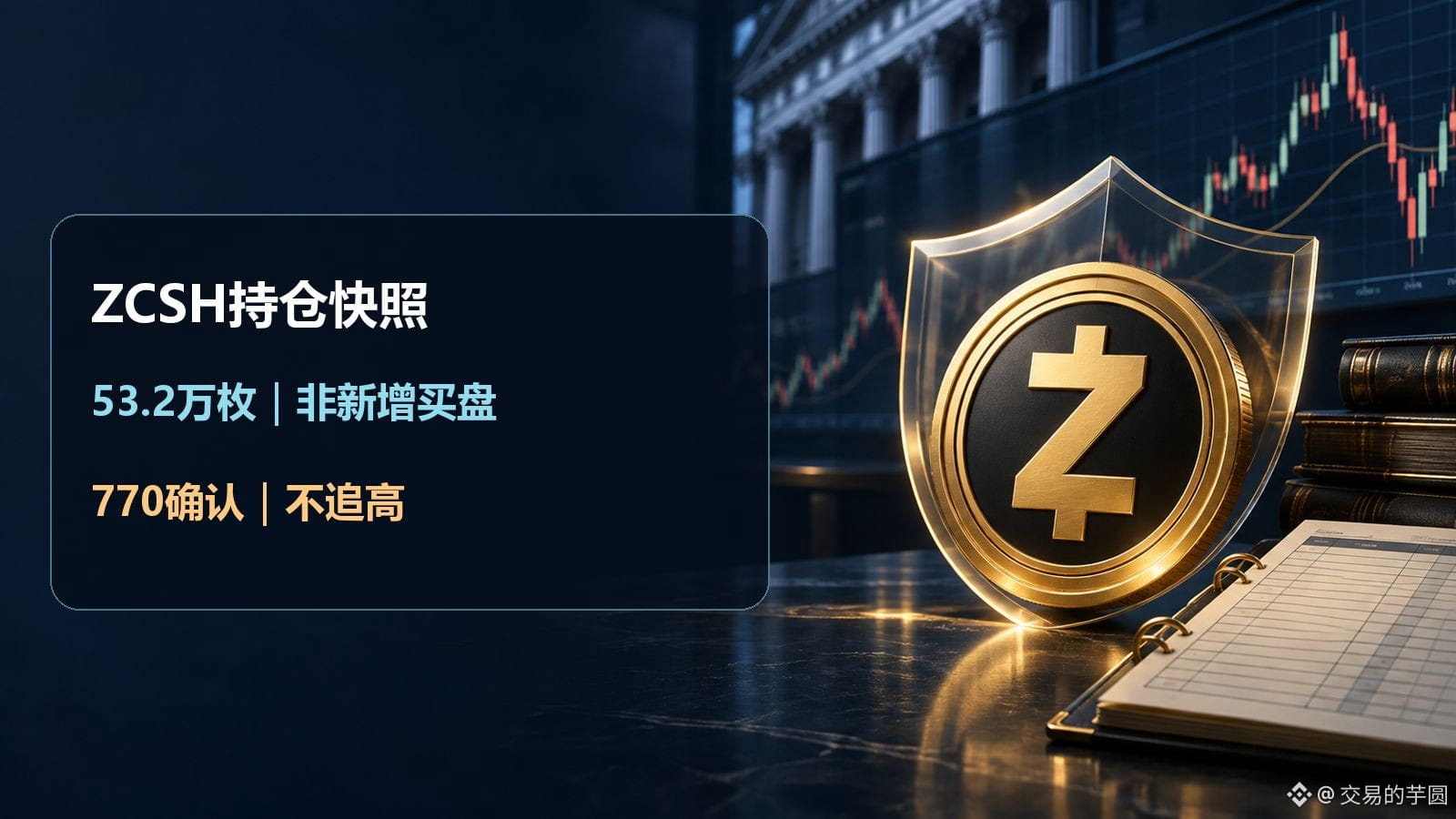
Grayscale discloses ZCSH holdings snapshot | ZEC rebound doesn’t mean new inflows | I’m waiting for range confirmation
My stance is to observe and not chase the rally for now. As of November 24, Grayscale’s official page for its Zcash spot fund, ZCSH, showed that the fund held approximately 532,453 ZEC, with assets under management of about $387.6 million on a non-GAAP basis, and approximately 0.026559 ZEC per share. This is a holdings and asset snapshot for a particular date. It does not mean that the fund just added this many tokens on November 25, nor should changes in assets under management caused by price movements be mistaken for an equivalent amount of inflows. Farside’s ZCSH flow table showed net inflows of approximately $4.6 million on November 23 and zero on the 24th; the corresponding product column for the 25th still showed a dash. The zero in the automatic total column cannot be used to prove that net inflows for that day had already settled at zero. The two pages use different methodologies and update at different times, so they must be read separately.
Why does this data matter for ZEC? ZCSH actually holds ZEC, and if share creations or redemptions occur, they could affect spot supply and demand through the creation and redemption mechanism. However, a rise in the fund’s price on a given day can also increase its assets under management, so new buying cannot be inferred from the fund’s size alone. Grayscale also has a leveraged ZEC fund, ZECX, which seeks to deliver twice the daily performance of ZCSH and primarily uses derivatives. ZECX trading volume should not be treated as equivalent to spot ZEC being bought. For conservative traders, it is more useful to track whether subsequent finalized net flows, share count, and actual token holdings all change together, rather than seize on one big number to claim that “institutions are scooping up coins.”
As of 05:22 Beijing time on November 26, ZEC/USD on Kraken was around $760, with a 24-hour open near $739, a low of $673, and a high of $766. The price has rebounded substantially from its low and is already near the top of the range. This indicates significant market volatility, but does not prove that the rise was driven by Grayscale’s latest holdings snapshot. The $766–$770 area is the current resistance zone, while $760 is the level to watch for a retest after a breakout. If the price falls back below $739, the quality of the short-term rebound will weaken; a break below $735 would invalidate my bullish watch. ZEC appearing in Square’s Most Searched list shows that interest remains elevated, but attention itself is not new capital.
If I were trading this myself, I would stay out for now and only consider a leveraged-free spot long, with an allocation of no more than 0.5% of my total capital. The entry trigger would be a four-hour close above $770, followed by a successful retest of $760–$770, while BTC avoids a simultaneous sharp drop. Otherwise, I would remain flat. If triggered, I would first take half off near $790, with a target of $815 for the rest; I would set a stop-loss below $735. I would also close the position proactively if a retest fails to hold $760, or if the next fund holdings or flow data show a clear deterioration. If the price shoots straight past the target without a retest, I’d rather miss the move. A plan whose trigger has not been met is not a trade, and I won’t use reports that have yet to be updated to reassure myself.
Sources: Grayscale’s official ZCSH fund page, Farside’s Zcash flow table, Kraken’s publicly available market data, and trending searches on Binance Square. #ZEC
The above is solely my personal market observation and does not constitute investment advice.