


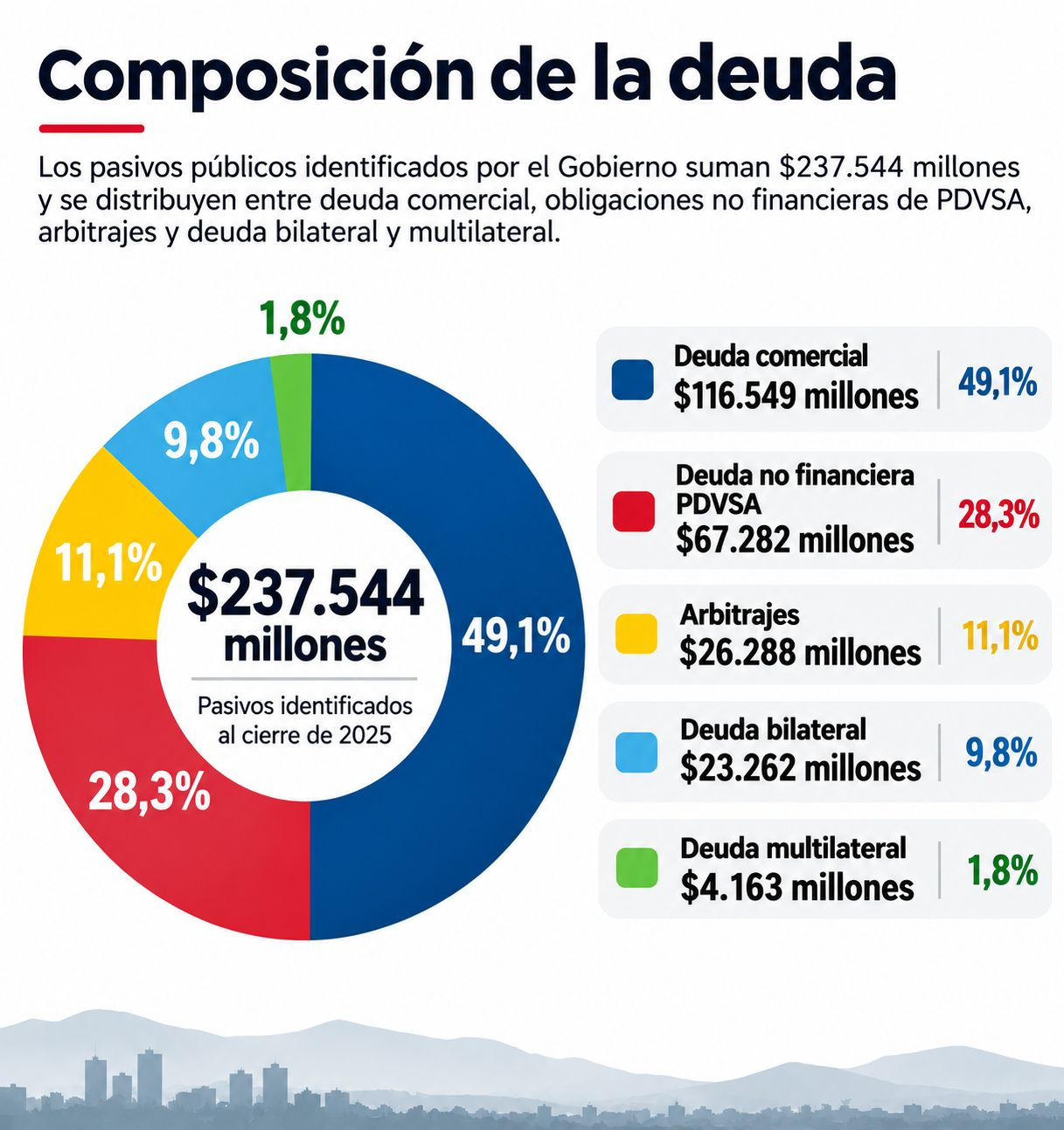
Venezuela’s caretaker government published the document “Venezuela Rises Again. National Program for Recovery and Prosperity” on November 24, presenting a detailed overview of public-sector liabilities as of the end of 2025. The identified figure totals $237.544 billion, equivalent to about 242% of Venezuela’s GDP that year.
The figure helps put the scale of the country’s financial problem into perspective after years of defaults, loss of access to international markets, and the accumulation of obligations. But an important qualification accompanies the figure in the official document itself. The government states that the figure refers to identified liabilities and expressly clarifies that its publication does not imply recognition of the amount, basis, validity, or legal enforceability of all the obligations included.
This means that, for now, the $237.544 billion should be understood as an inventory of obligations identified by the State, and not necessarily as a debt that can be collected in full on the terms under which it appears in the accounts. The documentation itself keeps the Central Government, PDVSA, and other public entities legally separate, even when some of their obligations are consolidated for fiscal analysis.
Debt concentrated in commercial obligations and PDVSA
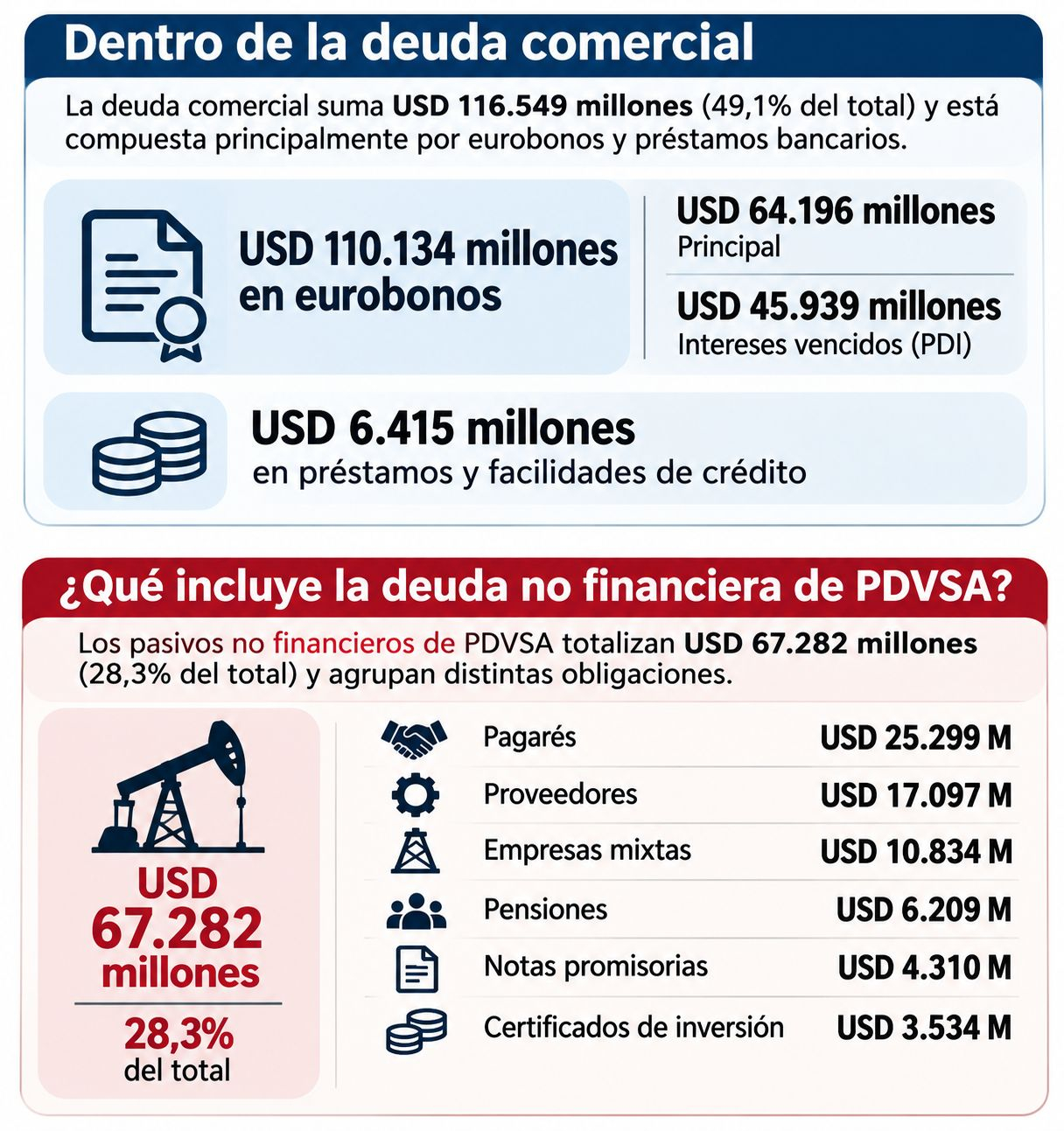
Almost half of the identified liabilities correspond to commercial debt, which stood at $116.549 billion at the end of 2025, equivalent to 49.1% of the total.
Eurobonds stand out within this category, at $110.134 billion. Of that amount, $64.196 billion is principal and another $45.939 billion is overdue interest, identified in the document as PDI, for past due interest. In other words, a considerable part of the figure is not just the originally issued principal, but also interest that accumulated after the default.
The second-largest component is PDVSA’s non-financial liabilities, which totaled $67.282 billion, equivalent to 28.3% of the total. These include $17.097 billion in obligations to suppliers, $10.834 billion in debt owed by joint ventures, $25.299 billion in promissory notes, $3.534 billion in investment certificates, and $6.209 billion in pension-related obligations.
The remainder consists of $26.288 billion in obligations arising from arbitration rulings, $23.262 billion in bilateral debt, and $4.163 billion in multilateral debt. The latter mainly includes obligations to the IDB totaling $2.735 billion and to CAF totaling $1.423 billion.
Some of Venezuela’s main state lenders are among its bilateral creditors. The document identifies $16.866 billion owed to the China Development Bank, equivalent to 7.1% of total identified liabilities, while another $5.080 billion is owed to Russia’s Vnesheconombank, equivalent to 2.1%. This is in addition to $1.128 billion owed to Brazil’s BNDES and another $187 million classified as bilateral debt.
The breakdown also shows where the problem is concentrated. The document attributes $116.279 billion to PDVSA, $103.322 billion to the Central Government, $16.866 billion to BANDES, and $1.077 billion to ELECAR, although some obligations involve components within the public sector, and the report itself provides clarifications on their accounting treatment.
On overdue interest
Within the overall structure, the $45.939 billion in overdue interest associated with eurobonds is particularly significant. It represents 19.3% of all liabilities identified by the Government and shows how a financial obligation can grow substantially when a country remains without normal access to financing for years and accumulates arrears.
The document dates Venezuela’s default to 2017 and notes that arrears, unpaid interest, and penalties have continued to accumulate since then. It also links the situation to falling hydrocarbon revenues, macroeconomic imbalances, and international financial restrictions.
A distinction is worth making here. The government report presents financial sanctions as one of the factors that limited Venezuela’s ability to refinance its obligations and process external payments, especially after 2017. This helps explain the subsequent accumulation of arrears, but it does not automatically make sanctions the origin of all the debt that appears on the balance sheet today.
How much does the debt represent for Venezuela?
Comparing the debt with the size of the economy helps put the scale of the problem into perspective. The document itself estimates nominal GDP at $98.100 billion for 2025, meaning the $237.544 billion in identified liabilities is equivalent to approximately 2.42 times the size of the Venezuelan economy.
Another way to visualize it is to divide the amount by Venezuela’s population. Using a population of around 28.5 million, the mathematical result would be approximately $8,300 per person.
The figure now opens the door to a more complex discussion
The government’s publication provides something that has been difficult to obtain in Venezuela for years: an official and relatively detailed snapshot of the structure of public obligations. But it also leaves open a second stage that may be even more complex: reconciling and legally determining each liability.
Not all obligations are of the same nature or documented to the same extent. Eurobonds, for example, are backed by identifiable contracts and issuances, while other components include commercial claims, obligations to suppliers, joint ventures, and arbitration proceedings whose legal and financial status may require specific reviews.
That is why the $237.544 billion figure matters not only because of its size, but because it establishes a starting point for a possible normalization of Venezuelan debt. The Government itself acknowledges that the scale, diversity, and legal complexity of these obligations call for a comprehensive approach.
The real challenge will be what to do with those $237.544 billion
The document states that restoring debt sustainability will require a credible macroeconomic stabilization program, stronger institutions, and greater transparency regarding public obligations. It also identifies the normalization of relations with external creditors and the restoration of ties with international financial institutions as priorities.
In other words, publishing the figure is only the first step. The next challenge will be to determine what portion of these liabilities can be recognized, reconciled, and eventually restructured, under what conditions, and with what actual capacity to pay.