
This is a major change. If you plan to participate, be sure to read this carefully. I’ll do my best to make it detailed and easy to understand.
Contents: Changes in the revamp / Estimated annualized returns / FAQs / Ultimate strategy / Summary
Airdrop event period: 26/11/27 8:00 ~ 26/12/25 7:59
1. Main changes in the revamp 🆚
Before: Put funds in Flexible Earn and subscribe directly. Differences in annualized returns mainly came from VIP levels, and there was a per-user limit.
Now: You can put funds in Earn, a Unified Account, Spot, and more. Differences in annualized returns mainly come from “New Positions” and “Trading Boosts,” with no per-user limit.
——————————————
II. Estimated APY (bonus tasks) 💰
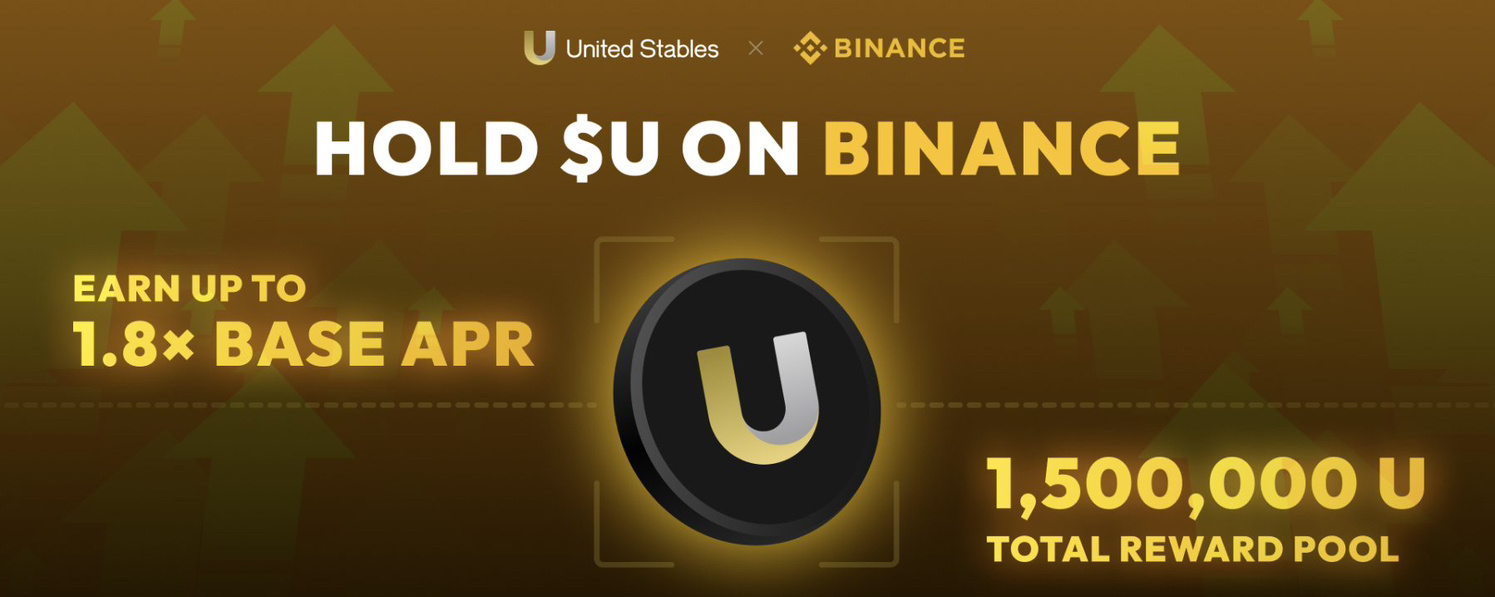
Total reward pool: 1.5 million U (airdropped once a week)
Note: The APYs below are estimates based on projected figures from the announcement. Actual APYs will decrease as more funds participate, so be sure to DYOR!
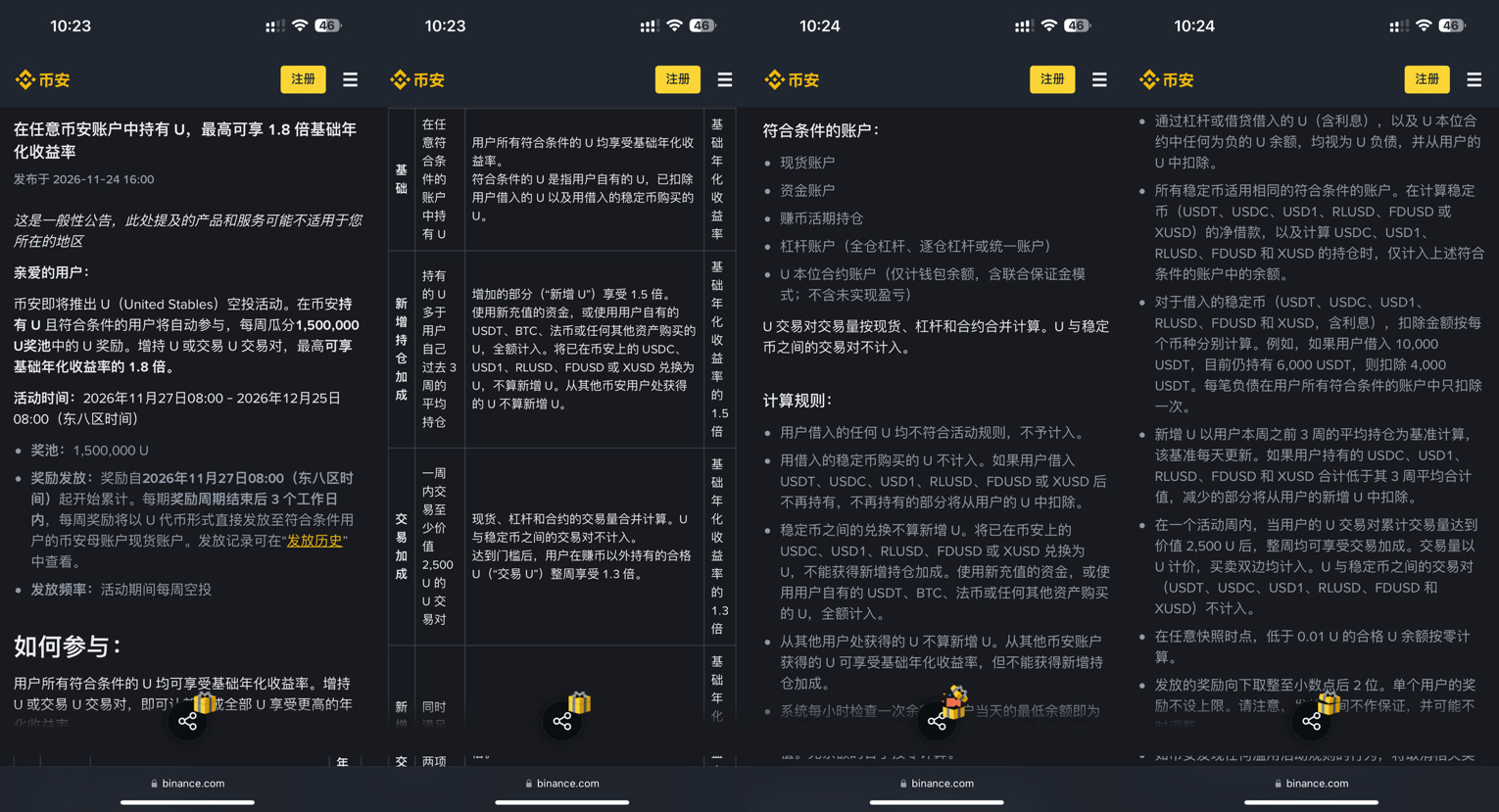
1⃣️ 1.0x base: 5%
Any eligible account holding “your own U” qualifies
2⃣️ 1.5x new funds: 7.5%
If your current U holdings are higher than your average U holdings over the past 3 weeks, the “new U” portion qualifies
3⃣️ 1.3x trading: 6.5%
If you trade ≥ 2,500 U in non-stablecoin/U pairs in a given week (Friday 8:00 to the following Friday 7:59), U held outside Flexible Savings qualifies
4⃣️ 1.8x new funds + trading: 9%
Applies to the portion of U that qualifies for both the new-funds and trading bonuses
5⃣️ Flexible Savings exclusive: around 6%
This adds around 1% in dynamic Earn returns to the 5% base airdrop. However, if you keep your U in Flexible Savings, you won’t qualify for the 1.3x trading bonus (around 1.5%)
——————————————
III. Frequently asked questions / things to note 🤔️
1⃣️ What does “your own U” mean?
Your own U = U in your account − borrowed U − U bought using borrowed stablecoins − deductions for borrowed stablecoins that have been spent
Both “new holdings” and the “trading bonus” require you to first qualify based on “your own U” before you can receive any additional rewards
For example: you have 1,000 U of your own
You borrow 5,000 USDT and buy 5,000 U with it → your account balance reaches 6,000 U → the 5,000 U doesn’t count as your own (even if you haven’t transferred it out) → 1,000 U qualifies for the airdrop
You borrow 5,000 USDT, then sell it for BTC or transfer it out of Binance → 5,000 U is deducted → 0 U qualifies for the airdrop
2⃣️ What does “new U” mean?
New U = max(0, this week’s qualifying weekly balance (the average of the 7 daily minimum balances) − the average holdings baseline for the past 3 weeks) − the reduction in the combined balance of other stablecoins (USDC, USD1, RLUSD, FDUSD, XUSD) below their average over the past 3 weeks
Simply put, only U bought with “existing USDT/non-stablecoins” + “net deposits of other stablecoins” counts
✅ U bought with existing USDT or non-stablecoins counts toward “new U”
✅ U deposited from an external wallet or exchange counts toward “new U”
❎ Buying U with other stablecoins already held (USDC, USD1, RLUSD, FDUSD, XUSD) does not count toward “new U”
⚠️ For example, converting existing USDC to USDT and then to U does not count toward “new U”
⚠️ Withdrawing or selling other stablecoins you already held—even if you don’t use them to buy U—reduces your “new U” if your balance falls below its average over the past 3 weeks
❎ U transferred to you by another Binance user does not count toward “new U”
✅ RWUSD is not considered another stablecoin, so converting RWUSD to USDT and then to U qualifies as “new U”
3⃣️ What does “≥ 2,500 U in non-stablecoin/U trading volume” mean?
Stablecoin/U trading pairs don’t count. For example, USDT/U doesn’t count
Spot, margin, and futures trading pairs for non-stablecoin/U all count, and both buys and sells are included. I’d choose a BTC/U or ETH/U futures pair and trade 1,300 U each way. Since maker orders have no fees, you can place a maker order and then immediately close the position at market once it fills. Estimated slippage + fees should stay under 1 U
Note that the measurement period is every Friday at 8:00 to the following Friday at 7:59. You need to do this every week!
4⃣️ Should you keep U in the Earn account or the Unified Trading Account?
In the Earn account: 1.0x base + approximately 1% APY on Flexible Savings ≈ 6%
In the Unified Trading Account: 1.3x trading ≈ 6.5% (but task-related costs are estimated at 1 U)
Assuming no additional funds are added, the difference is 0.5%. If you have more than 8,500 U, keeping it in the Unified Trading Account is more worthwhile. The Unified Trading Account also supports futures margin and collateral for borrowing, giving you more flexibility with strategies such as leveraged looping
5⃣️ Is the balance used to calculate airdrop rewards measured hourly, daily, or weekly?
Strictly speaking, it’s based on the weekly balance. The system checks your balance once every hour, and your lowest balance for the day is used as your balance for that day in this promotion. Your weekly balance is the average of your 7 daily balances
——————————————
IV. The ultimate strategy 🚀
1⃣️ If you already hold U
If you have less than 8,500 U, or don’t want the hassle: keep it in the Earn account to get the 5% base airdrop + around 1% interest on Flexible Savings
If you have more than 8,500 U: keep it in the Unified Trading Account and complete the trading task to get the 5% base airdrop + 1.5% trading airdrop. You can also use it for futures or borrowing—for example, borrow ETH to participate in the ETH/SXT leaderboard event
2⃣️ If you held little or no U in the past three weeks
If you only have USDT or non-stablecoins, simply deposit enough to fill your balance. Whether to do the trading task is up to you; see above
If you have stablecoins other than USDT, leave those stablecoins untouched and deposit net new USDT to convert to U and participate (you can also make a net deposit of U)
Note: If you really want to benefit from the new U bonus, it’s best to be a new user
——————————————
V. Summary 📝
This change expands the ways U can be used
The advantages are the removal of the per-user cap and the ability to use funds in the Unified Trading Account for futures and borrowing, improving capital efficiency
The downsides are that existing funds don’t qualify for some of the bonuses, and large holders may pile in and drive down the APY
For me, the pros outweigh the cons, but I’ll need to figure out how to consolidate funds to qualify for as much of the bonus on new funds as possible
🙋 After this change to U, are you still planning to hold it? Will you keep it in the Unified Trading Account like me, or leave it in Earn as before? Feel free to leave a comment with any questions or strategies—we can discuss and share ideas together~