
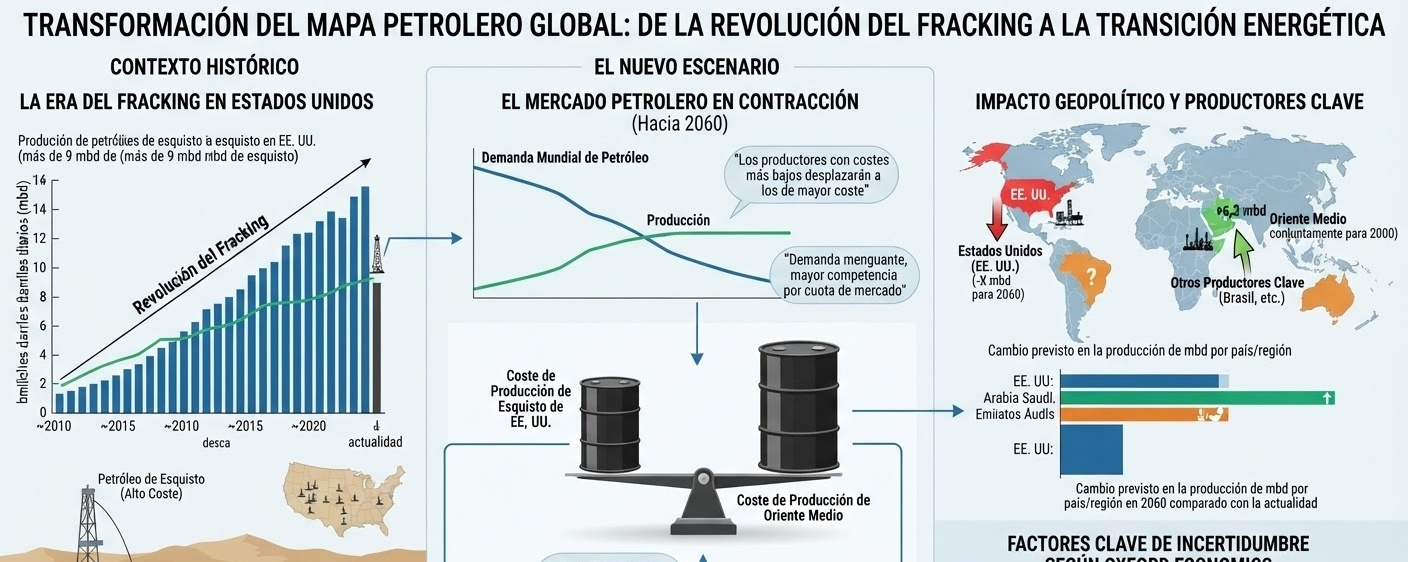

Cheap oil from Saudi Arabia and the United Arab Emirates could spell the end of the US fracking boom in an oil market dominated by supply, according to Oxford Economics
Falling demand due to electrification will unleash a price war
Oxford Economics believes Gulf countries will prevail over the US
Deutsche Bank expects Brent crude to fall another $20 per barrel
The fracking (hydraulic fracturing) revolution has turned the United States into the world’s leading oil power, upsetting the historic energy balance and wresting a significant share of the market and influence from Saudi Arabia and the rest of the Middle East’s producers. However, the market itself could be on the verge of a turning point that sends oil back to square one. In other words, a world where OPEC countries (especially Saudi Arabia, the United Arab Emirates and Iraq) begin to regain market share (after years of losing ground), gradually pushing out US crude until it becomes negligible.
Like any other industry, the oil industry has its investment cycles: higher production, falling prices, production cuts, and then starting all over again (boom and bust). These cycles could be about to change as a result of a fundamental shift in the crude oil market unlike anything seen before. The key factor will be demand. Until now, companies and countries had been working on the assumption that demand for crude oil would continue to rise. Now that demand appears to have peaked, the battle to sell a barrel of oil will be fierce, and only the countries that are most efficient in terms of costs and production will succeed. All signs point to US fracking not being one of them.
This controversial forecast comes from one of the most highly regarded economic analysis firms in the world: Oxford Economics. It argues that a structural decline in demand for crude oil, driven by the unstoppable electrification of the world, will cause oil prices to plummet, pushing out less efficient producers (those with higher costs), such as fracking operators. The forecast for peak demand has been pushed back to 2028 (it will come later, but the decline will be steeper than previously forecast), but it will eventually arrive and affect crude oil prices. Although this hypothesis makes sense, it faces a significant risk. Advances in technology and productivity could gradually allow fracking and the US to remain competitive in a market awash with cheap oil. Only time will tell who is right in this fascinating battle to dominate the oil market.
Global oil demand could peak before 2030
The November 2026 and October 2025 projections anticipate a subsequent decline through 2060. Figures in millions of barrels per day.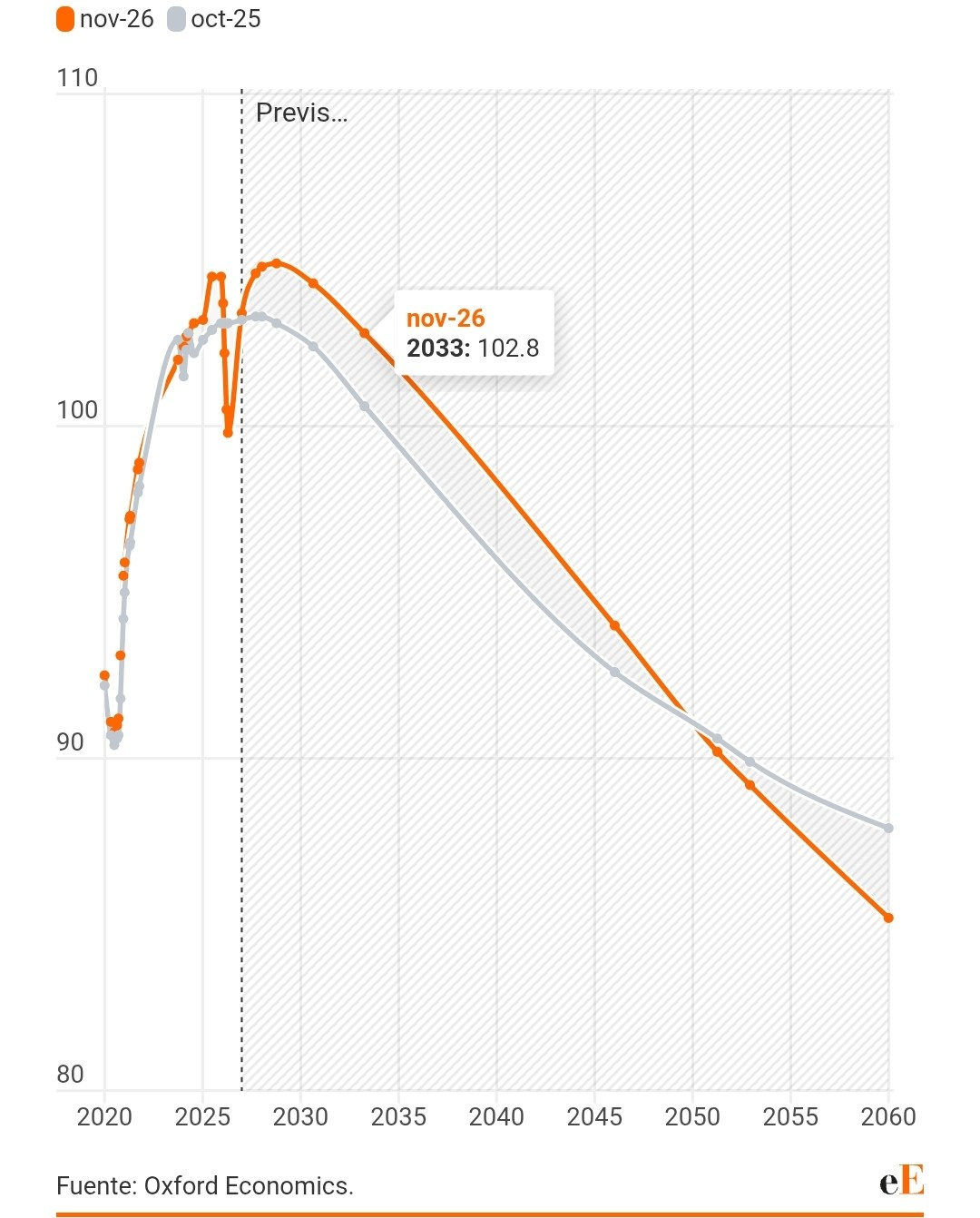
Even so, Oxford Economics experts have developed a scenario in which US production of oil and other liquid hydrocarbons plunges by more than 15 million barrels per day by 2060, while Saudi Arabia and the United Arab Emirates increase their supply by 4.8 million and 1.5 million barrels per day, respectively. This scenario does not reflect an oil shortage—quite the opposite. An abundance of crude and a structural decline in the price per barrel will push producers with the highest extraction costs out of the market.
The starting point for this transformation is the gradual exhaustion of growth in global demand. Oxford Economics estimates that oil consumption, which reached 105 million barrels per day in 2025, will peak at the end of this decade and begin a structural decline from 2028, falling to around 85 million barrels per day by 2060. That represents a drop of nearly 19% in a world whose economy will continue to grow, even as it needs less and less oil to generate the same amount of wealth.
The United States is expected to lead the decline in oil supply through 2060
Estimated change between 2025 and 2060, in millions of barrels per day of total liquids. Saudi Arabia records the largest increase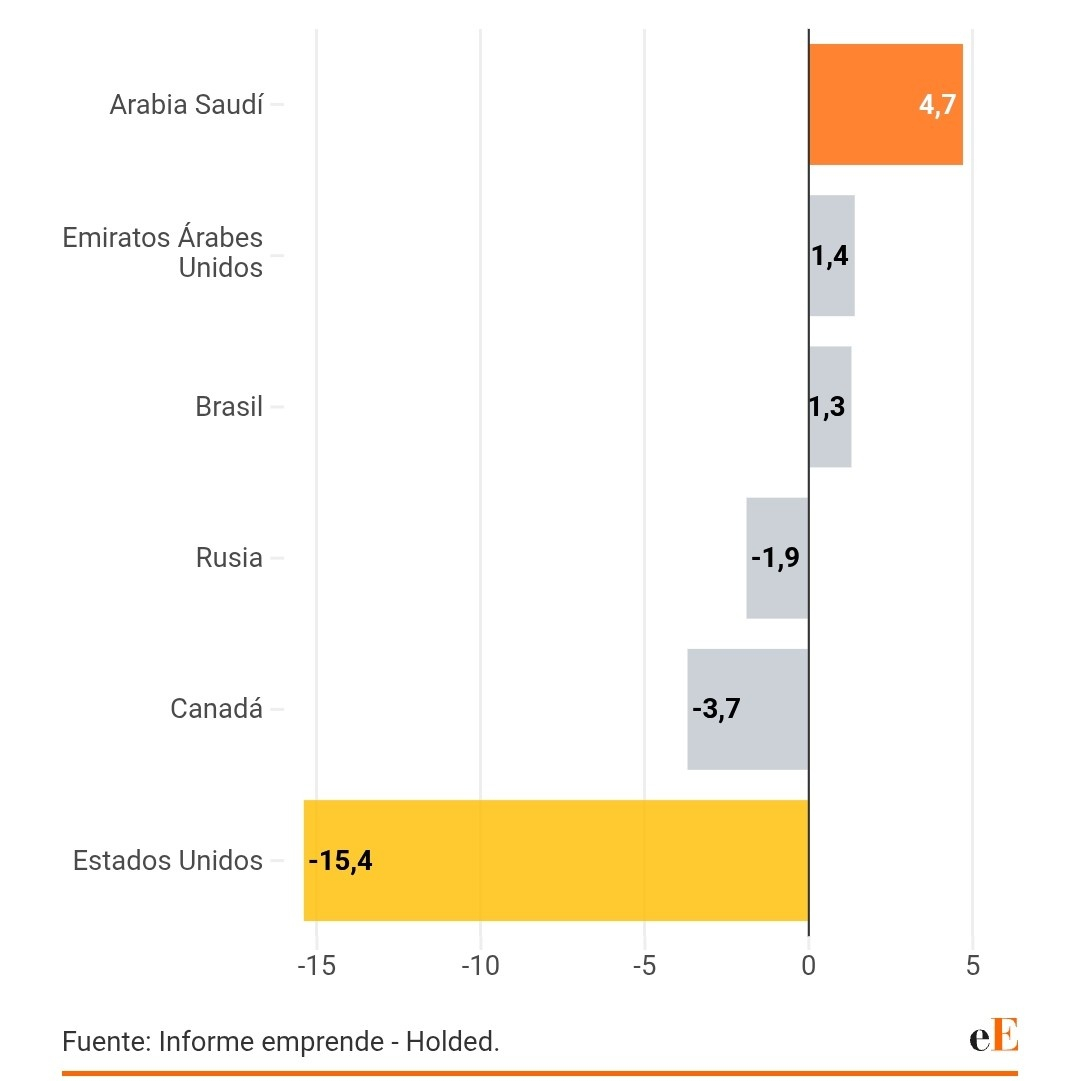
Transport electrification, improvements in energy efficiency, and slower economic growth explain this change in trend. According to the analysis firm's forecasts, global oil intensity—that is, the amount of crude consumed per unit of GDP—will fall by approximately half by 2050. The result will be a market in which producers can no longer rely on ever-increasing consumption to sell their barrels.
Fracking will be the victim
This new scenario poses a threat to the US oil industry because of its characteristics. Unlike the large conventional fields in the Middle East, much of the growth in US production comes from shale oil wells, which require constant drilling and a steady flow of investment to offset the rapid decline of existing wells. This makes fracking particularly sensitive to movements in the price per barrel.
Oxford Economics explains that "the relatively high costs and short development timelines of shale production make supply particularly responsive to prices." In other words, when oil prices rise, US companies can quickly increase their investment and production, but when prices fall for an extended period, much of that activity ceases to be profitable and companies cut back on drilling. The numbers help put the scale of the problem into perspective.
Oxford Economics cites a Dallas Federal Reserve survey showing that US shale producers need an average of around $66 per barrel to make drilling new wells profitable. However, the consultancy expects international oil prices to converge toward an equilibrium slightly below $60 per barrel in 2030, in constant 2026 dollars, and projects a marginal production cost of around $50 in the longer term. This does not mean that the entire US industry will suddenly become unprofitable, since costs vary significantly between fields and companies. But it does mean that a growing share of investment projects could cease to offer sufficient returns. If companies drill fewer new wells while existing ones continue to run dry, production will eventually decline.
Oxford Economics expects the United States to experience the largest absolute reduction in global oil supply by 2060. These forecasts, however, do not take technological developments into account—developments that can both lower costs and increase production across entire areas or fields. In fact, 15 years ago, extracting oil profitably from US shale fields seemed impossible. Today, shale fields alone produce more than 9 million barrels of oil, and together with conventional fields have made the US the world's largest oil producer, pumping close to 14 million barrels a day, compared with 9 million in Saudi Arabia or Russia. However, a drop in oil prices—assuming that fracking efficiency gains stall—could push this crude out of the market.
The market is expected to get smaller and smaller, unlike what is happening today. Falling demand, combined with supply that has been rising for years, could create a perfect storm for crude prices, driving out producers with higher costs per barrel pumped. The most efficient producers will benefit. The biggest winner from this transformation will be the Middle East. Saudi Arabia and the United Arab Emirates have huge conventional reserves that can be exploited at costs considerably lower than those of US shale oil.
They will therefore be able to maintain and even increase production in a market characterized by lower prices and dwindling demand. Oxford Economics notes that "as global oil demand declines, we expect production to become increasingly concentrated among lower-cost producers, while higher-cost suppliers will face growing pressure to remain competitive." This natural selection will particularly benefit Riyadh and Abu Dhabi, whose combined production is projected to increase by 6.3 million barrels per day by 2060.
The fracking revolution allowed Washington to reduce its energy dependence and challenge the Gulf monarchies for oil-market leadership; now, the energy transition threatens to partially reverse that process and return some of the lost market share to these countries. The war with Iran is causing significant disruption to this scenario, but Oxford Economics believes its effects on prices will be largely temporary. The conflict has constrained Middle Eastern supply, caused a supply shortfall, and reduced global oil inventories, keeping prices above pre-war forecasts for the next few years. However, the consultancy expects the recovery of regional production and the normalization of inventories to return the market to its long-term equilibrium around 2030.
"We expect strong production growth to restore the underlying surplus and forecast a return to our long-term equilibrium, slightly below $60 per barrel in real terms, by 2030," the experts explain. The point is that the same cheap oil that will ease energy bills in importing countries could end up accelerating the decline of the industry that turned the United States into an energy superpower. The new reality will also force Saudi Arabia and other major producers to rethink their strategy. For decades, OPEC has tried to support prices through coordinated supply restrictions, voluntarily sacrificing some sales to prevent price collapses. But this policy is harder to sustain when the market stops growing and producers compete for an ever-shrinking pool of demand.
OPEC will change forever
Oxford Economics warns that "the decline in oil demand is also likely to change OPEC's strategy, as producers compete increasingly for market share in a shrinking market." Countries able to extract crude at very low costs will have an incentive to sell more barrels and displace higher-cost competitors, even if that means accepting lower prices. The consultancy believes this dynamic could gradually weaken the cartel's ability to influence prices through production quotas, although it acknowledges that its forecasts do not factor in specific changes to the organization's structure. The outcome could be a radical transformation of the global oil landscape.
The United States will continue to have significant energy resources, but its fracking industry will have to contend with a far less favorable market than the one that enabled its extraordinary expansion over recent decades. Saudi Arabia, the United Arab Emirates, and other competitive producers such as Brazil will be better positioned to benefit as the costliest operations are phased out. However, Oxford Economics notes that these forecasts depend on the pace of transport electrification, global economic growth, technological advances, and geopolitical developments—all factors that could substantially alter the outlook.
Related
Chaos in the Middle East 'ties OPEC+'s hands': the market expects it to freeze output despite record prices
Iraq is preparing to flood the oil market and blow up OPEC from within: Big Oil is going after its crude.