


Pons has one of the more aggressive token buyback models among crypto launchpads.
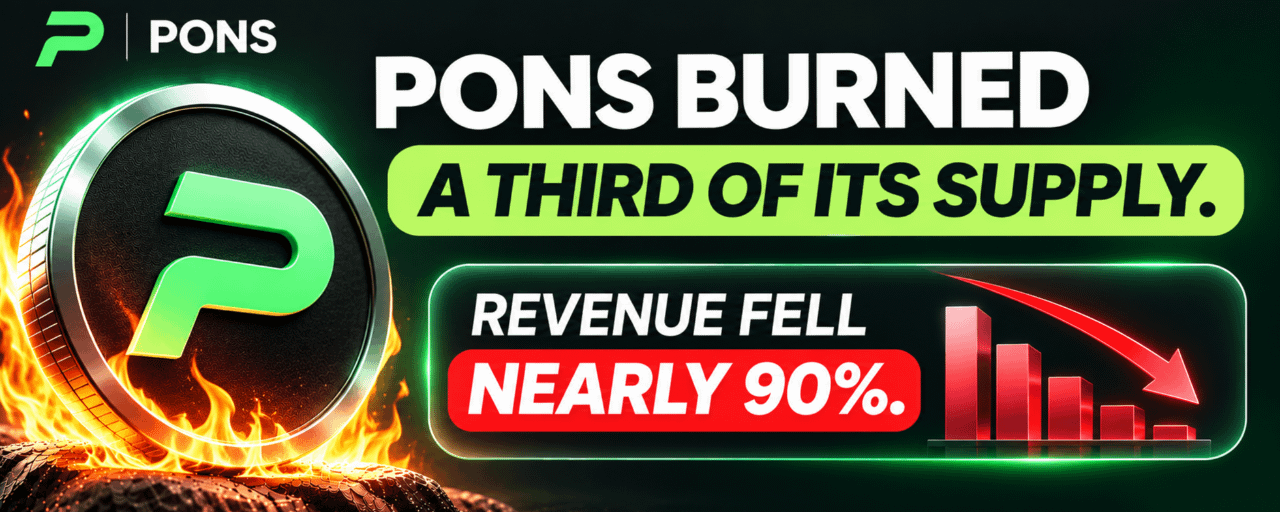
It uses 80% of its share of platform fees to purchase PONS and send those tokens to a burn address.
And the amount removed from circulation is already substantial.
By November 25, approximately 331.9 million PONS had been sent to the burn address.
That's about one-third of its original supply.
But I found another number that changes how I'd look at the token.
Pons generated around $23.4 million in protocol revenue during September 2026.
In October, that figure fell to approximately $2.48 million.
A decline of nearly 90%.
That's worth examining before assuming the burn mechanism alone makes PONS attractive.
Pons operates on Robinhood Chain, allowing anyone to create and trade new tokens without writing code.
Tokens initially trade through a bonding curve. Once they meet the graduation conditions, liquidity moves into a Uniswap pool.
The platform collects fees from launches and trading activity.
Creators also receive a portion of trading fees, giving them a financial incentive to bring new projects and communities onto the platform.
It's a business model that can generate considerable revenue when speculative trading is active.
And September showed just how profitable that can become.
According to DeFiLlama, traders paid approximately $137 million in fees on Pons during the month.
But most of that money didn't belong to the protocol.
Creator rewards, trading arrangements, and other fee allocations accounted for a substantial share.
The protocol retained around $23.4 million.
Under its current mechanism, 80% of the protocol's allocated fees are directed toward PONS purchases and burns.
That distinction matters.
It's not 80% of every dollar traders pay.
And there's another detail about the burn figures.
On-chain analysis shows roughly 195 million PONS reached the burn address during the token's first week in July.
That's more than half of all PONS burned to date.
Some of those early transfers came from large wallets, and the complete funding history of every purchase hasn't been independently established.
So I wouldn't describe the entire 331.9 million PONS as tokens purchased using operating revenue.
What matters going forward is the recurring burn activity funded by real fees.
And that has slowed.
An independent burn tracker recorded approximately 4.1 million PONS burned during the 30 days ending November 24.
That's about 64% less than the preceding 30-day period.
The buyback mechanism is still operating.
But its effectiveness depends on the underlying business.
When people launch fewer tokens or trade less frequently, fee revenue falls.
And less revenue generally means less money available for buybacks.
There's also something I appreciate about PONS's supply structure.
The token launched with one billion units and doesn't have a conventional multiyear investor vesting schedule.
That removes one source of uncertainty found in many newer crypto projects.
However, there's a technical distinction.
PONS doesn't have a native burn function.
Tokens are transferred to an inaccessible address, so the smart contract's total supply still reads one billion.
The economically available supply is lower because those burned tokens cannot ordinarily be spent.
Another concern is control over the buyback mechanism.
Pons's documentation states that its buyback splitter remains upgradeable by a single wallet.
That wallet can change the treasury allocation and the contract implementation.
The current 80% buyback policy therefore shouldn't be treated as an unchangeable guarantee.
Pons also operates in a particularly speculative market.
Its platform lets almost anyone launch a token, including projects with little economic substance.
The documentation warns about impersonation, creator-controlled fees, and trading risks.
It also states that no audit report has been published for the relevant contracts.
For me, those details matter just as much as the impressive burn total.
Pons has demonstrated that a crypto launchpad can produce substantial revenue and convert part of it into token purchases.
But September also showed how sensitive that revenue can be to market enthusiasm.
I'd watch monthly protocol revenue, actual PONS burned from fee-funded purchases, and whether trading activity remains healthy after the initial Robinhood Chain excitement fades.
The burn mechanism is real.
The question is whether the business generating those burns can stay strong through a quieter market.