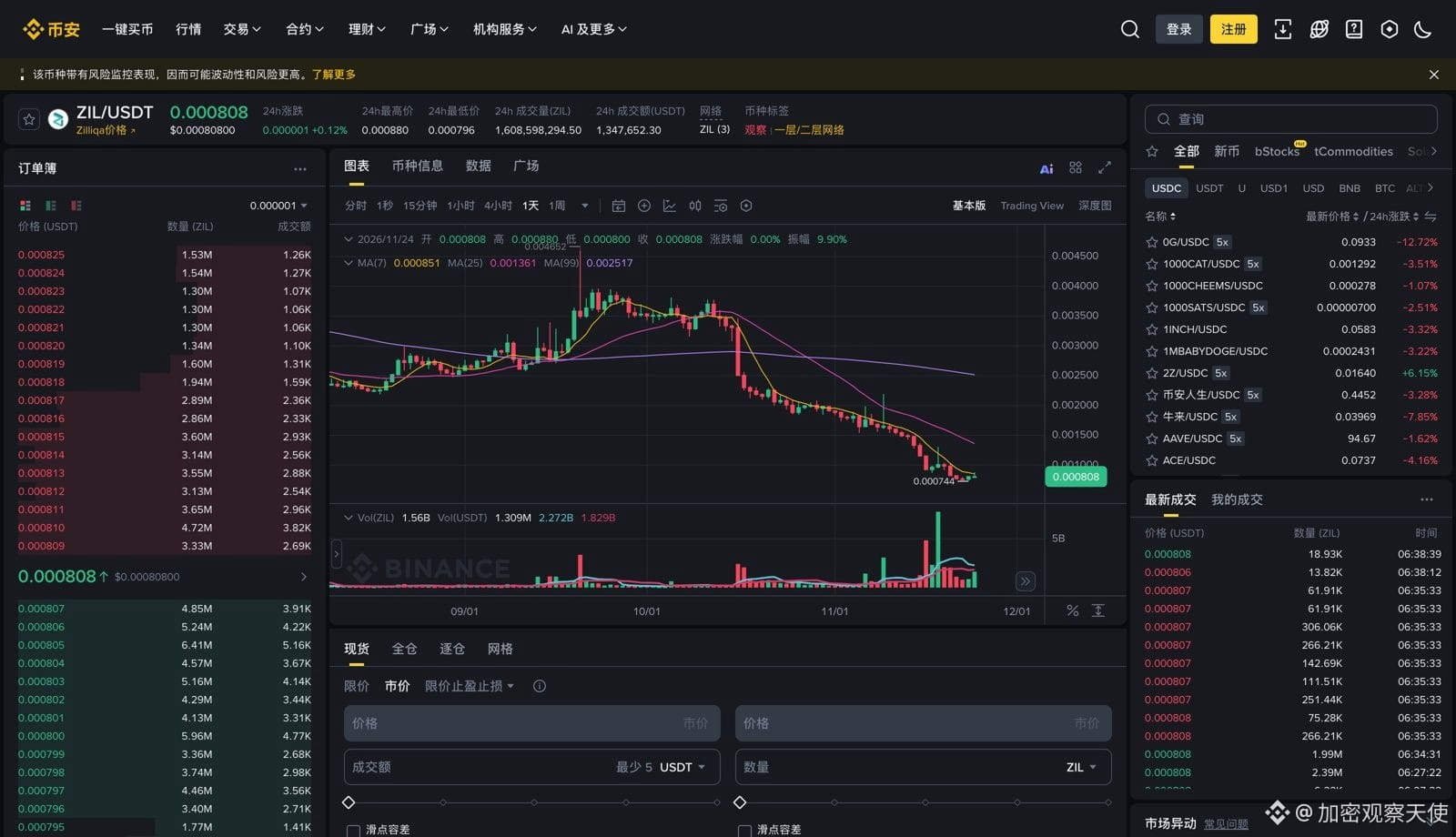
For the same amount of ZIL, the amount you can borrow against it drops from 30% to 10%.
This isn’t a change in interest rates. The collateral ratio has been cut. The announcement says it’s being reduced from 30% to 10%.
On November 24, Binance announced that it would adjust the ratios starting at 6:00 a.m. on the 27th, with the changes expected to take about half an hour.
Three things are changing: the collateral ratios for borrowing and transfers in Cross Margin, the collateral ratios for Portfolio Margin, and the tiers for Portfolio Margin Pro.
First, the most important change. In Cross Margin and Portfolio Margin, ZIL’s collateral ratio is dropping from 30% to 10%.
The collateral ratio determines how much borrowing power a coin counts toward. A drop from 30% to 10% means that the same amount of ZIL will support only one-third as much borrowing.
Put another way, the amount you can borrow is down by about two-thirds.
This doesn’t reduce the amount of ZIL you hold. The number of coins stays exactly the same.
What changes is the value assigned to it as collateral.
The table for Portfolio Margin Pro has also been restructured.
Previously, ZIL from $0 to $100,000 counted at full value, while the $100,000 to $250,000 tier counted at 80%.
After the change, amounts from $0 to $50,000 count at full value, while the $50,000 to $100,000 tier counts at 80%.
The same tiers, shifted down one level.
There’s one warning in the announcement that deserves close attention: collateral ratios and leverage affect the unified maintenance margin ratio.
If the unified maintenance margin ratio falls, it could trigger liquidation.
In other words, even if you do nothing, the ZIL in your position is repriced, bringing you closer to the liquidation threshold.
This isn’t a cash payout or a reward. It’s purely a change to risk parameters.
It’s different from a delisting. A delisting means the coin is no longer available; a collateral ratio adjustment means the coin is still there, but it’s worth less as collateral.
ZIL was also on last month’s monitoring tag list. That meant the coin was added to a list subject to regular review.
This time, the change directly affects its borrowing power.
If you use ZIL as collateral, it’s best to recalculate your new maintenance margin ratio yourself before and after the adjustment takes effect.
Promotions and product parameters may change. Please refer to the official page for the latest information.
When was the last time you recalculated the collateral value of the assets you hold?
(Notes: The collateral ratios, effective time, and tiers are taken from Binance’s official announcement. “Down by two-thirds” is an arithmetic calculation based on 10 ÷ 30, not the official wording. This is an explanation of the rules, not investment advice.) #DYOR