
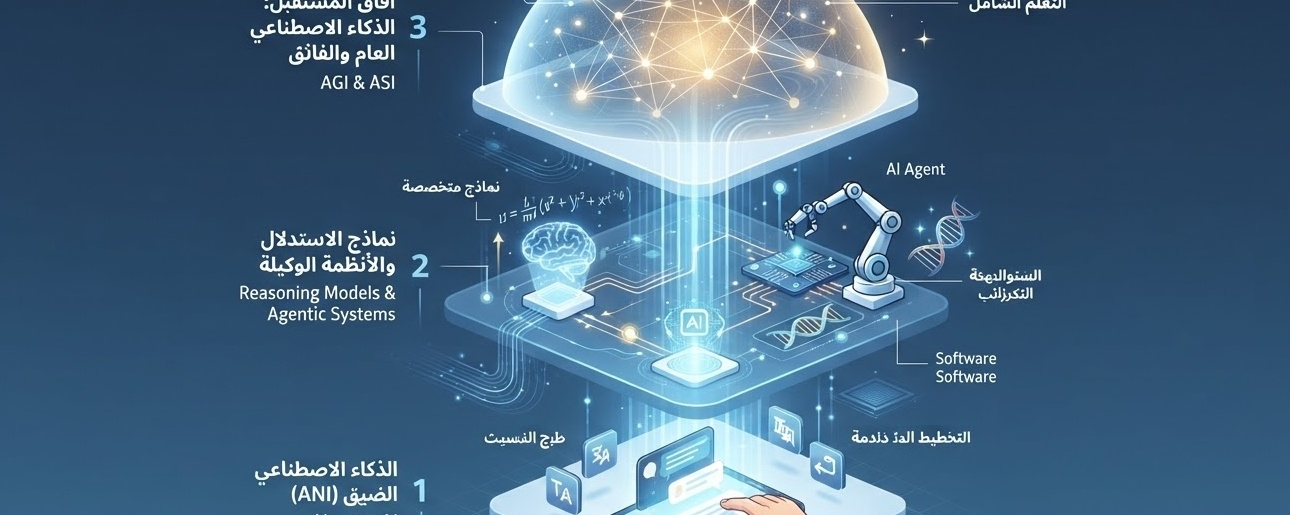

#When we interact daily with AI models to generate text or summarize information, we are in fact engaging with the surface layer of a technology far broader in its computational architecture and cognitive capabilities. Behind this simple interactive interface, deeper and more specialized systems are evolving, going beyond mere language prediction into fields such as logical reasoning, scientific modeling, and autonomous automation.
Scientifically, currently available systems fall into the category of narrow or specialized artificial intelligence (ANI), which excels at performing specific tasks based on statistical patterns derived from massive datasets. Recent advances, however, have produced sophisticated generations within this framework, most notably Reasoning Models, which use chain-of-thought and self-verification techniques to break down complex mathematical and programming problems before reaching a final conclusion. Specialized scientific models have also brought about tangible advances in structural biology, drug discovery, and the simulation of physical and climatic phenomena.
In parallel, engineering research is moving toward Agentic AI systems: software architectures that do more than generate textual responses. They can plan in stages, call digital tools, and interact with databases and software environments to accomplish multistep goals while monitoring results and autonomously correcting course. These systems rely on high-performance computing clusters comprising thousands of parallel processors, while future research in this area intersects with quantum computing to accelerate optimization and simulation processes beyond the capabilities of conventional architectures.
At the long-term conceptual level, global research efforts are focused on the transition from specialized intelligence to artificial general intelligence (AGI), a system presumed to possess the cognitive flexibility to transfer knowledge and learn autonomously across unrelated domains with efficiency comparable to human cognition. Theoretically, this would be followed by artificial superintelligence (ASI), which surpasses human intellectual capabilities in analysis and innovation. Nevertheless, these systems remain constrained by fundamental limitations related to the probabilistic nature of their algorithms, data quality, and the absence of genuine self-awareness, making human oversight and systematic guidance essential to transforming this computational power into reliable scientific and practical value.