

📉 WHEN BITCOIN PREDICTIONS KEEP GOING WRONG: A COSTLY LESSON IN RISK MANAGEMENT
In the cryptocurrency market, Bitcoin has always been one of the most volatile assets. In just a few minutes, its price can change significantly, making it much harder to predict whether it will go Up or Down.
Looking at the Binance Prediction payment history on November 25, 2026, I noticed a thought-provoking lesson about trading psychology and capital management.
1. Notable figures
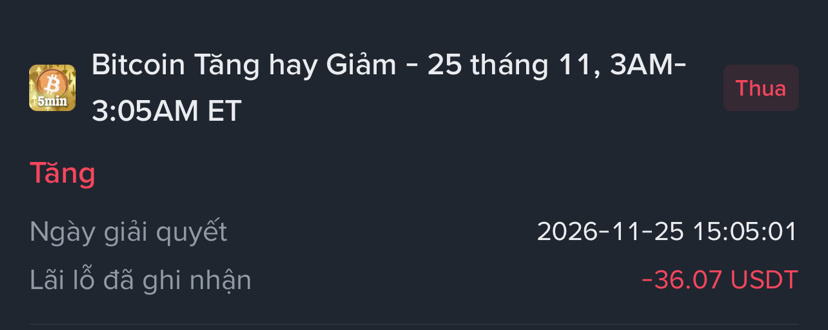
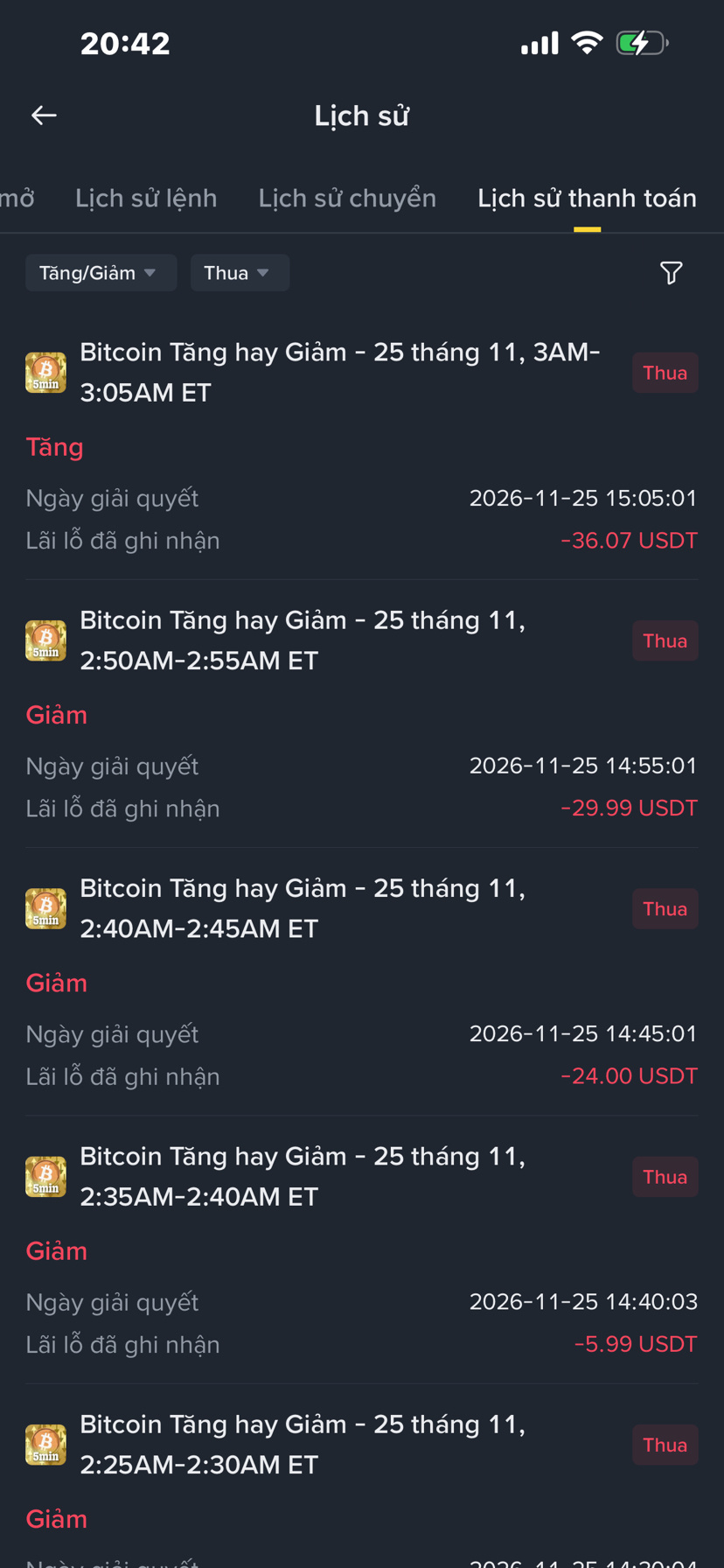
The payment history image shows 4 fully visible losing orders:
* Bitcoin Up order, 3:00–3:05 AM ET: loss of 36.07 USDT.
* Bitcoin Down order, 2:50–2:55 AM ET: loss of 29.99 USDT.
* Bitcoin Down order, 2:40–2:45 AM ET: loss of 24 USDT.
* Bitcoin Down order, 2:35–2:40 AM ET: loss of 5.99 USDT.
The total loss across the 4 fully visible orders is 96.05 USDT.
These figures are recorded directly in the image and do not include other trades outside the screenshot.
2. Why is it difficult to predict Bitcoin over short time frames?
Many people often think that simply identifying whether the trend is rising or falling is enough to make an accurate decision.
However, the reality is much more complex.
The price of Bitcoin is affected by many factors:
* Market supply and demand fluctuations.
* Investor sentiment and profit-taking activity.
* Economic news and unexpected events.
* Liquidity and volatility at any given time.
* Rapid changes in short-term trends.
In particular, with prediction windows lasting only 5 minutes, even a small price movement can lead to an outcome that differs from the initial expectation.
A long-term upward trend does not always mean that the price will rise over the next 5 minutes.
3. Lessons about psychology and capital management
In my personal opinion, what matters most is not just the money lost, but also how we respond after each incorrect prediction.
When they lose repeatedly, many people are tempted to quickly win back the money they have lost. This can lead them to increase their stake, make hasty decisions, or continue making predictions without enough evidence.
I believe it is important to remember a few principles:
* Do not use an amount that exceeds your risk tolerance.
* Do not increase your stake just to recover losses.
* Do not make decisions based on emotions.
* Set clear loss limits.
* Know when to stop when the market offers no convincing signals.
* Keep a record of your results so you can review your decisions.
Sometimes, not participating is also a good decision.
4. Wins and losses are both part of the market
One successful trade does not prove that we are always right. Conversely, a few losses do not mean that all our analysis is worthless.
What matters is looking at the results honestly, assessing the causes, and improving your risk management approach.
The crypto market is not a place where every price movement can be predicted accurately. No strategy can guarantee absolute success.
Therefore, protecting your capital and controlling your emotions should take priority over trying to make short-term profits.
5. Personal perspective
Looking at the trades shown in the image, I realize that sometimes the biggest lessons do not come from winning, but from facing our poor decisions honestly.
96.05 USDT is a notable loss across the 4 orders shown. But if you know when to stop, assess your mistakes, and change how you manage your capital, this experience can still become a useful lesson.
I believe patience, discipline, and the ability to control risk are important factors for long-term survival in the crypto market.
What do you think is more important when making Bitcoin predictions: the ability to analyze trends or disciplined capital management?
Share your perspective!
#Binance #Bitcoin #BTC #BinancePrediction #CryptoTrading #RiskManagement
Note: This post only lists the 4 orders fully visible in the image and does not claim that these represent the account's total losses.