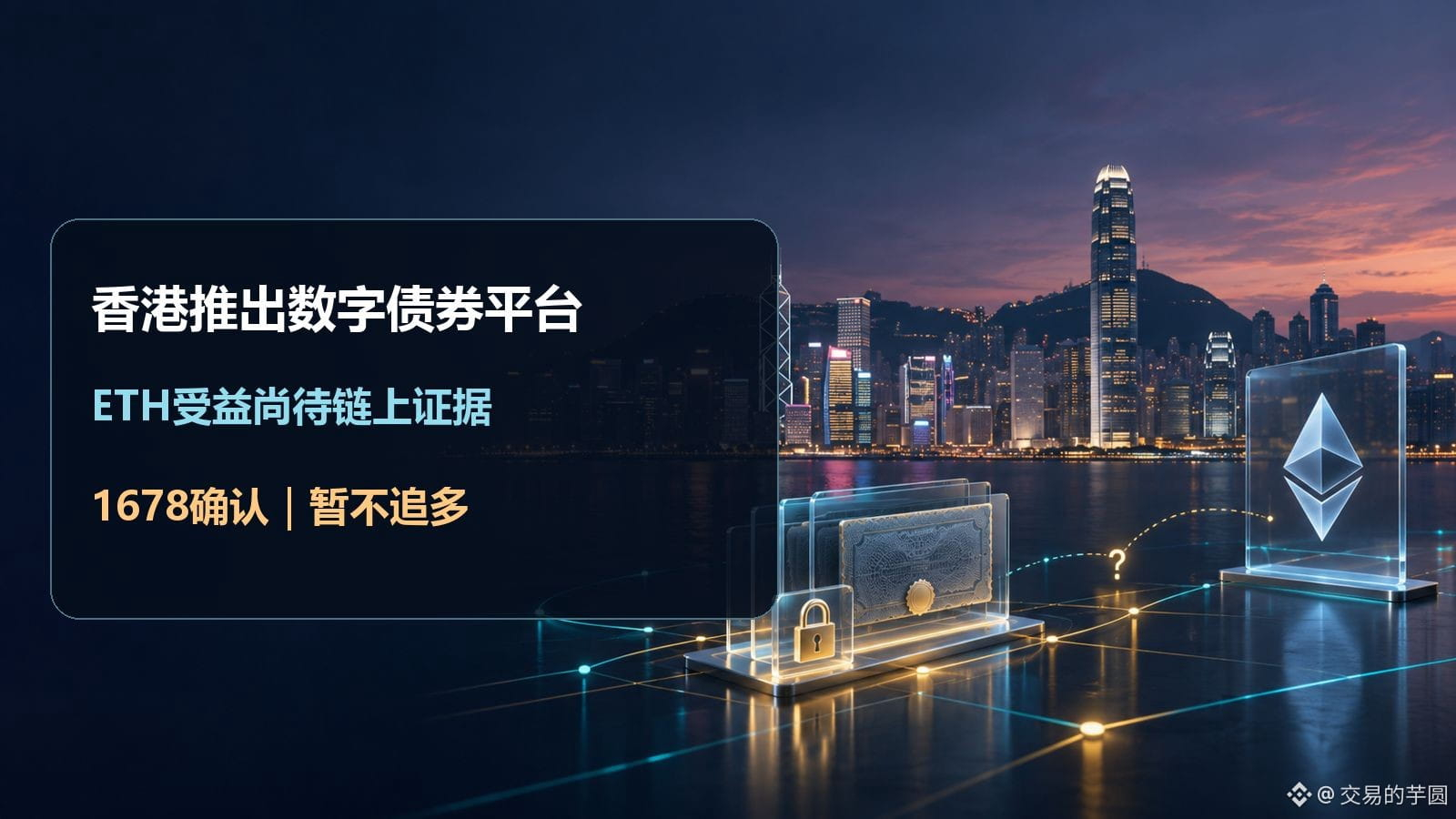
Hong Kong Monetary Authority launches digital bond platform | ETH needs on-chain evidence to benefit | I’m not chasing longs for now
My stance is neutral to cautious. Binance Square is discussing the Hong Kong Monetary Authority’s launch of the CMU digital asset platform. Today’s official press release from the HKMA corroborates an announcement from platform operator CMU OmniClear: the platform is now live, with several banks among its first direct participants. Its functions cover bond issuance, secondary-market settlement, coupon payments and redemption at maturity, and it supports the tokenization of traditional bonds. It uses on-chain atomic delivery-versus-payment settlement and connects to the real-time gross settlement system and central bank digital currency. CMU OmniClear says it will also explore connecting to other distributed ledger platforms in the future. The platform that has launched and its planned future interoperability capabilities must be viewed separately.
This matters to the crypto market because it takes tokenized bonds from concept to actual financial infrastructure operations, creating a testable use case for coordination among banks, settlement systems and cash instruments. But the press release does not say these bonds are being issued on the Ethereum mainnet, that settlement requires ETH to pay gas fees, or that any of the banks involved are accumulating ETH. If we translate “digital asset platform launch” directly into “a guaranteed source of buying demand for ETH,” we’re skipping four links in the chain: the choice of public blockchain, cross-chain deployment, asset scale and actual transaction volume. I’d rather watch for technical documentation and issuance details than focus only on the hype.
How has the market reacted so far? As of 21:19 Beijing time, ETH/USD on Kraken was around $1,644. It opened at about $1,678 over the past 24 hours and traded in a range of roughly $1,631 to $1,704, with the price still below the open. This price action alone cannot prove that the HKMA news pushed ETH up or down. A macro data release is approaching, and expectations for dollar interest rates and overall risk appetite may have a more direct impact on short-term prices. If ETH is merely rebounding along with BTC, with no official evidence that the platform uses Ethereum, I’d treat the rise as market-wide correlation and assign it no additional “Hong Kong platform premium.”
The key levels are the intraday low near $1,630 and the opening price near $1,678. A break below $1,630 followed by a failed retest would signal weakening support; reclaiming $1,678 and holding above it would be a prerequisite for looking again at $1,700–$1,705. Even if the price surges, any subsequent official confirmation that the platform has no actual connection to the Ethereum public blockchain would invalidate the thematic thesis. I would only raise my medium-term outlook if announcements about on-chain issuance or settlement volumes clearly point to Ethereum. In either case, I’ll wait for facts rather than use rumors as evidence.
If I were trading this myself, I wouldn’t chase the hot narrative right now. My directional view is a conditional spot long. I’d buy without leverage, using no more than 0.5% of my total capital, only if a four-hour candle closes above $1,678, the price retests and holds $1,668–$1,678, and the sharp volatility following the macro data release has subsided. My first target would be $1,705, where I’d take half off; I’d aim for $1,740 with the remainder and move the stop up to around breakeven. I’d place the initial stop below $1,628. If $1,630 breaks first, I’d cancel the plan. After entry, I’d exit the entire position if the price falls back below $1,668 or if official evidence disproves the assumption that Ethereum will benefit on-chain. If none of these conditions are met, I’ll keep watching from the sidelines and won’t treat the plan as a completed trade.
#HKMALaunchesCMUDigitalAssetPlatformForBondTokenization #ETH
The above is solely my personal market observation and does not constitute investment advice.