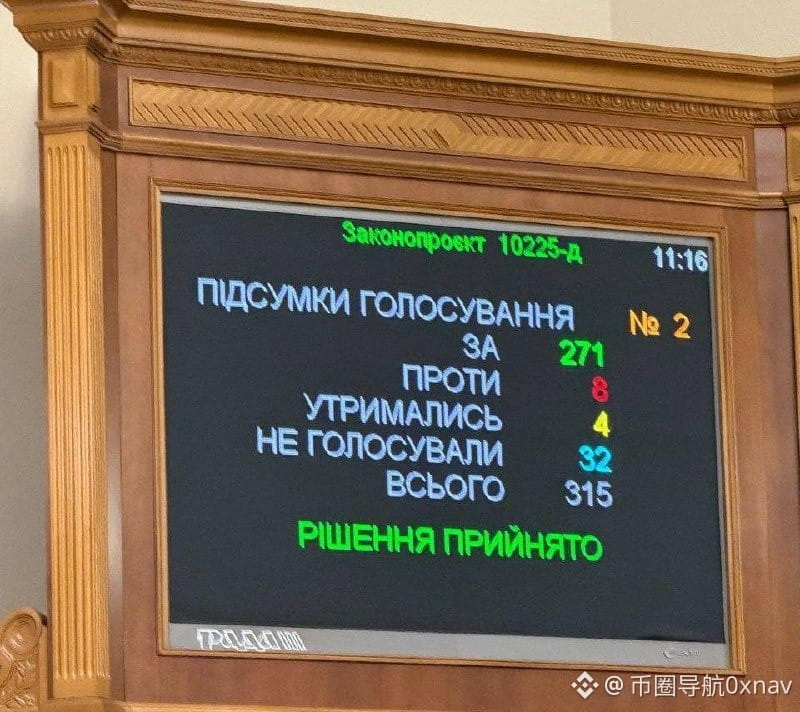
When the vote-counting screen flashes “Decision adopted,” the first thought is probably: So will I have to pay tax when I cash out tomorrow? Not so fast—the effective date is still next year.
On November 25, Ukraine’s Verkhovna Rada held the second reading and a full-floor vote on Virtual Assets Bill No. 10225-д. The official roll-call record states that at 11:16 that day, 271 voted in favor, 8 against, 4 abstained, and 32 did not vote, for a total of 315 votes. The resolution was adopted. The bill’s official status is “ready for signature”—the presidential signature and formal publication are still pending. The main provisions are scheduled to take effect on July 1, 2027, so taxes do not start today.
This is different from the situation in early November, when the Finance Committee had only recommended submitting the bill for a second reading, and the central bank had publicly expressed reservations. The committee then held further discussions with regulators, and only today was the bill adopted by the full chamber. It passed its first reading on September 3, 2025.
A few points that directly affect ordinary people 👇
🔹 Selling crypto is taxed on annual profits: Individuals pay 18% personal income tax plus a 5% military levy only on the profit—the sale price minus the documented purchase cost. Crypto-to-crypto swaps are not taxed. Profits up to one minimum wage per year are tax-exempt. Tokens received free of charge are not taxed. The issuance and exchange of virtual assets are not subject to VAT.
🔹 Transitional rules for existing holdings: Assets already held before the law takes effect may qualify for a 5% personal income tax plus a 5% military levy during the transition period, which runs through the end of 2028. Some lawmakers have publicly described this as applying “to the entire amount,” which differs from the general rule of “taxing only the profit.” The official text will be authoritative.
🔹 Platforms need authorization: Exchanges, custodians, and other service providers must obtain authorization and register within 60 days. Providers serving Ukrainian residents, including those based abroad, must also report clients’ transactions to the tax authorities every year. The Securities and Stock Market Commission will handle licensing and oversight, while the central bank will handle matters related to the hryvnia, financial stability, and certain forms of electronic money and payment tokens.
🔹 Advertising red lines: Crypto assets must not be promoted as a means of payment in Ukraine, and guaranteed returns must not be promised. Customer-asset protection and verification of the source of funds will follow standards closer to those used by banks.
In short: the parliament has passed a package covering “legalization + licensing + taxation,” but this does not mean “cash out tomorrow and get taxed.” If you’re in Ukraine or commonly use local on- and off-ramps, first check whether your platform will apply for authorization, and keep proof of the cost basis for your existing holdings. That’s more useful than chasing headlines claiming “it’s already legal and taxes start immediately.”
Which matters more to you: how taxes will be calculated starting in July 2027, or whether your usual exchange will get authorization and whether you’ll still be able to deposit and withdraw funds?
#乌克兰通过虚拟资产合法化法案 #BTC #ETH