
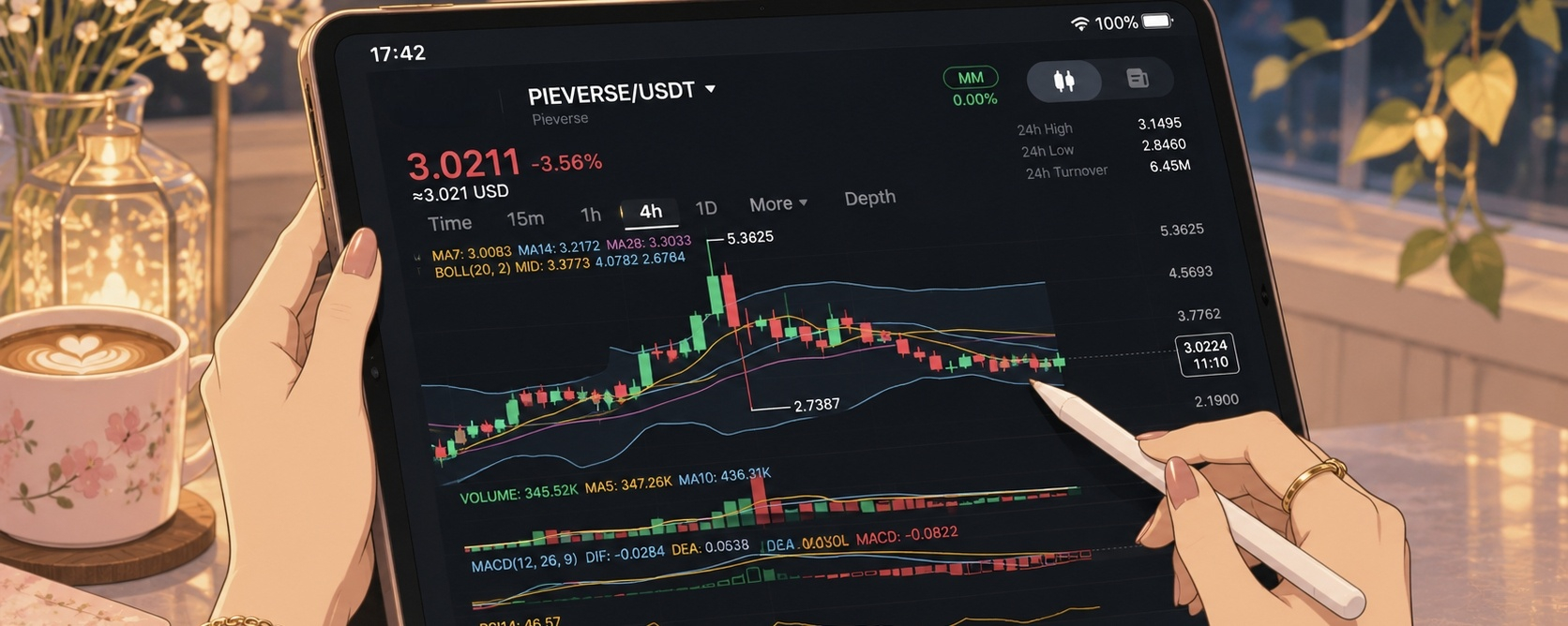


PIEVERSE is approaching an interesting point. Despite having an expanding role in the AI-agent and Web3 payment narrative, its chart is struggling to attract fresh buying interest. The token is trading close to $3.02, and the latest pullback raises a more important question than whether it can bounce: is the market losing interest, or are buyers simply waiting for a better entry?
The 4-hour structure currently favors caution. PIEVERSE has retreated from its recent highs and is now trading below its major short-term moving averages. The Bollinger middle line sits near $3.3773, leaving a considerable gap between the current price and the level needed for a stronger recovery. RSI at 46.57 is not deeply oversold, so there is still room for further weakness before momentum reaches an extreme. MACD remains negative, although the price is beginning to stabilize around the $3.00 area.
What makes PIEVERSE worth watching is the direction of its underlying product. Pieverse is attempting to connect blockchain payments with verifiable invoices, timestamped transactions and AI-agent commerce. This is a different proposition from simply building another DeFi application. If autonomous agents eventually become meaningful participants in digital commerce, payment verification and transaction infrastructure could become increasingly relevant. The challenge is turning that possibility into measurable usage and sustained demand for the token.
There is also a supply consideration entering the picture. PIEVERSE has a maximum supply of one billion tokens, and the beginning of linear vesting for team and investor allocations introduces an additional variable for the market. The estimated December unlock deserves attention, particularly if trading activity remains weak. Vesting does not automatically mean selling, but available supply can influence sentiment when buyers are already hesitant.
One detail on the chart stands out: the $2.8460 low has become an important reference point. Buyers have an opportunity to establish a base above this level, but the market has not yet demonstrated enough strength to call the recent weakness a reversal. On the upside, $3.1495 is the first hurdle. Beyond that, the $3.30–$3.38 region is more significant because it overlaps with the declining technical structure and Bollinger middle band.
The derivatives picture should also be interpreted carefully. Elevated leveraged participation can make a recovery look stronger than the underlying demand actually is. Positive funding means long positions are paying shorts, so positioning and spot-market participation will matter when assessing whether another advance is sustainable.
Market snapshot
• Price: ~$3.0211
• 24H change: -3.56%
• 24H high / low: $3.1495 / $2.8460
• RSI (14): 46.57
• MACD: Negative
• Bollinger middle: $3.3773
• Key support: $2.8460, then $2.7387
• First resistance: $3.1495
• Major recovery area: $3.30–$3.38
• Maximum supply: 1 billion PIEVERSE
What would change the outlook?
A move back above $3.15 with improving volume would be the first indication that buyers are becoming more active. Reclaiming $3.38 would make the recovery considerably more convincing and bring $3.50 into view.
On the other hand, another rejection followed by a break under $2.8460 would suggest that the current stabilization is failing. In that case, $2.7387 becomes the next important level to watch.
PIEVERSE has an interesting business direction, but a promising narrative and a strong token chart are two different things. Right now, the product story has potential while the technical picture still needs repair. I would rather see evidence of genuine demand returning than assume that ecosystem developments alone will push the token higher.