Shanghai’s housing market has stabilized first—but what’s stabilizing isn’t prices, it’s sales volume.
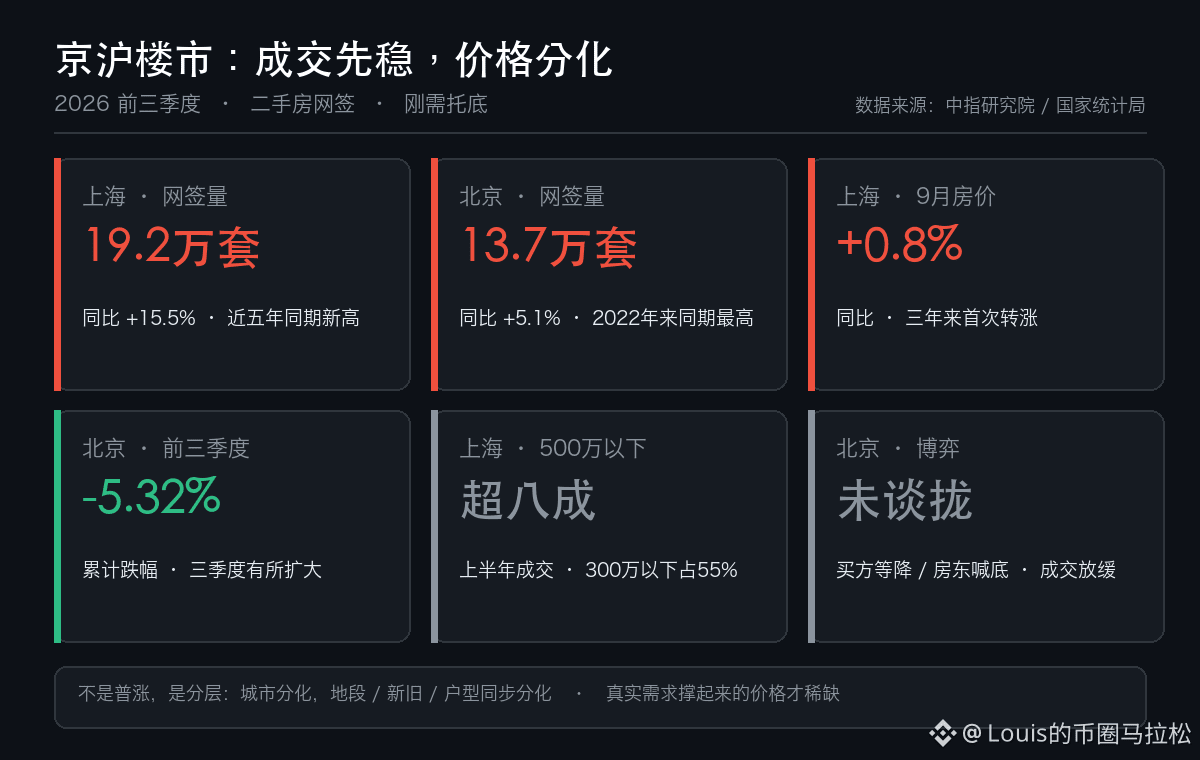
In the first three quarters, 192,000 resale homes were registered online, up 15.5% year over year. Beijing saw 137,000 transactions, up just 5.1%. The figures look close, but the trends have diverged: in September, Shanghai’s resale home prices rose 0.8% year over year, their first increase in three years. Beijing’s prices fell 5.32% cumulatively in the first three quarters, and the decline widened in the third quarter.
The difference comes down to who’s buying. In Shanghai, more than 80% of transactions in the first half were for homes priced under 5 million yuan, and 55% were under 3 million. Homes within reach and within budget have propped up the market floor first. In Beijing, buyers are waiting for prices to fall further while sellers insist they’ve hit rock bottom. They can’t agree on a price, so naturally, transactions slow.
This isn’t a broad-based rally; it’s a market splitting into tiers. Cities are diverging from one another, and within the same city, neighborhoods, property age, and layouts are diverging too. Judging by the overall market’s ups and downs is becoming less and less useful.
The same logic applies to $BTC : when prices rise, not every coin rises together; when they fall, they don’t all fall together either. What’s truly scarce has never been the size of the gains, but the certainty that comes from something people use, live in, and can afford.
In the end, the housing market and crypto reward the same thing: prices supported by real demand.
Which city do you think will be the next to stabilize? Let’s talk in the comments.