

Hong Kong Monetary Authority launches CMU Digital Asset Platform: infrastructure is in place, but ETH demand remains unconfirmed
The Hong Kong Monetary Authority announced today the official launch of the CMU Digital Asset Platform. The related topic `#HKMALaunchesCMUDigitalAssetPlatformForBondTokenization` ranked fifth on the trending list, and the page showed six people discussing it. This is an event worth watching, but it is easy to misread it as “traditional finance moving on-chain, so ETH is immediately bullish.” A more accurate assessment is that the infrastructure is in place, while the scale of assets and on-chain demand have yet to be proven.
According to the Hong Kong Monetary Authority (CMU Digital Asset Platform Launch) (November 25, 2026), the platform was developed and is operated with the assistance of Fast Clearing Limited. Based on distributed ledger technology, it covers paperless processes for primary bond issuance, secondary-market trading, settlement and delivery, coupon payments, and redemption at maturity, and supports the tokenization of traditional bonds. It also uses on-chain atomic delivery-versus-payment (DvP) settlement, can connect with real-time payment and settlement systems and central bank digital currencies, and supports 24/7 multi-currency settlement through cash tokens.
This is more substantive than “yet another conceptual project” because it transforms the settlement process in the bond market. But it still does not directly prove demand for public-chain tokens: the announcement did not disclose the volume of bonds issued, average daily settlement volume, a list of participating institutions, or any increase in public-chain fees resulting from the launch. Future expansion to funds, real-world assets, tokenized deposits, and regulated stablecoins is also part of the roadmap, not proof that all of this has already been implemented today.
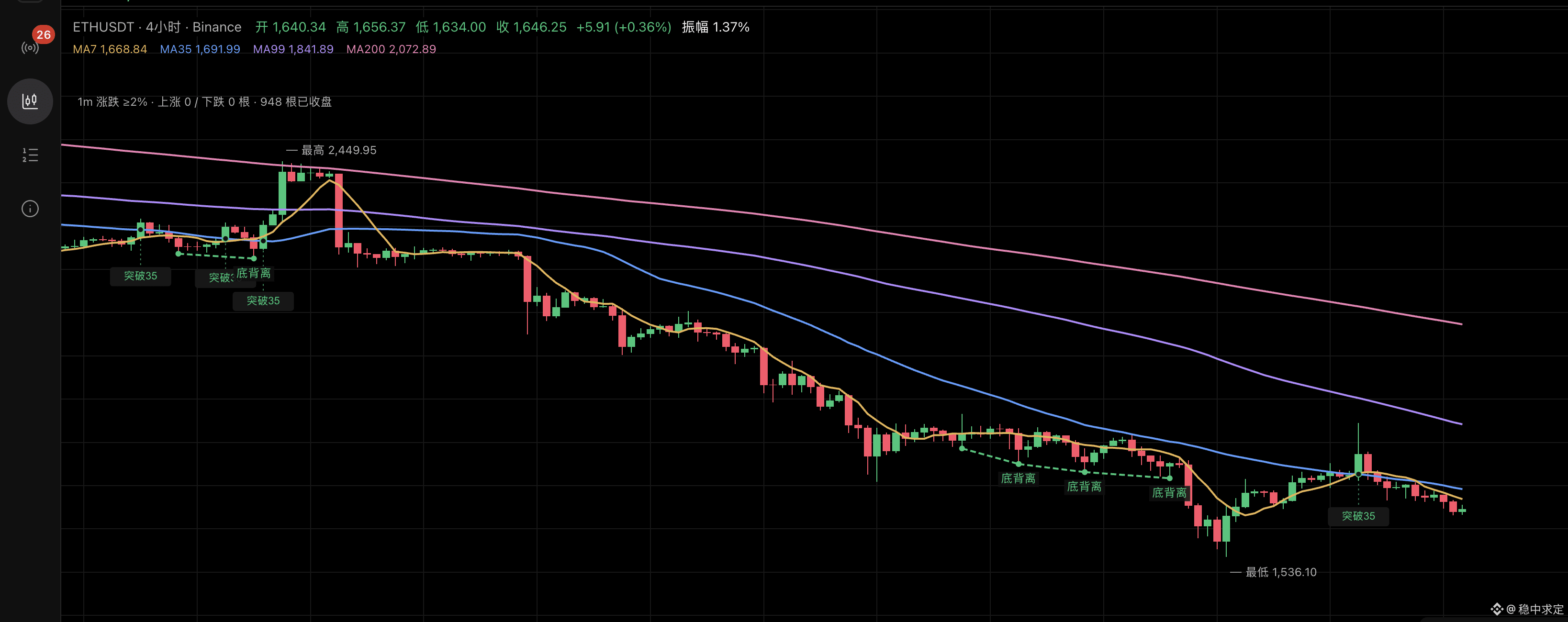
For ETH spot, you can refer to the Binance ETH/USDT spot page: https://www.binance.com/en/trade/ETH_USDT . At around 18:37 Beijing time, ETH was approximately 1,646.26 USDT, down about 2.307% over 24 hours, with an intraday range of approximately 1,633.11–1,708.16 and quoted trading volume of about 480 million USDT. This is an intraday snapshot, not a closing price.
For the leveraged market, you can refer to the Binance ETHUSDT USDⓈ-M perpetual page: https://www.binance.com/en/futures/ETHUSDT . At the same time, the perpetual mark price was about 1,645.73, the funding rate was about +0.004122% per interval, and open interest was about 2.395 million ETH. A positive funding rate means that under the current settlement rules, longs pay funding fees to shorts, but this does not show that longs have the upper hand; OI is also just the amount of open positions, not net inflows.
BTC can serve as a reference for risk appetite. Spot page: https://www.binance.com/en/trade/BTC_USDT . At the same snapshot, BTC was about 59,009.99 USDT, down about 1.356% over 24 hours, with quoted trading volume of about 1.270 billion USDT. ETH’s most recent completed four-hour candle for 12:00–16:00 Beijing time closed at 1,664.44; the current 16:00–20:00 candle had not yet closed. Therefore, the CMU platform launch and ETH’s short-term weakness occurring at the same time can only be described as “the event has gone live, but the price has yet to confirm,” and the two should not be forcibly interpreted as cause and effect.
My view is that this news matters more for the industry over the medium term than for ETH’s immediate pricing. The first thing to watch is not whether ETH rebounds right away, but whether actual issuance, settlement, and access to real funding instruments follow. The second is whether cash tokens, tokenized deposits, and regulated stablecoins can form a stable delivery-and-settlement loop. The third is whether these activities opt to use public chains and generate verifiable settlement demand.
What would overturn this view? If the HKMA or the platform later discloses substantial digital bond issuance and settlement volumes, identifies institutional participants, reports stable 24-hour multi-currency settlement volumes, and demonstrates genuine interoperability with public chains or regulated stablecoins, then the view that “infrastructure comes first and token demand lags” should be revised upward. Conversely, if the platform remains stuck at the pilot, roadmap, and low-frequency showcase stage for a long time, ETH should not receive an additional valuation premium just because of the words “bond tokenization.”
The cover is an ETHUSDT four-hour chart captured from a local chart preview at around 18:38 Beijing time; the automatic price axis, candlesticks, and high/low prices have loaded. The chart is for trend observation only. The current official long-form article interface confirms support for a single cover image, so this does not justify claiming that the chart is embedded in the article body.
Risk warning: This article distinguishes between an infrastructure launch, a future roadmap, and quantified business scale. Spot and USDⓈ-M perpetual markets have different prices, liquidity, funding rates, liquidation, and settlement mechanisms. Intraday data and unclosed candles are no substitute for a confirmed closing price. This article discusses public events and market observations and does not constitute investment advice.
Sources: Binance Square trending list; Hong Kong Monetary Authority (Launch of the CMU Digital Asset Platform) (November 25, 2026); Hong Kong Monetary Authority (Roadmap for the Development of Fixed Income and Currency Markets) (September 25, 2025); HKMA Bulletin 01/2026.
\u003cc-53/\u003e$BTC