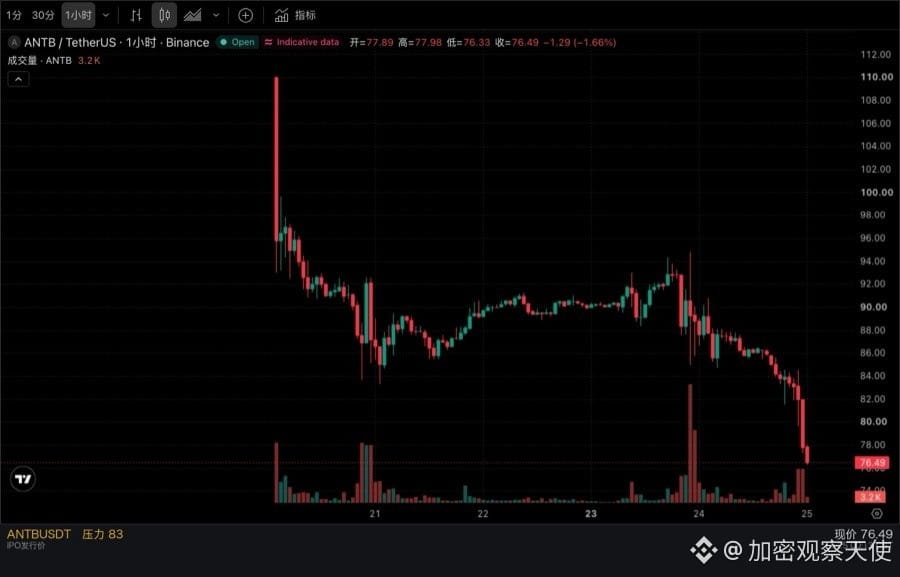
A company fell below its IPO price less than a week after going public. On the second day of trading, two founders sold shares to the underwriters at exactly the IPO price. This isn’t something coincidence can explain—the prospectus spells it out clearly.
Anthropic went public on November 19 at an IPO price of $83. On the 24th, its intraday low was $77.10, and it closed at $77.56, down more than 10% for the day.
Its market cap fell to around $1.03 trillion. On its first day of trading, it had briefly surged to a fully diluted valuation of more than $2 trillion. In four trading sessions, half that valuation was gone.
SEC filings show who was among those who sold near the top.
CEO Dario Amodei’s Form 4 shows that on November 20, he sold more than 3.37 million shares at $83, pocketing $280.41 million.
That same day, the company withheld more than 340,000 shares to cover taxes on the vesting of restricted stock. President Daniela Amodei reported the same transaction.
Under the arrangement laid out in the prospectus, the seven co-founders sold a total of $1.96 billion worth of shares this time. All were sold at $83.
Here’s an important distinction: an “S” on Form 4 means a sale to the underwriters. This was a sale of existing shares as part of the offering, not a casual dump on the secondary market. The prospectus states that the company itself receives nothing from the sale of existing shares.
The money went into the founders’ pockets, and the shares went to the underwriters, who then sold them to IPO buyers. Six days later, those shares were worth $77.56.
Token $ANTB also fell 11.02% that day, to $77.77. That price doesn’t move in sync with the U.S. stock market’s regular cash session; it can only serve as a gauge of after-hours sentiment, not as an official price.
The IPO has put the final link in the chain on display. The earlier links—capital expenditures, chip revenue, and cloud orders—can all be checked against actual figures. Until now, whether model companies actually make money has largely been a matter of faith.
Now the answer is written in the candlestick chart: the 17% gain on the first day was completely wiped out over the next four trading sessions.
Of the $1.96 billion in existing shares sold, how much was genuine trimming of holdings, and how much was for taxes or part of a predetermined arrangement? Form 4 records share counts and prices, not motives. There’s no answer in the public filings.
The $83 price has now become resistance. If $ANTB gets back above it, the selling pressure will have been absorbed; if it stays below, the break below the IPO price remains on the books.
At the November 30 close, MSCI will add ANT to its Global Standard Index. We’ll find out then whether index funds can buy the stock back above $83.
Source: SEC EDGAR 424B4 and Form 4 (CIK 2130357). Prices are based on the U.S. market close on November 24. This is not investment advice.