


While watching the markets over the past couple of days, I noticed something worth looking into.
Today, Nvidia fell about 8.5% on Binance, Anthropic plunged more than 9%, and SanDisk dropped over 15%.
Chip stocks and some AI-related stocks faced heavy selling.
However, this time BTC is hovering around $59,000, down about 3% over the past 24 hours.
Although the trading hours and statistical methods for the two aren't exactly the same, BTC's decline this time has indeed been different from the sharp drops of the past few days.
Why has this changed?
1. Bitcoin has already gone through a round of leveraged position liquidations
On November 21, BTC briefly fell to $55,126.
At the time, CoinGlass data showed that about $1.15 billion in BTC futures positions had been liquidated over the previous 24 hours, 89% of them longs.
BTC futures open interest across the market also fell by nearly 10%.
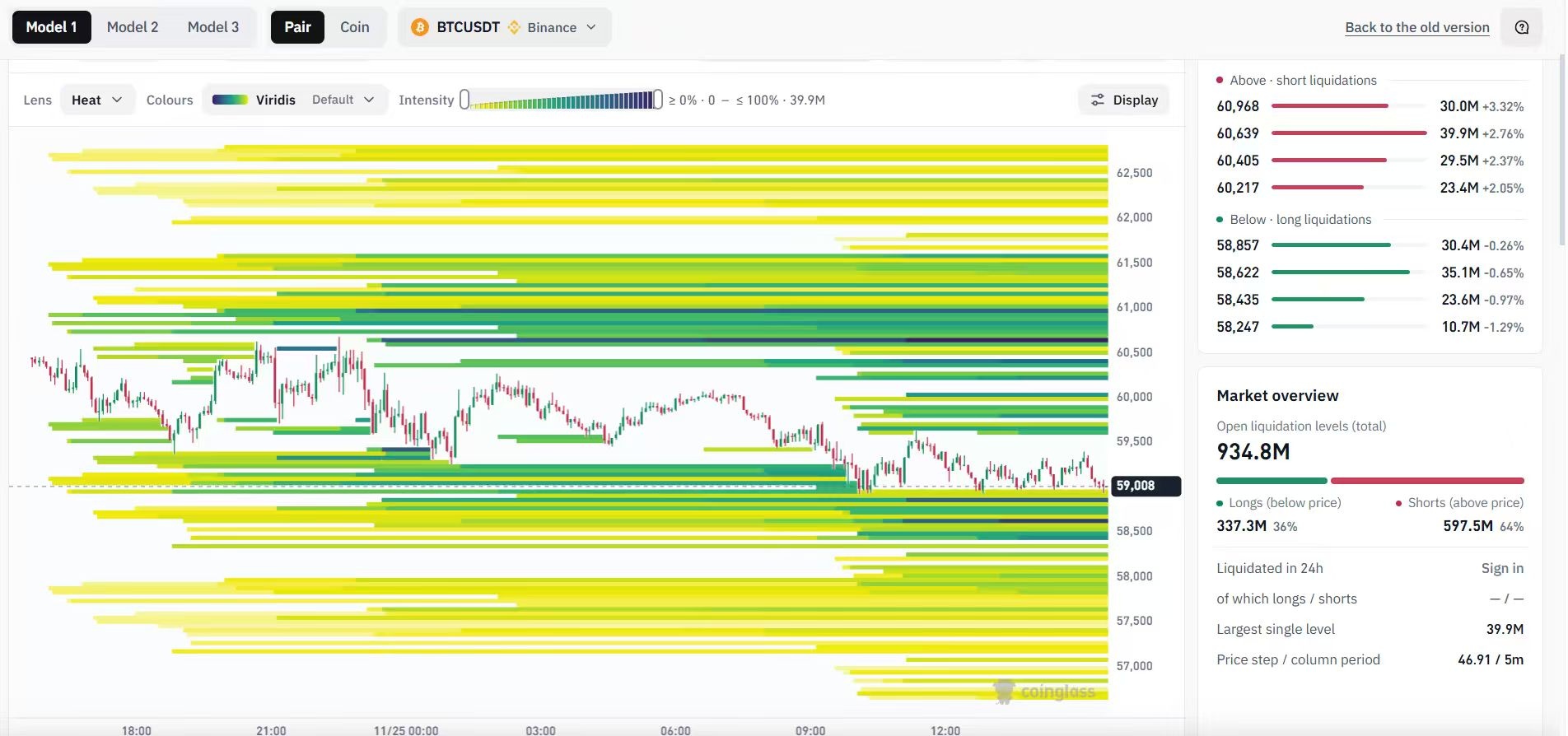
Looking at the data today, BTC futures open interest across the market is about $38.7 billion, near the 20th percentile of the past year. Binance BTC futures trading volume over 24 hours has also fallen from $30.875 billion on the day of the crash to $12.85 billion.
A decline of more than 58%.
The large-scale liquidations of the past few days may have already flushed out some leverage risk. If new negative external factors emerge, cascading liquidations may have a weaker amplifying effect on price declines.
2. AI stocks are working through their own risks
On November 23, Jensen Huang returned to the role of Nvidia CEO, Nvidia surged 31.5% in a single day, and the Nasdaq rose 6.5%.
Just one day later, Nvidia fell nearly 6%.
Interestingly, while the Nasdaq fell, the Dow rose.
This suggests that investors aren’t indiscriminately selling all risk assets. Some companies selling essential consumer goods saw their share prices surge.
AI-sector valuations, corporate governance, returns on capital investment, and short-term profit-taking could all contribute to selling pressure specific to tech stocks.
BTC is also affected by macro liquidity, but it isn’t directly exposed to the operational and valuation risks of AI companies.
So it’s not surprising that these two asset classes have seen different short-term declines.
3. ETFs are still seeing outflows, but selling pressure has eased somewhat
This is the data I’m paying the most attention to today.
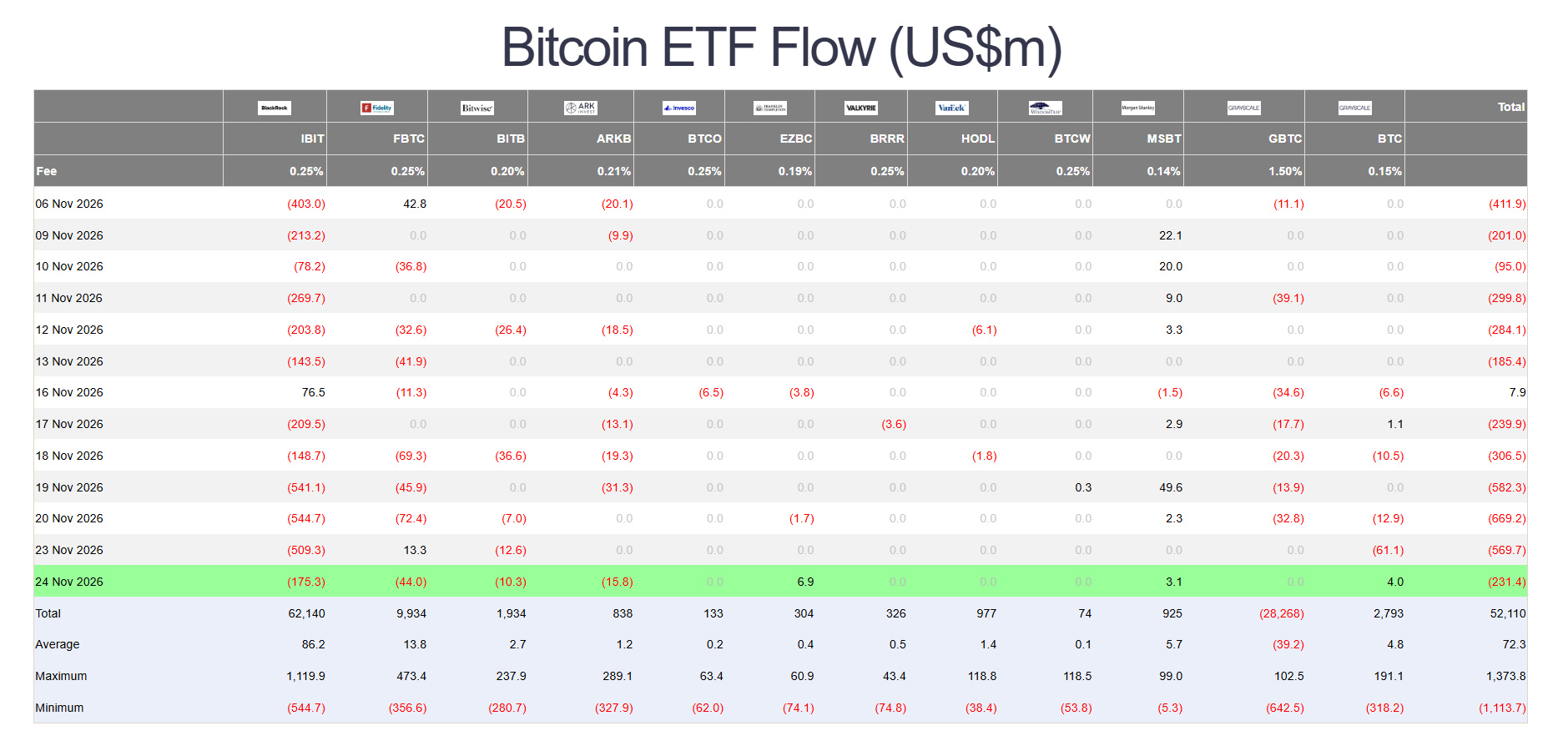
U.S. spot BTC ETFs have recorded net outflows for six consecutive trading days, totaling about $2.6 billion.
Specifically:
November 20: $669 million in net outflows.
November 23: $570 million in net outflows.
November 24: $231 million in net outflows.
The latest single-day outflow was about 59% lower than on the previous trading day.
This is a development worth watching:
Fewer sellers and more buyers are two different things.
4. Has BTC become more resilient? I’m not ready to draw that conclusion yet.
BTC is still trading below the 4-hour EMA7 and EMA20, so the short-term trend remains weak.
Besides, plenty of people on the Square are calling for prices to fall to $30,000 or $40,000.
There are also plenty of people promising to eat shit on livestream if BTC breaks below $64,000.
Anyway, it’s become hard to find people who are bullish.
Also, Binance futures open interest has recovered somewhat from its November 21 level, and funding rates have climbed again.
This means the risk from leverage hasn’t disappeared completely.
Next, we can focus on watching three signals:
First, can BTC reclaim and hold the $60,000–$60,500 range?
Second, will ETF outflows continue to narrow, or even turn into net inflows?
Third, when U.S. tech stocks become volatile again, can BTC remain relatively stable, rather than simply falling a little less on occasion?
Bitcoin may be moving on from the panic-driven sell-off of the past few days and entering a phase where selling pressure is gradually being absorbed.
But easing selling pressure is only one possible condition for the market to stabilize. A genuine trend reversal still needs to be confirmed by sustained buying.
I think it’s too early to say that BTC has decoupled from U.S. stocks or that a new rally is beginning.
Sources: Binance, CoinGlass, Farside Investors, Reuters, November 21–25.