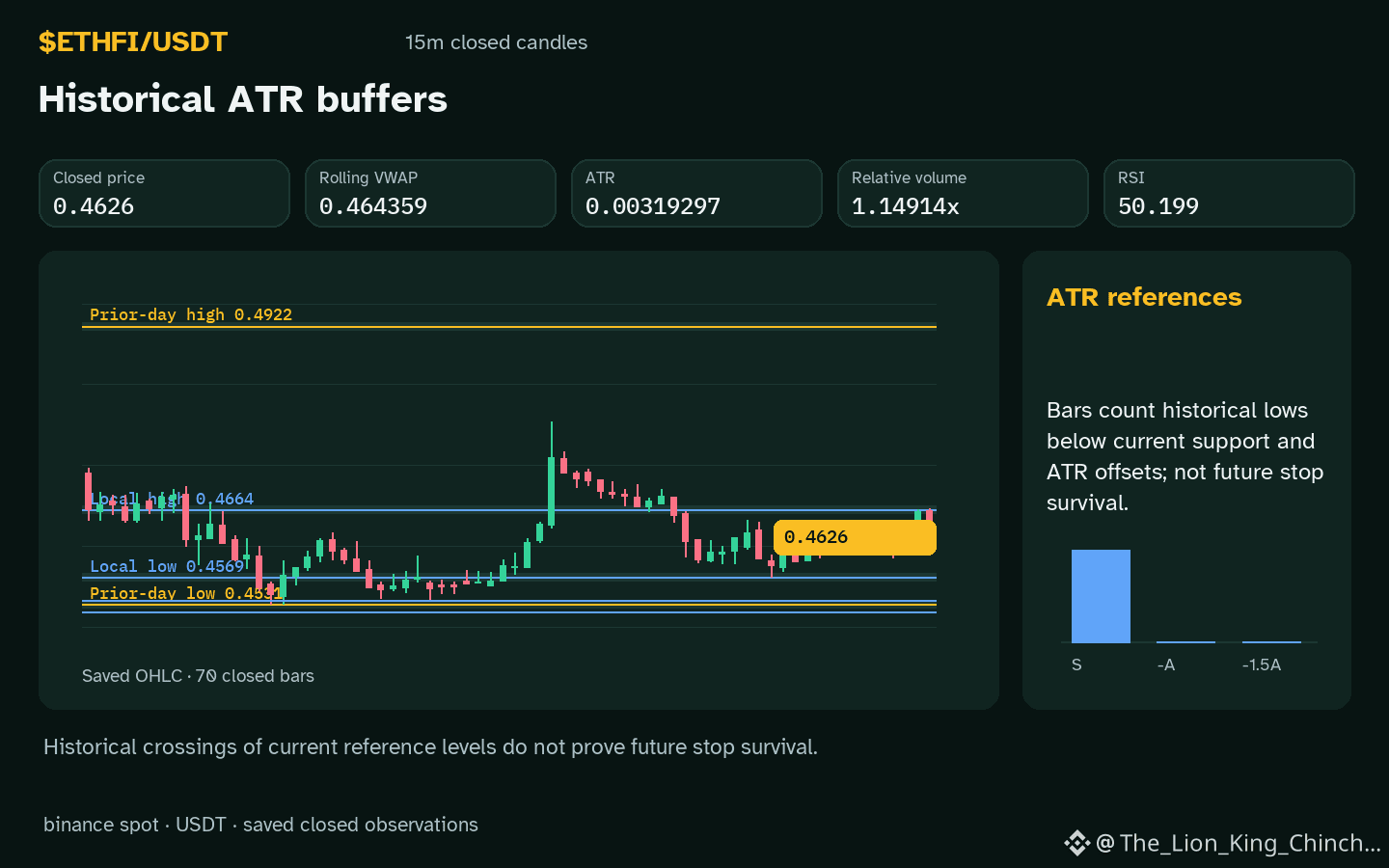
$ETHFI: Balancing Entry Precision and Chasing Temptation
$ETHFI: ETHFI shows an hourly direction up while volume sits above baseline. The observation raises a practical question: should a trader wait for a clearer invalidation signal or accept a stronger-looking entry now?
The research dilemma centers on entry quality versus the urge to chase a move. Imagine a thought experiment where a trader defines a rule: enter only after price breaks the local resistance and the baseline volume ratio exceeds 1.15. If the breakout occurs early in the hour, the trader faces two paths. One path follows the rule, waiting for a confirming candle that validates the move. The other path takes the initial breakout as a stronger-looking entry, accepting a wider stop.
The trade‑off can be framed as entry quality versus chasing. A tighter entry improves risk‑reward but may miss the move if the breakout stalls. A broader entry captures more momentum but requires a larger stop distance, increasing the chance of a false‑alarm. The mechanism behind this trade‑off is the relationship between stop placement and the volatility measured by the average true range 0.00319297. A tighter stop relative to 0.00319297 tightens risk but also raises the probability of being stopped out on normal price swings.
A rule worth testing would compare two scenarios over a set of candles: Scenario A waits for a clear invalidation, using a stop one 0.00319297 away. Scenario B enters immediately with a stop two 0.00319297 away. The outcome difference can be reassessed when a future hourly candle closes below the local support 0.4569 or when the baseline volume ratio falls back toward one. If either condition appears, the hypothesis that waiting improves entry quality gains support; otherwise, the chasing approach may be justified. This self‑check keeps the analysis grounded without presuming any specific market outcome.
Probabilistic market research, not a recommendation or guaranteed return.
#ETHFI #RiskManagement #CryptoLearning