

Plasma is building a blockchain around a simple idea.
Sending digital dollars should be almost as easy as sending a text message.
No complicated gas payments. No expensive transfers. No need to understand how a blockchain works before using it.
That sounds attractive.
But when I checked Plasma's latest network data, one number caught my attention.
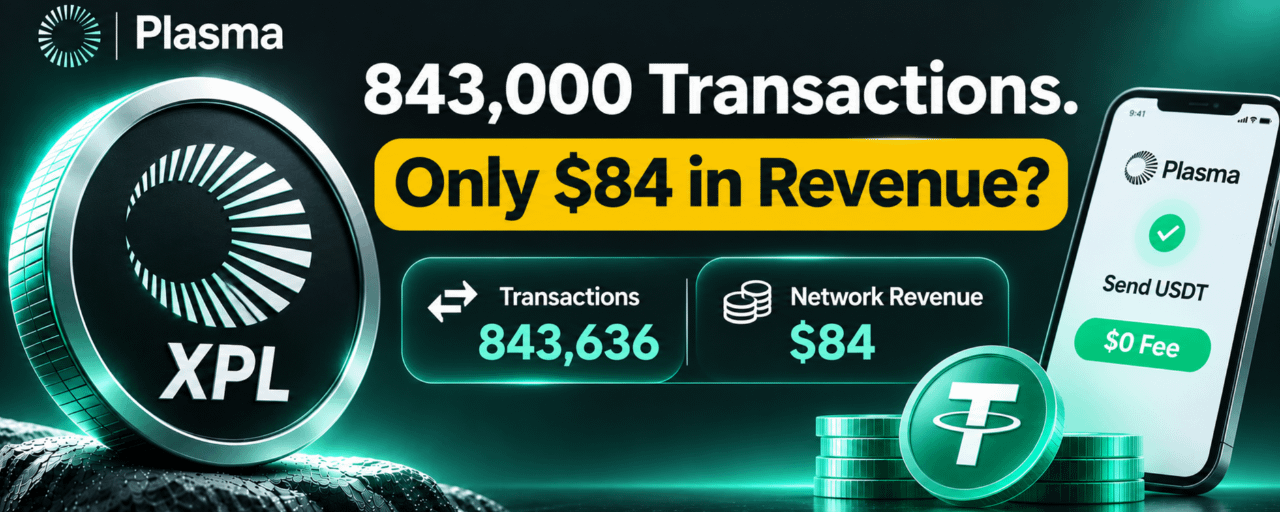
The chain processed approximately 843,636 transactions over 24 hours.
Its recorded network revenue was around $84.
That gap says a lot about what Plasma is trying to build.
And the challenge facing XPL.
Plasma launched its mainnet beta in September 2025, focusing on stablecoin payments rather than general-purpose crypto speculation.
One of its main features is zero-fee USDT transfers through supported interfaces.
The network can sponsor transaction costs so users don't have to manage the native token every time they move money.
For people sending stablecoins regularly, that's useful.
But there's a tradeoff.
High transaction volume doesn't necessarily translate into high fee revenue.
And low fee revenue means fewer tokens can be burned through the network's fee mechanism.
Plasma uses XPL as its native asset for network security and transaction execution.
Its tokenomics include an EIP-1559-style system where base fees paid on the blockchain are permanently burned.
That connects some network activity to XPL supply reduction.
But if ordinary users aren't paying much, the amount burned may remain limited.
Meanwhile, Plasma is attracting meaningful stablecoin liquidity.
According to DeFiLlama, the network held approximately $1.10 billion in stablecoins on November 25.
DeFi total value locked stood around $387 million.
Applications including Aave, Fluid, Euler, and other lending and liquidity products operate in the ecosystem.
Those are signs that the infrastructure is being used.
However, stablecoin balances had fallen by approximately 28% over the previous seven days.
That caught my attention because liquidity attracted by launch incentives doesn't always remain after those incentives weaken.
I'd want to know how much capital stays for payments and borrowing when promotional rewards are reduced.
There's another part of Plasma's strategy that interests me.
Plasma One brings stablecoin balances into a consumer payment experience, including a card and cashback rewards.
The card program can pay eligible rewards in XPL.
Higher membership tiers can also require customers to lock XPL or pay subscription fees.
That gives the token some utility outside ordinary blockchain transactions.
But cashback paid in XPL isn't automatically a buyback.
If rewards come from allocated token inventory, they may increase circulating supply rather than create new market demand.
I'd like to see how those rewards are funded and whether customers actually hold the tokens after receiving them.
Then there's the unlock schedule.
Plasma launched with an initial supply of 10 billion XPL.
The allocation includes 40% for ecosystem growth, 25% for the team, 25% for investors, and 10% for the public sale.
On November 25, approximately 227.78 million XPL are scheduled to become unlocked across ecosystem, team, and investor allocations.
That's a substantial amount relative to the network's current circulating supply.
Unlocking doesn't mean every recipient will sell.
But it increases the amount of supply potentially available to the market.
And there's another issue worth watching.
XPL doesn't have a permanent 10 billion token cap.
When external validators and staking delegation become operational, Plasma's published model calls for annual inflation starting at 5%, gradually declining toward 3%.
Those rewards are intended to support network security.
The question is whether token burning and increased demand can eventually offset that additional issuance.
I wouldn't call XPL deflationary simply because a burn mechanism exists.
For me, Plasma has a compelling product idea.
Moving stablecoins cheaply is something people genuinely want.
But the economic test is more difficult.
Can Plasma attract recurring payment activity without relying heavily on subsidies?
Can Plasma One create lasting demand for XPL?
And can that demand grow fast enough to absorb ecosystem distributions, insider unlocks, and future staking rewards?
The technology is trying to make money move more easily.
Now the token needs an economic model that benefits from that success.