
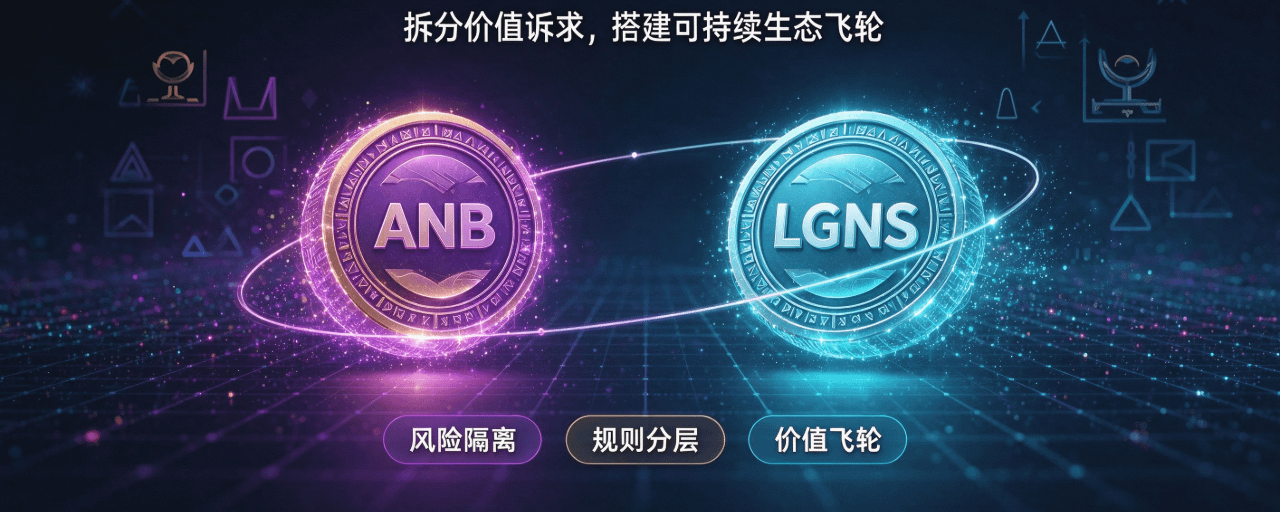

Many Web3 projects easily fall into the single-token dilemma during tokenomics design: one token is expected to serve every purpose. It must act as the gas fuel for on-chain interactions, supporting everyday transfers and contract calls, while also carrying value-related functions such as community governance, value capture, dividend incentives, and buybacks and burns. This model is inherently contradictory: when the token price surges, gas costs rise with it, raising the barrier to entry for ordinary users; when the price plunges, the incentive system and confidence in governance collapse in tandem, and ecosystem liquidity quickly drains away. By tightly binding usage demand to value expectations, market volatility directly impacts the ecosystem’s foundations, making it difficult for project teams to balance short-term circulation stability with long-term value growth. Anubis’s ANB+LGNS dual-token architecture is built around a core idea: to completely separate these two kinds of needs and isolate risk at the economic foundation. This creates a healthier virtuous cycle for both project operators and ecosystem participants.
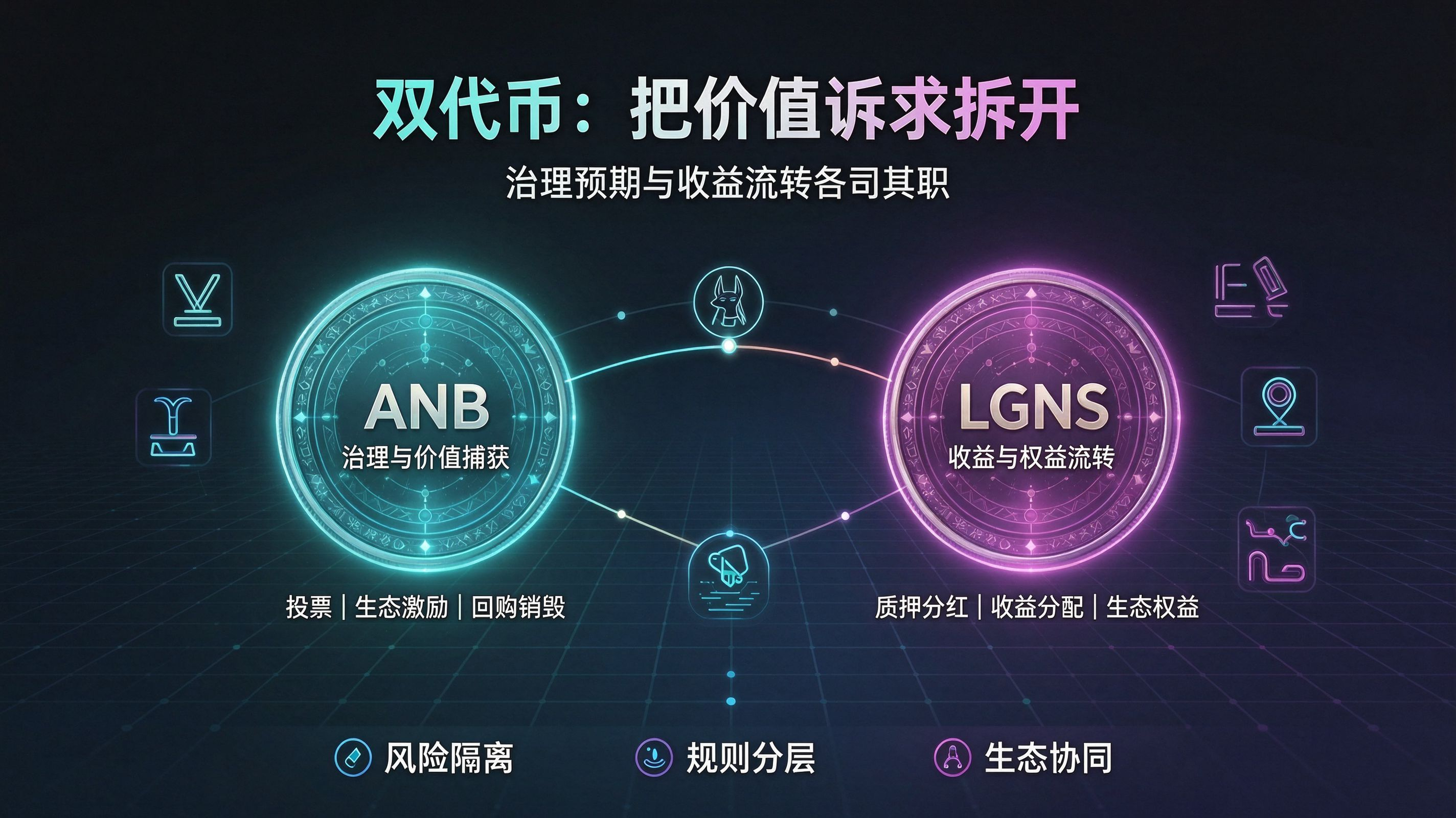
Within this system, the two tokens have clear roles and separate responsibilities, each serving its own purpose without competing for functionality. ANB is the ecosystem’s core governance and value-capture token, representing a stake in the long-term growth of the entire ecosystem. Holders can vote on community proposals and help govern major ecosystem rules. Meanwhile, protocol profits and ecosystem revenue are earmarked for ANB buybacks and burns, capturing the benefits of ecosystem growth in ANB. It is intended for investors and community members who believe in the ecosystem’s long-term prospects and are willing to help build it. LGNS, by contrast, is a token for yield distribution and circulation, focused on stable allocations and staking returns. It primarily supports staking dividends, the distribution of ecosystem benefits, and the circulation of yield claims. It does not bear the burden of serving as the public chain’s base gas token and is designed specifically for users seeking stable cash-flow returns.
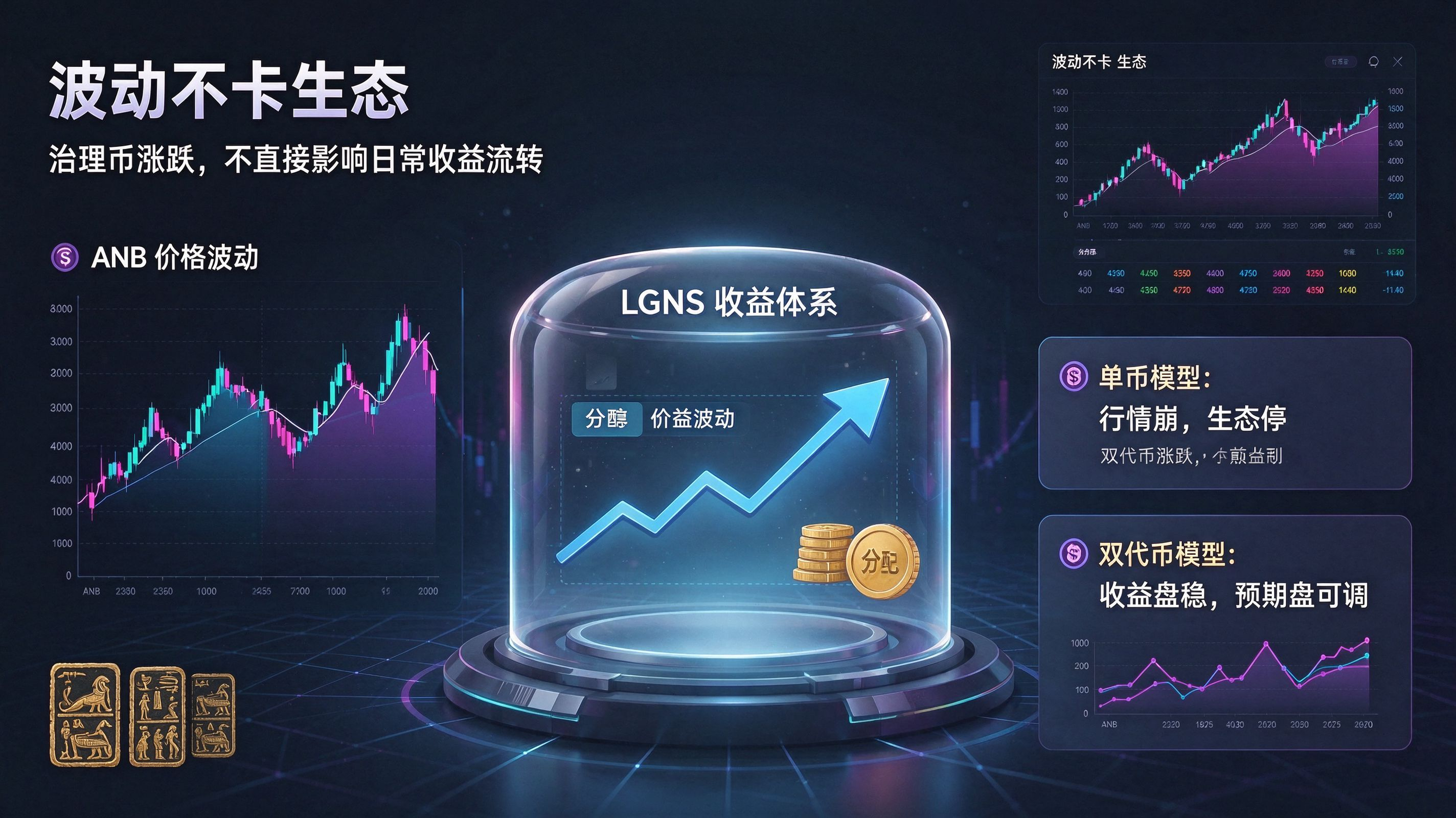
The key benefit of this separation is risk isolation, which greatly reduces the ecosystem’s vulnerability. In a single-token model, if the governance and value token suffers a market downturn or large holders sell off in bulk, not only can its price plunge, but staking, fees, and contract interactions can all be affected, potentially bringing the ecosystem to a standstill. Under Anubis’s dual-token system, fluctuations in ANB’s market price do not disrupt LGNS dividend distributions or staking and unlocking mechanisms. Even if ANB experiences significant short-term volatility, users seeking stable returns can still stake LGNS and collect dividends as usual. The underlying yield system does not collapse along with the market, helping keep the ecosystem’s foundation stable.
For a project team, the biggest advantage of a dual-token model is the ability to customize vesting, burning, and staking rules separately, allowing selling pressure to be managed more precisely. For ANB (the governance token), the team can introduce long-term lockups, phased unlocking, and regular buyback-and-burn mechanisms to curb short-term sell-offs and protect long-term value consensus. For LGNS (the yield token), it can design rules such as periodic dividends, linear vesting, and staking rewards with lockups to smooth the outflow of returns and avoid a rush to sell when tokens unlock all at once. There is no need to repeatedly balance “liquidity” against “value expectations” within a single token. The rules can be designed with far greater flexibility, making it easier to address potential flaws in the economic model in advance.
More importantly, this structure makes it easier to create a self-sustaining value flywheel. Transaction fees, protocol revenue, and income from various business activities generated by the ecosystem can first be pooled in the treasury and then, according to predefined rules, directed primarily to LGNS to deliver ongoing staking dividends and retain users who prefer stable returns. A portion of the ecosystem’s steady cash flow can then be used for ANB buybacks and burns, continually increasing the governance token’s scarcity and long-term value. The yield token sustains ecosystem engagement, while the value token embodies long-term expectations. The two mechanisms reinforce each other instead of competing within a single token.
At the same time, the ecosystem’s user segments can take shape naturally. Community members can choose how they want to participate: those who believe in Anubis’s long-term development, want a say in ecosystem decisions, and seek long-term growth potential can choose ANB; users who do not want to participate deeply in governance and simply want to invest funds and earn steady dividends can choose LGNS. The needs of these two groups do not conflict. When carrying out future marketing, community events, and node incentives, the project team can segment its operations precisely and tailor its engagement to each group, making its strategies easier to implement.
Of course, a dual-token system is not a one-size-fits-all solution; it demands more from the project team. The contract logic is more complex and requires rigorous audits and transparent publication of on-chain data. Treasury funds, allocation ratios, and unlocking mechanisms must all be publicly disclosed and verifiable. If the rules are poorly designed or the contracts contain vulnerabilities, the risks of a dual-token model can be magnified. However, compared with the inherent structural tensions of a single-token model, a well-designed dual-token economy with transparent rules can balance liquidity stability, revenue distribution, and long-term value capture. It is an excellent economic framework for public-chain and DApp projects seeking to build a lasting ecosystem.